

India Sets Goal for Energy Self-Reliance by 2047 and Achieving Net-Zero by 2070, Says Hardeep Singh Puri
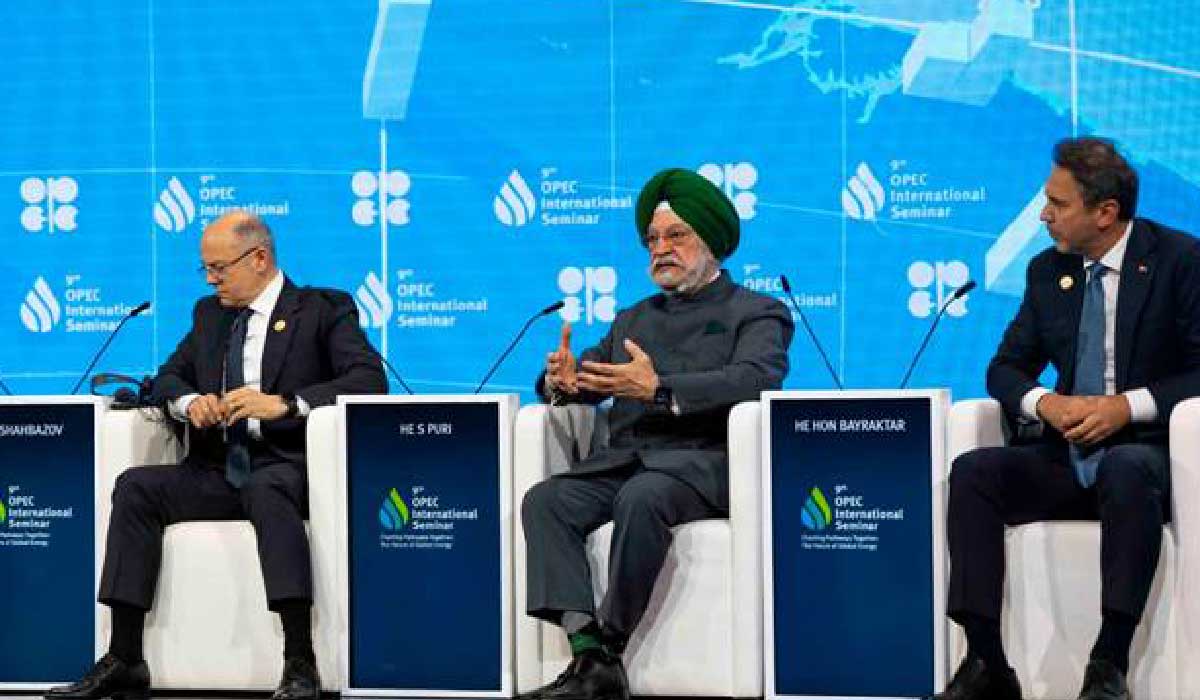
At the 9th OPEC International Seminar in Vienna, Austria, India presented an ambitious roadmap for energy security and sustainability. Addressing global energy leaders and industry experts, Petroleum and Natural Gas Minister Hardeep Singh Puri underscored India’s dedication to reaching energy independence by 2047 and net-zero emissions by 2070.
Speaking on the theme ‘Oil Markets: Energy Security, Growth & Prosperity’, Minister Puri outlined India’s ambitious plans to expand hydrocarbon exploration. Under the Open Acreage Licensing Policy (OALP) Round-10, 2.5 lakh sq km has been opened for exploration, with a goal to increase this to 0.5 million sq km by 2025 and 1 million sq km by 2030. He also pointed to a potential breakthrough in the Andaman Sea, suggesting India could discover an oilfield on the scale of Guyana’s, signaling major upstream growth under Prime Minister Narendra Modi’s leadership.
This momentum is being fueled by key policy reforms. India has shifted from the Production Sharing Contract model to a Revenue Sharing regime under the Hydrocarbon Exploration and Licensing Policy (HELP). Additionally, amendments to the Oilfields (Regulation and Development) Act, 1948 have been introduced to enhance lease management, safety standards, and dispute resolution mechanisms.
Significantly, 99% of formerly restricted ‘No-Go’ zones have now been opened up, unlocking over 1 million sq km for exploration. This expansion is supported by major national data initiatives such as the National Seismic Program, the Andaman Offshore Project, Mission Anveshan, and the Extended Continental Shelf Survey.
Emphasizing India’s rising influence in global energy markets, Puri stated that as the world’s third-largest energy consumer—with a daily demand of approximately 5.4 million barrels—India serves as both a structural growth driver and a stabilizing force in the oil sector. “India will account for nearly 25% of the incremental growth in global energy demand in the coming years,” he added.
In a bid to enhance energy security, India is expanding its crude oil import base from 27 to 40 countries, increasing domestic production, promoting alternative fuels, and aiming to scale up refining capacity to 310 MMTPA by 2028. Additionally, the country is targeting a USD 300 billion petrochemical industry by 2030 to further strengthen its energy and industrial ecosystem.
Despite ongoing global geopolitical challenges, Puri emphasized India’s achievement in maintaining affordable energy access. “India is the only major economy that has lowered fuel prices even as international oil prices have climbed,” he noted.
On the clean energy front, the Minister emphasized the pivotal role of biofuels in India’s decarbonization strategy. The Global Biofuels Alliance — spearheaded by India — now enjoys the backing of over 29 countries and 14 international organizations. Domestically, India is rapidly advancing the adoption of ethanol, compressed biogas (CBG), biodiesel, and sustainable aviation fuel (SAF). “India strongly believes that the global energy transition must be just, inclusive, and equitable. For 1.4 billion Indians and billions across the Global South, development must be pursued with dignity,” he stated.
He also highlighted the success of the Pradhan Mantri Ujjwala Yojana (PMUY), the world’s largest clean cooking initiative. Since its inception, more than 103 million LPG connections have been provided to women from economically disadvantaged households, increasing LPG coverage from 55% in 2014 to nearly universal levels today. Despite a 58% surge in global LPG prices, PMUY beneficiaries pay just $6–7 for a standard 14.2 kg cylinder — roughly 39% below last year’s international market rate — thanks to substantial government subsidies and $4.7 billion in losses absorbed by oil marketing companies.