
From Asia-Pacific to Indo-Pacific: President Marcos Highlights Strategic Shift During Delhi Visit
In a world increasingly defined by shifting alliances and economic realignments, words matter — and so do the regions they describe. During his recent visit to New Delhi, Philippines President Ferdinand Romualdez Marcos Jr. offered a pointed reflection on this transformation: “Indo-Pacific is the correct evolution of Asia-Pacific.”
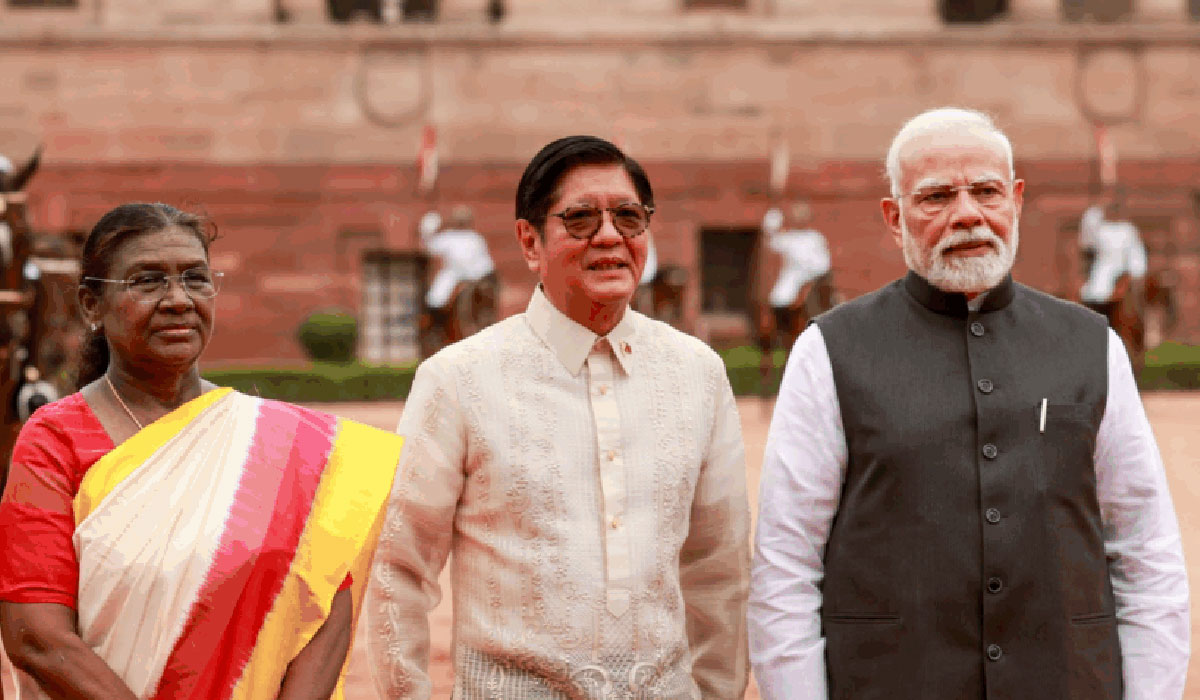
It was more than a semantic observation. Standing at the forecourt of India’s Rashtrapati Bhavan after receiving a ceremonial welcome from President Droupadi Murmu and Prime Minister Narendra Modi, Marcos laid out a view of the Indo-Pacific not just as a new geopolitical term, but as a symbol of the region’s evolving role in global affairs.
“What used to be referred to as the Asia-Pacific region, we now refer to as the Indo-Pacific region,” Marcos told reporters. “I think it is a correct evolution of that understanding because of the global nature of politics, trade, and the economy.”
A Strategic Reaffirmation
President Marcos’s visit marks his first to India since taking office in 2022 and coincides with the 75th anniversary of diplomatic ties between India and the Philippines — a symbolic moment for two nations increasingly looking toward each other for strategic alignment. Accompanied by First Lady Louise Araneta-Marcos and a high-level delegation of Cabinet ministers, Marcos’s five-day state visit aims to deepen bilateral cooperation across critical sectors, from defence and maritime security to emerging technologies and trade.
In a world where the Indo-Pacific has become the fulcrum of global power competition — involving major players like the United States, China, India, and ASEAN nations — Manila’s recalibration toward this framework reflects broader regional anxieties and ambitions.
“This visit is a reaffirmation of the alliance and the partnership that we are strengthening,” Marcos said, underscoring the importance of keeping pace with rapid technological changes and shifting geopolitical realities.
India and the Philippines: Strengthening a Strategic Axis
The visit began with diplomatic warmth and optimism. On the eve of Marcos’s ceremonial welcome, India’s External Affairs Minister S. Jaishankar met with the President, calling their interaction a “strong start” to the visit. “Confident that his talks with PM Narendra Modi tomorrow will significantly deepen our bilateral partnership,” Jaishankar wrote on X (formerly Twitter).
Indeed, both New Delhi and Manila have increasingly found common cause — from shared concerns over maritime security in the South China Sea to ambitions for technological innovation and resilient supply chains. As India continues to champion its “Act East” policy and the Philippines seeks to diversify its strategic partnerships beyond traditional allies, the timing of this visit feels particularly opportune.
The Bigger Picture
The evolution from “Asia-Pacific” to “Indo-Pacific” is not merely a diplomatic rebranding. It reflects a broader understanding that the Indian and Pacific Oceans are no longer separate spheres, but deeply interconnected strategic theaters. For nations like the Philippines, this shift represents both a challenge and an opportunity — to assert agency in an increasingly multipolar world.
President Marcos’s words in Delhi encapsulate a sentiment gaining traction among many regional powers: that staying relevant in today’s world order means adapting not only policies, but perspectives.
As his visit progresses, all eyes will be on what concrete agreements and initiatives emerge from the talks. But even before any official announcements are made, one thing is clear: for the Philippines and India alike, the Indo-Pacific isn’t just a new term — it’s a new chapter.