



ACADEMIC SYMPOSIUM: India–Nepal Buddhist Heritage – A Common Legacy
Date: 8 December 2025 | Auditorium Hall, Central Office, Lumbini Buddhist University, Lumbini, Nepal
Organized by:
Embassy of India, Kathmandu & Indian Council for Cultural Relations (ICCR), Ministry of External Affairs, Government of India
In collaboration with: Faculty of Buddhist Studies, Lumbini Buddhist University
Overview
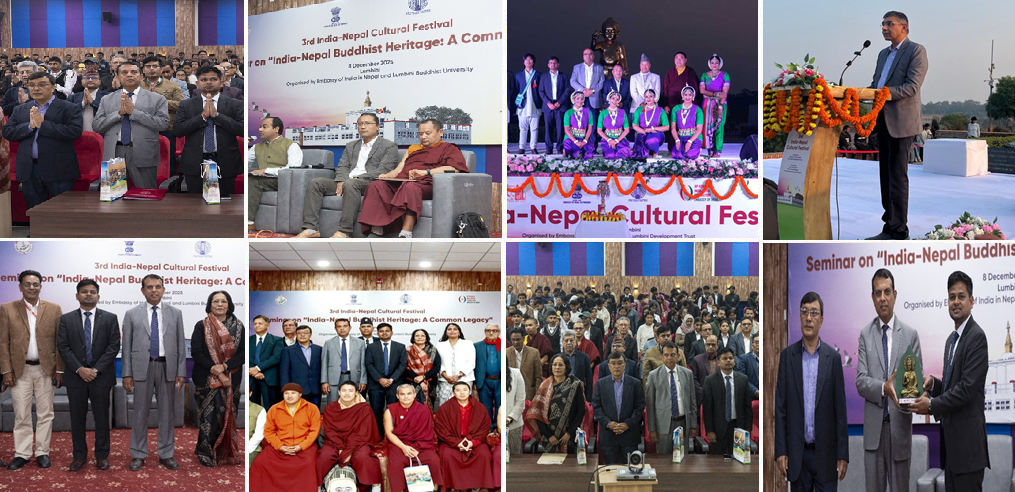
Lumbini Buddhist University (LBU) hosted a landmark academic symposium titled “India–Nepal Buddhist Heritage: A Common Legacy” on 8 December 2025. The symposium brought together nearly 300 participants, including scholars, monastics, diplomats, heritage professionals, policymakers, and students from India and Nepal. The event examined the shared Buddhist civilizational heritage of the two countries and its relevance for contemporary cultural diplomacy, academic collaboration, and sustainable heritage conservation.
Conceptual Framework
The symposium was guided by a well-defined Concept Note emphasizing the shared sacred geography connecting Lumbini, Kapilavastu, Bodh Gaya, Sarnath, and Kushinagar. Though located across national borders, these sites together form a unified spiritual landscape central to the life of the Buddha and the spread of Buddhism. The discussions stressed the preservation of both tangible heritage—archaeological sites, monasteries, manuscripts, and art—and intangible heritage, including rituals, pilgrimage traditions, monastic lineages, and oral histories. Buddhist values such as peace, compassion, non-violence, and mindfulness were highlighted as enduring instruments of soft power and people-to-people connectivity.
Inaugural Session
The symposium opened with a traditional lamp-lighting ceremony and homage to the Buddha, followed by the national anthems of India and Nepal. Buddha Vandana was chanted by Dr. Vajira Bhante, and the LBU University Song was performed by faculty members and students, creating a reflective spiritual atmosphere.
Dr. Tilak Ram Acharya, Registrar of Lumbini Buddhist University and Chief Guest of the inaugural session, welcomed the participants. He emphasized that Lumbini, as the birthplace of the Buddha, is a global spiritual heritage and not confined to national boundaries. Highlighting Nepal’s custodial responsibility, he called for deeper collaboration with India through joint research initiatives, manuscript cataloguing, academic exchanges, and heritage conservation projects.
Keynote and Special Addresses
The keynote address was delivered by Mr. Basist Nandan, First Secretary, Embassy of India, Kathmandu. He reaffirmed Buddhist heritage as a foundational pillar of India–Nepal relations and noted that the Buddhist civilizational continuum predates modern political boundaries. He emphasized the global relevance of Buddhist principles in addressing contemporary challenges such as conflict resolution, environmental sustainability, and intercultural dialogue.
Prof. Sangraula, a special invitee, underscored Buddhist heritage as a strategic asset for strengthening bilateral ties. He highlighted the role of pilgrimage routes, heritage sites, and academic exchanges in fostering trust, mutual understanding, and peaceful cooperation between India and Nepal.
Academic Sessions
Two academic sessions featured scholarly presentations from India and Nepal.
The first session, moderated by Dr. Basanta Poudel, included papers by Prof. Subhra Barua Pavagadhi (University of Delhi) on Buddhist heritage as a civilizational bridge; Dr. Nir Bahadur Gurung (LBU) on Mustang as a trans-Himalayan spiritual corridor linked to Guru Padmasambhava; and Dr. Dayanidhi Gautam (LBU) on Buddhist ethics as a framework for peaceful international relations.
The second session, chaired by Dr. Shree Prasad Bhattarai, featured Dr. Elora Trivedy (Nalanda University) on shared pilgrimage networks; Dr. Nyima Sherpa (LBU) on monastic continuities across India, Nepal, and Tibet; and Mr. Sanjay Shakya (LBU) on early Nepalese Buddhist art and its trans-regional influences.
Focus on Dhamma Setu (IICBCH)
A key highlight was the discussion on the India International Centre for Buddhist Culture and Heritage (IICBCH), also known as Dhamma Setu, proposed in the Lumbini Monastic Zone. A documentary screening introduced participants to the Centre’s lotus-inspired, net-zero design and its vision as a global hub for research, meditation, exhibitions, and inter-monastic dialogue. The Centre is envisaged as a lasting bridge connecting Buddhist traditions across Asia.
Concluding Session
The concluding session was chaired by Dr. Manik Ratna Shakya, Dean, Faculty of Buddhist Studies, LBU. He synthesized the discussions and stressed the need to institutionalize the symposium’s recommendations through joint working groups, digitization of manuscripts, revival of pilgrimage corridors with ecological sensitivity, and inclusive scholarly access to the IICBCH. Prof. Gitu Giri delivered the vote of thanks, acknowledging the Embassy of India, ICCR, scholars, faculty, students, media, and volunteers.
Cultural Festival
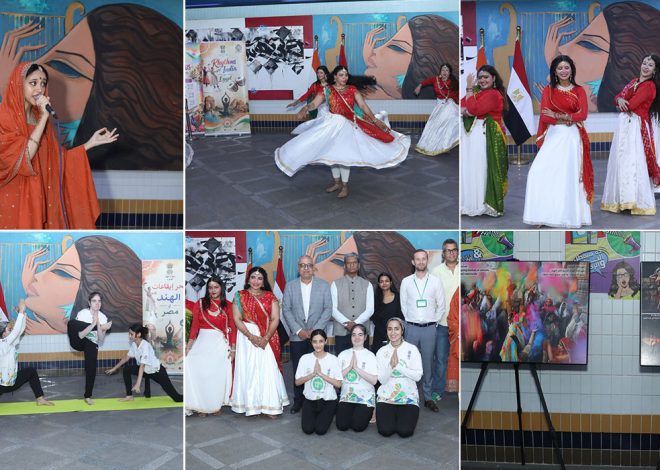
The day concluded with the 3rd India–Nepal Cultural Festival at the Little Buddha Statue near the Mayadevi Temple. The festival featured an ICCR-sponsored Indian dance performance themed on Yaśodhara and a Nepali musical presentation blending traditional and contemporary forms. Senior dignitaries, including Mr. Munu Mahawar, Additional Secretary (North), Ministry of External Affairs, Government of India, attended the event, reinforcing the integration of academic dialogue and cultural diplomacy.
Conclusion
The symposium reaffirmed that India–Nepal Buddhist heritage is both a shared inheritance and a shared responsibility. By integrating scholarship, diplomacy, and public cultural engagement, the event demonstrated how Buddhist heritage continues to serve as a living bridge of peace, cooperation, and sustainable cultural exchange in the 21st century.
About the Author