



Africa – A Land of Opportunities for Innovators, Entrepreneurs, Ruralpreneurs and Agripreneurs
Globalization aims at bringing the World closer like a Global Village. As the World population rises, Africa’s agricultural potential will become increasingly critical to global – and regional - food security. The Africa Continent with its 55 Nations, is endowed with an abundance of natural resources, including 60% of the World’s arable land (www.undp.org). It is a land of opportunities and technological innovations, and it is the second largest continent in area and the third largest in population. Africa’s population is currently around 1.54 billion, representing about 18.83% of the World’s population (www.Worldometer.info).
Africa’s immense environmental and agricultural heterogeneity profoundly shapes its farming practices and crop cultivation. The continent’s diverse climates, ranging from arid deserts to tropical rainforests, present varied
agricultural challenges concerning water availability, temperature, and pest and disease prevalence. This diversity
manifests across numerous agro-ecological zones, including North Africa’s arid regions, Central Africa’s lush rainforests, Mediterranean-type climates, high-altitude plateaus, and expansive savannas. While peasant and subsistence farming remain prevalent, supporting a significant portion of the agricultural population, irrigated systems are vital in specific areas. Africa’s crop portfolio mirrors this diversity.
Agricultural Landscape in Africa includes both traditional and more modern agricultural practices, emphasizing the
importance of both crop and livestock production, as well as aquaculture and forestry, all of which are vital for food security and livelihoods in Africa. Agriculture is a cornerstone of Africa’s economy, employing over 50% of the Workforce and contributing up to 60% to GDP in some nations in Africa. The Report “Unlocking the Food belts of Asia and Africa” of Federation of Indian Chambers of Commerce and Industry (FICCI), released during the Asia Africa Agribusiness Summit 2014 held at New Delhi, estimated that “by 2030, the Agriculture and Agribusiness industry is projected to be 3 trillion US Dollars in Africa and almost 4.5 trillion US Dollars in Asia”. It also said that “Africa and Asia are fast emerging as the food bowl of the World”. While Asia has constraint of land availability, currently only 183 million hectares of land is under cultivation in Sub-Saharan Africa which has about 452 Million hectare of suitable land for agriculture remaining uncultivated.
According to published reports in www.researchgate.net , the Globalization has significantly impacted Africa’s agriculture sector, bringing both Opportunities and Challenges. While increased global trade and investment can lead to higher production and access to new markets, it also exposes African farmers to intense competition, potential price volatility, and the risk of marginalization.
Challenges and Potential due to Globalisation: Strategies for Digital Transformation of African Agriculture
Many International Organizations and Forums associated with Food and Agriculture System, and Farmers viz., The
World Bank, IMF, UNDP, FAO, ITC, UNCTAD, ITU, WTO, WEF, ICRISAT, GFFA, GFF and AARDO indicate that Globalization of Agriculture has had a mixed impact on Africa, with both positive and negative consequences for its food systems and farmers, particularly smallholders, economic development, and climate change. Their assertions are visible and clear for working out appropriate strategies country-wise, region-wise and village levels, to accelerate positive impacts in a sustainable manner and minimizing negative impacts to the extent possible. The hot-line tag was “Smallholder farmers are not left behind”, and “Advocate for a Sustainable Green Revolution”, in Africa.
The African Union (AU) recognizes Digital Transformation as crucial for modernizing African agriculture and driving
economic growth, particularly through its “Agenda 2063” Vision. The AU’s Digital Transformation Strategy for
Africa (2020-2030) outlines how digital technologies could modernize the agricultural sector, create jobs, and
boost economic growth. This strategy aims to address inequalities in access to digital technologies, particularly for Women and Youth in rural area (www.au.int). The International Organizations and Forums viewed “Digital
Transformation in African Agriculture” was crucial and its Challenges understood, Priorities drawn and Strategies worked out viz., build Digital Public Infrastructure (DPI) to support digitalisation of agriculture; but, see inclusive digital transformation as crucial and recognise its potential for offering opportunities to: enhance Productivity, better Market Access through online platforms, achieve Supply Chain efficiency, access to Knowledge and Information, access to Credit, and ensure Food security leading to better livelihoods.
As correctly postulated, the African Union (AU), a continental body consisting of the 55 Member States, as of
today, has emphasized the need for Africa-led solutions to address the challenges of globalization, including policies that promote sustainable agriculture growth, protect interests of local farmers, and diversify export markets.
Agenda 2063: The Africa We Want – A Blueprint and Master Plan for Transformation
The AGENDA 2063 is Africa’s blueprint and master plan for transforming Africa into the global powerhouse of the future with a set of Seven Aspirations and 20 Development Goals, aligned with SDGs. Among the 20 Agenda 2063 Goals, the Goal No. 2, 3, 5, 6 and 7 are related to the African Food and Agriculture System , as detailed below:-
| Agenda 2063 Goal | Goal Mission | Aligned to UN SDG |
| 2 | Well educated citizens and skills revolution underpinned by Science, Technology and Innovation | 4 |
| 3 | Healthy and well-nourished Citizens | 3 |
| 5 | Modern agriculture for increased productivity and production | 2 |
| 6 | Blue/Ocean economy for accelerated economic growth | 14 |
| 7 | Environmentally sustainable and climate resilient economies and communities | 6, 7, 13, 15 |
The Continental Frameworks are developed to address the development of key sectors such as Agriculture, Trade, Transport, Energy and Mining viz., (a) Comprehensive African Agricultural Development Programme (CAADP), (b) Programme for Infrastructural Development in Africa (PIDA), (c) African Mining Vision (AMV), (d) Science Technology Innovation Strategy for Africa (STISA), (e) Boosting Intra African Trade (BIAT), and (f) Accelerated Industrial Development for Africa (AIDA). It demands to have Digital Ecosystem to integrate these Continental Frameworks seamlessly in Africa to drive maximum benefits for growth and development, with an agreed timeline.
Knowledge is at the heart of Sustainable Development. The Forum for Agricultural Research in Africa (FARA) has established the “Knowledge Management Models for Agricultural Development” (KM4AgD) Challenge 2021 : Strengthening the Knowledge Ecosystem, with its Continental Partners – Centre for Coordination of Agricultural Research and Development for Southern Africa (CCARDESA), West and Central African Council for Agricultural Research and Development (CORAF), Association for Strengthening Agricultural Research in Eastern and Central Africa (ASARECA), African Forum for Agricultural Advisory Services (AFAAS) and Knowledge for Development Partner (K4DP). Along the line of Industry 4.0 and Society 5.0, Agriculture 4.0 and Extension 5.0 Frameworks are essential for CAADP.
Comprehensive African Agricultural Development Programme (CAADP) – A Great Opportunity Digital Transformation through Technology (T3) in Agricultural Landscape of Africa
The Comprehensive African Agricultural Development Programme (CAADP), is an Agenda 2063 continental initiative that aims to help African countries eliminate hunger and reduce poverty by raising economic growth through agriculture-led development: increasing productivity and farm incomes, and improving the sustainability of agricultural production and use of natural resources. The CAADP has 4 priority areas (Pillars) namely:
1. Sustainable Land and Water Management - Extending the area under sustainable land management and reliable water control systems;
2. Market Access: Improving rural infrastructure and trade-related capacities for market access;
3. Food Supply and Reduce Hunger: Increasing food supply, reducing hunger, and improving responses to food emergency crises; and
4. Agricultural Research: Improving agriculture research, technology dissemination and adoption.
Each Pillar of CAADP needs adoption of Digital Public Infrastructure (DPI) based on Ecosystem Architecture to facilitate Digital Transformation. African Agriculture must embrace transforming agriculture sector in Africa continent by making extensive use of modern technologies, including digital technologies, enabled by connectivity.
In Africa, however, low productivity, limited market access, and climate change hinder its potential. Fragmented supply chains and inefficient farming practices exacerbate these issues, threatening food security and sustainable development. Application of Digital Technology in Agriculture and ushering in Digital transformation offers a promising solution, with innovations poised to enhance agricultural efficiency, transparency, and inclusivity. Transformation through Technology (T3) involves Information Technology (now Digital Technology), Operational Technology and Knowledge Management Technology. By leveraging digital technologies, African agriculture is facilitated moving towards improved productivity, market integration, and resource management, while fostering a more resilient and inclusive sector.
A Sustainable Agriculture and Food Farming System for Self-Reliant and Climate Resilient Agriculture requires intensive application of science and technology within a well-defined framework to adopt “strategic use” of Digital Technology in Farming System Life Cycle, as adopted in India through the Ashok Dalwai Committee on Doubling Farmers’ Income by 2022 Report 2018 of the Government of India (Volume 12B – Chapter 10) as follows: -
- Digitalised Agriculture: Digital Technology and Innovation for Transformational Reforms in Agricultural Sector - SMART Irrigated Farming, Smart Rainfed Farming and Smart Tribal Farming
- Digitalised Agro-Met Advisories & Agricultural Risk Management Solution
- Digitalized Agricultural Resources Information System and Micro-Level Planning for achieving SMART VILLAGE & SMART FARMING
- Digitalized Value Chain for Agricultural Commodities (Agriculture, Horticulture, Livestock, Fisheries etc)
- Digitalised Access to Inputs, Technology, Knowledge, Skill, Agricultural Finance, Credit, Marketing and Agribusiness Management, to Farmers (Farming as a Service)
- Digitalized Integrated Land and Water Management System
- Digitalized Farm Health Management (Public Health, Plant health, Animal health, Soil Health and Environmental health) for reduction of Farmers’ Losses.
These seven Mission Mode Programs will facilitate establishing AgriTech StartUps in a cluster of 10-15 Villages through Ecosystem Architecture at grassroot level, facilitating StartUps to StandUp, GrowUp and ScaleUp, through appropriate assessment and valuation at each stage. This framework will promote “Decision Science” in “Agricultural Science” through an Agricultural Informatics Programme. Agricultural Informatics and e-Governance Programme has enormous potential and opportunities as an important Research, Academic and Development disciplines for digital penetration in Villages through AgriTech StartUps for the African Landscape of Agriculture. Higher Education Institutions (HEI) with Data Science Courses / Agricultural Science Courses can join with Civil Society Organisations (CSO) to promote AgriTech StartUps for Agriculture 4.0 & Extension 5.0, in a cluster of 10-15 Villages in Africa. Such Development Model (One HEI – One CSO) is under implementation for promoting Smart Tribal Farming in Tribal Villages, as pilot Initiatives in India.
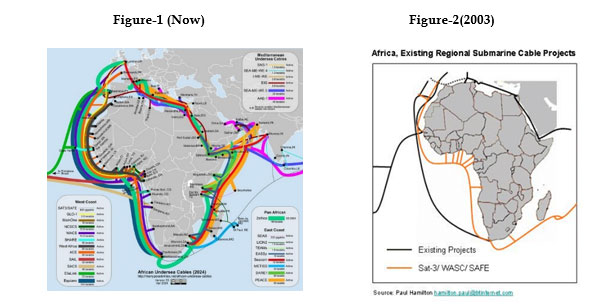
During the last 20 years, Africa’s Undersea Cable Capacity has undergone a tremendous growth which is visible from Figure-1 and Figure-2. Figue-1 refers to the Africa Undersea Cable System as of 2024, whereas Figure-2 shows the Africa Undersea Cable as available in 2003. Globalization impact on Digital Networks for undertaking digital transformation in Africa Continent is noticeable. What Africa NEEDS today is terrestrial fiber to drive the existing subsea cable capacity inland to improve the broadband capacity of the wireless and cellphone networks (Eric Osiakwan in AfrISIA, 23 November 2020), and it may be better and faster to leverage on projects like Starlink in Africa, instead of depending only on building terrestrial networks. Starlink delivers high-speed Internet almost anywhere on Earth (www.starlink.com).
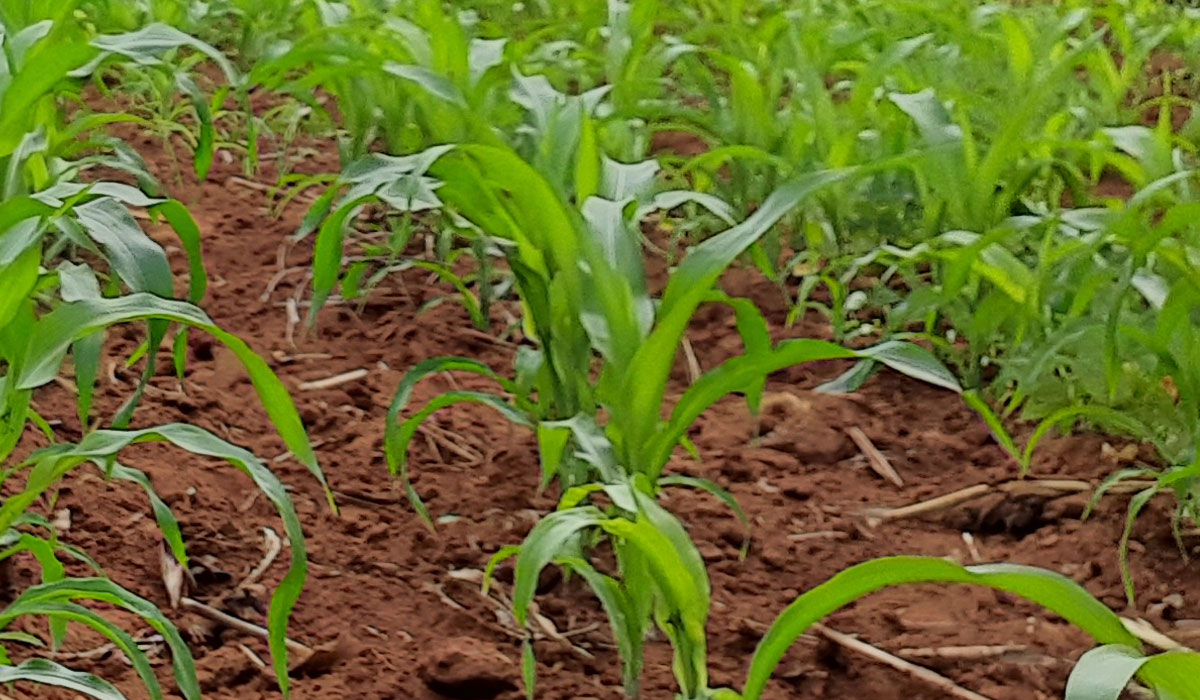
Many Africa Nations, e.g. Malawi and Sierra Leone, rely primarily on Rainfed Agriculture. The Case study of Malawi and Sierra Leone, which are familiar to me, amply justifies the need for development of Informatics Network and Agricultural Commodity Value Chains, and also Smart Rainfed Farming as an ecosystem applying GRIN (Genomics, Robotics, Informatics and Nano Technology) Revolution. An unexploited huge potential for job creation, inclusion of small famers, income generation, and agricultural productivity increase, is existing to be achieved through Digital Transformation in a globalized and digitalised economy.
Conclusion
The hot-line tag has been “Smallholder farmers are not left behind”, and “Advocate for a Sustainable Green Revolution”, in Africa. The Agenda 2063 and Comprehensive African Agricultural Development Programme (CAADP) may adopt the ecosystem Approach as proposed for Strategic Use of Digital Technology in Farming System Life Cycle, through 7 Mission Mode Programmes recommended by the Government of India’s Ashok Dalwai Committee on Doubling Farmers’ Income by 2022 Report 2018 of (Volume 12B – Chapter 10). This Eco-system Approach is required as the “future of farming” will be mostly based on extensive research and development in the areas of Genomics, Robotics, Informatics and Nanotechnology (GRIN). Creation of Agricultural Informatics Network and Value Chains for Country specific Agricultural Commodities is undertaken as “Top Most PRIORITY” under the CAADP.
The Comprehensive African Agricultural Development Programme (CAADP) of Agenda 2063 needs to usher in Digital Transformation to sustain the positive impacts and minimize the negative impacts due to the Globalisation of African Agriculture, and benefit from the Globalized Digital Economy.