
BIMSTEC: India’s Eastward Ho!
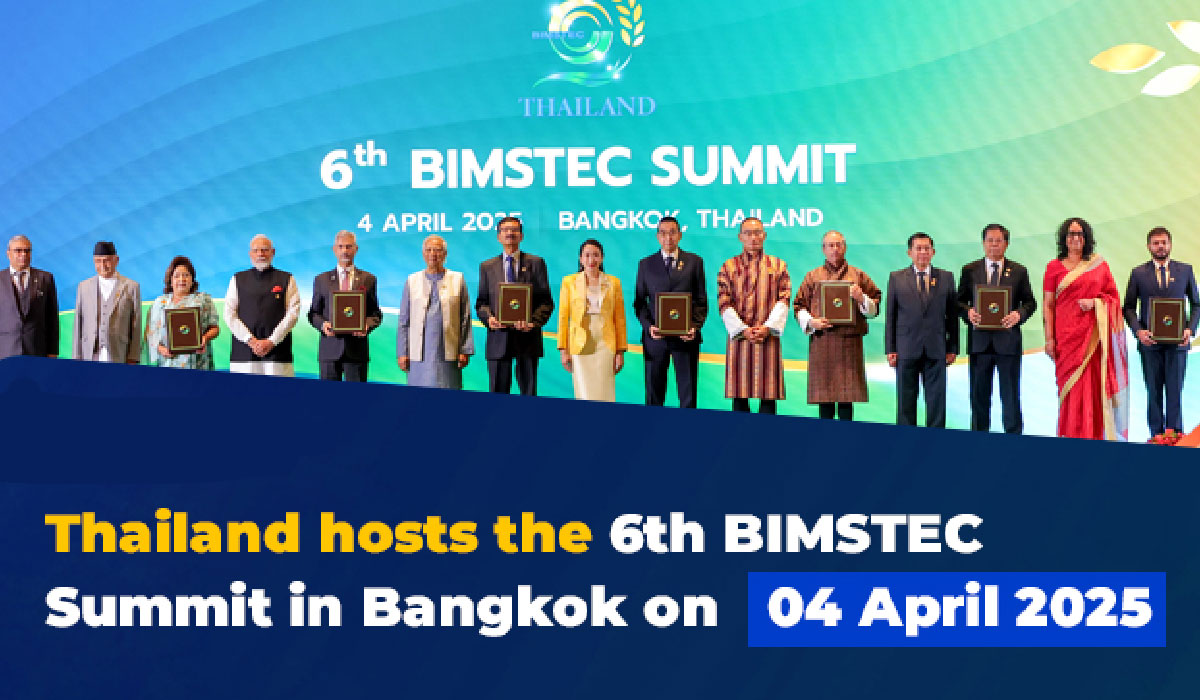
The Indian Prime Minister, Narendra Modi, made a significant visit to Thailand on April 6, 2025, for the BIMSTEC (Bay of Bengal Initiative for Multi-Sectoral Technical and Economic Cooperation) summit. This visit underscores the deep bilateral and political ties between the two nations, emphasizing three key principles of India’s foreign policy: the Act East Policy, the Neighbours First approach, and a renewed commitment to developing the Bay of Bengal region.
BIMSTEC which is now entering its twenty-eighth year since its establishment in 1997, centers on economic growth, prosperity, and regional cooperation in a region facing its own unique challenges. As the major player in the region, India’s strategic position has significantly influenced its relationship with BIMSTEC on both regional and global stages. India’s political commitment and focus within BIMSTEC have long been instrumental in building and expanding its diplomatic and regional influence in the Bay of Bengal and the Indo-Pacific area. India’s two-pronged policy—Neighbourhood and Act East—underscores its dedication to fostering economic, strategic, and security partnerships while maintaining its status as a key player.
The Bay of Bengal serves as a crucial link between the Indian and Pacific Oceans, playing a significant role in the nation's maritime strategy. Its importance extends beyond mere trade. Major ports such as Kolkata, Chennai, and Visakhapatnam rely on secure sea routes to facilitate continuous trade and commerce. Additionally, the Andaman and Nicobar Islands provide a strategic vantage point for influence in the Indo-Pacific region.
Although in recent years, India has taken a proactive approach to ensure its maritime security through initiatives such as the Quad—comprising India, the United States, Japan, and Australia—which promotes a free and open Indo-Pacific, as well as SAGAR (Security and Growth for All in the Region) and MALABAR exercises, challenges persist. These challenges include China’s expanding naval presence, illegal fishing, and piracy. Additionally, China’s increasing influence through the Belt and Road Initiative and the growing significance of BIMSTEC are noteworthy developments for India
India's role in BIMSTEC is increasingly critical, as it enables all participating countries to shape regional discourse and strengthen collective security mechanisms. Since its inception, BIMSTEC has been regarded as a bridging mechanism between AISA and Southeast Asia. Furthermore, it serves as a platform for promoting technological advancement, energy collaboration, disaster management, and counter-terrorism efforts. India's ongoing commitment to BIMSTEC as a viable alternative can also be viewed as a primary instrument for enhancing regional cooperation, especially after its previous disengagement from SAARC. BIMSTEC has a broader reach as compared to SAARC, connecting South Asia and Southeast Asia, which aligns seamlessly with India's Act East Policy.
The development of the Northeastern states of India has been an important aspect of its Act East Policy, serving as an impetus for India’s broader eastward expansion. Initially launched as the Look East Policy under Prime Minister Narasimha Rao in 1992, the initiative witnessed significant infrastructural development during the tenure of Prime Minister Atal Bihari Vajpayee. Under the leadership of Prime Minister Narendra Modi, the initiative was rebranded as the Act East Policy and pursued with an unparalleled intensity with abudget allocation of 5 lakh crore for capital expenditure specifically designated for the Northeast.
Additionally, connectivity has been the primary focus of this transformation. The construction of highways and multi-modal transport corridors has significantly enhanced accessibility. The maritime transport corridors and the IMT Trilateral Highways could connect India’s Northeast to the Pacific. Rail networks and air connectivity under the UDAAN scheme have opened up remote locations to better and more efficient access. Innovative projects, such as the proposed underwater tunnel between Assam and Arunachal Pradesh, further highlight the government’s commitment to year-round connectivity and infrastructure development.
Together with a focus on connectivity, the government has revitalized border areas under various schemes such as the Vibrant Village Programme in the northeastern states of Arunachal Pradesh and Sikkim. These schemes and undertakings have seen a vast improvement in curbing migration while providing stability to border regions. The PM Gram Sadak Yojana has played a significant role in connecting previously isolated villages.
The Narendra Modi government’s endeavour to clinch the issue of longstanding insurgencies along the northeastern borders is seen to play a great role in providing stability to the region. The peace accord with the National Socialist Council of Nagaland in 2015 was a nonpareil resolution in putting a decade-long conflict to rest. It is with the help of such developmental measures that the government has been able to foster an economically robust Northeast. Under Prime Minister Narendra Modi's leadership, the northeastern region is increasingly recognized as a gateway to Southeast Asia, facilitating trade, tourism, and diplomatic engagement with neighboring countries.
At the recent 6th BIMSTEC Summit held in Thailand, the major agenda comprised of declaration of the 6th BIMSTEC Summit, the adoption of the BIMSTEC Bangkok Vision 2030, the signing of the Agreement on Maritime Transport Cooperation, and the signing of Memoranda of Understanding (MoUs) between BIMSTEC and the Indian Ocean Rim Association (IORA) as well as between BIMSTEC and the United Nations Office on Drugs and Crime (UNODC). Additionally, the leaders endorsed the BIMSTEC Leaders’ Joint Statement regarding the impact of the earthquake that struck Myanmar and Thailand on March 28th.
India’s participation in the 6th BIMSTEC summit clearly underlines its commitment to regional integration and reaffirms its leadership role in the Bay of Bengal region.
About the Author