







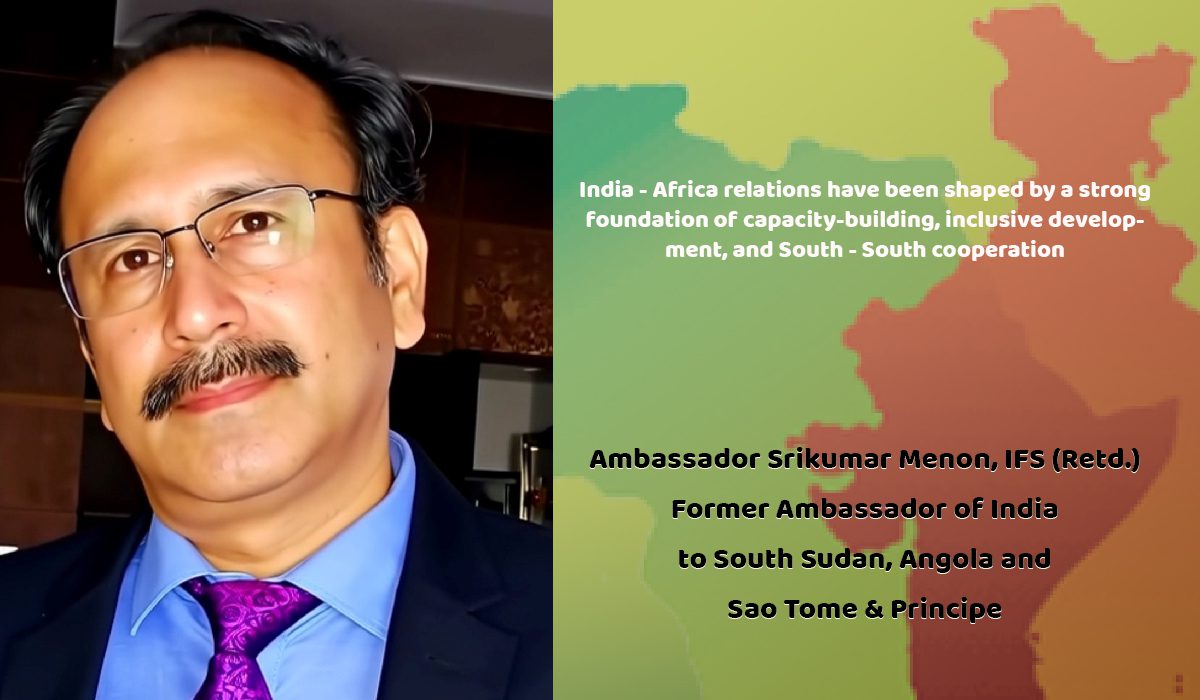
India – Africa Ties Must Be Built on Trust and Shared Growth: Ambassador Srikumar Menon
Interview
Ambassador Srikumar Menon, IFS (Retd.), highlights that India - Africa relations have been shaped by a strong foundation of capacity-building, inclusive development, and South - South cooperation. Reflecting on his diplomatic experience, he underscores India’s role in education, skills development, and the spread of affordable innovations in healthcare, agriculture, and digital services across Africa.
Looking ahead, he identifies human capital development, technology partnerships, sustainable infrastructure, and strategic trade as key pillars for future cooperation. He also emphasizes the growing importance of sectors such as agriculture, pharmaceuticals, digital economy, renewable energy, and infrastructure in strengthening economic ties.
Ambassador Menon stresses that India’s development model must remain collaborative and aligned with African priorities, focusing on skills transfer, sustainability, and local empowerment.
Concluding, he calls for a long-term, trust-based approach among policymakers, businesses, and young professionals, noting that India - Africa partnerships will thrive when commercial goals are aligned with shared development and resilience.
Read the exclusive interview with Ambassador Srikumar Menon in The Diplomat Today Magazine...
Q1. Reflections on Your Diplomatic Journey: Looking back at your tenure in Africa, what experiences most significantly shaped your understanding of India–Africa relations?
Response: Having served in Africa at different times in my diplomatic career, I can identify three stand-out experiences that profoundly shaped my understanding of India-Africa relations.
First, witnessing India’s supportive and steadfast role in capacity-building - through scholarships, vocational training, and technology transfer. These initiatives and approach have benefitted several African youth, men and women, over the years - emphasizing the fact that "education and skills" form the backbone of our long-term partnership.
Second - the personal satisfaction of witnessing tangible progress and benefits accruing from India’s deep engagement with African entrepreneurs who found value in India’s affordable innovations in healthcare, agriculture, and digital services. This approach underscores the importance of inclusive, frugal solutions in driving shared growth.
Finally, observing India’s diplomatic outreach - anchored in South-South cooperation and solidarity against colonial legacies - an approach that underlined that our relationship is not transactional but rooted in mutual respect and historical bonds.
What stands out has been India's consistent efforts, over the years, in championing the cause of the Global South, supporting initiatives to bring Africa into the global narrative, which eventually culminated in the G20 leaders' landmark decision in 2023 to include the African Union (AU) into their fold.
These first-hand experience of implementing organizational policies through practical, ground-level execution on the front lines, taught me that India-Africa ties thrive when you blend economic pragmatism with cultural empathy, creating a partnership that is both strategic and deeply human.
Q 2. India - Africa Strategic Engagement: In your view, what key areas should define the next phase of India - Africa cooperation?
Response: I believe that the next phase of India-Africa development cooperation, should have a 3-pronged focus on Bilateral, Regional and Pan-African Cooperation - specifically covering aspects of capacity building, education, health, sustainable development and trade & investment. To elaborate on:
First, "human capital development", with expanded scholarships, vocational training, and digital literacy programs to empower Africa’s youth.
Second, "technology and innovation partnerships" - leveraging India’s strengths in affordable healthcare, fintech, and agritech to drive inclusive growth.
Third, "infrastructure and energy collaboration", focusing on sustainable projects in transport, renewable energy, and digital connectivity to bridge development gaps.
Fourth, "strategic diplomacy and trade", deepening South-South cooperation through diversified trade, investment in local manufacturing, and joint positions on global governance issues.
Fifth, leverage Artificial Intelligence to support projects in areas like agriculture (providing real-time data on crops/livestock), education (online learning platforms), medical and healthcare services (electronic-tele-medicine) etc.
While doing so, India's outreach efforts should also invariably factor-in critical areas of importance for Africa's economic growth, like infrastructure, power, energy and project-financing. This will help supplement existing initiatives and address the imperative of all Africans to have access to necessities like electricity and water to run their homes, schools, hospitals and Industries.
India, of course, can contribute and even lead global efforts to combat the negative impact of climate change in partner countries in Africa, while ensuring sustainable development for the people of Africa, in-line with the SDG 2030 agenda.
Together, these priorities can transform India-Africa ties into a future-oriented partnership rooted in shared prosperity and resilience.
Q 3. Trade and Economic Opportunities: What sectors hold the greatest potential for expanding India- Africa trade and investment in the coming years?
Response: India-Africa trade and investment hold immense promise across several dynamic sectors. To mention a few -
"Agriculture, Agri-business and Agri-tech" stands out. Here there are opportunities in food processing & agri-food manufacturing, irrigation, and supply chain modernization to enhance food security.
"Healthcare and pharmaceuticals" offer scope for affordable medicines, surgical and medical equipment, telemedicine, and joint research - building on India’s strengths in low-cost innovation.
"Digital economy and fintech" present another frontier, as Africa’s young population embraces mobile payments, e-commerce, software development, besides digital services in form of insurance, banking and financial services, where Indian expertise can accelerate inclusion.
"Renewable energy", particularly solar and bioenergy, is vital for sustainable growth and aligns with both regions’ climate commitments.
"Partnerships in infrastructure & manufacturing" - covering the entire gamut of transport corridors to local production hubs - can deepen industrial linkages and considerably reduce dependency on imports.
And finally, leveraging the interesting opportunities presented by the AfCFTA for Indian businesses and companies; promote India-Africa trade through the Africa Growth Fund (AGF); enhance greater access to financing options, besides supporting African partner countries through infrastructure financing and undertaking joint initiatives.
Together, these sectoral engagements can transform India-Africa economic ties into engines of shared prosperity and resilience.
Q 4. Development and Capacity Building: How can India further strengthen its development partnership model with African nations?
Response: India can strengthen its development partnership with Africa by deepening collaboration in "human capital and skills training", expanding scholarships, vocational programs, and digital literacy initiatives to empower youth.
India is well placed to support African partners by enhancing "technology transfer and innovation ecosystems" - particularly in healthcare, agriculture, and fintech.
This approach ensures affordable, cost-effective and scalable solutions customised to local needs, reinforcing India’s commitment to push for African-led development deliverables to resolve and fix African challenges."
Investing in "sustainable infrastructure and renewable energy" can help bridge connectivity gaps while supporting climate resilience.
Equally important is fostering "inclusive capacity-building models", where projects are co-designed with African partners to reflect local priorities and ownership.
Finally, India should leverage its experience of "South–South cooperation" to champion joint positions on global governance, ensuring Africa’s voice is amplified in multilateral forums.
This holistic approach - rooted in skills, sustainability, and shared leadership - can make India-Africa development ties more impactful and future-ready.
Q 5. Advice for Shaping the Future of India - Africa Trade: What guidance would you offer to policymakers, business leaders, and young professionals working to build stronger economic ties between India and Africa?
Response: The future of India–Africa trade will be guided by the following three principles.
One - Policymakers should prioritize providing "enabling frameworks" that include simplifying regulations, improving logistics, and fostering regional value chains that make cross-border trade seamless.
Two - Business leaders must focus on "partnership-driven investment", building Local Manufacturing, Agri-tech, and Renewable Energy Ventures that create jobs and transfer skills rather than just exporting products. For young professionals, the opportunity lies in "innovation and digital entrepreneurship" ie. in leveraging fintech, e-commerce, and healthcare technology to bridge gaps and drive inclusive growth.
And the third guiding principle, I believe above all, is for all stakeholders to realise the need to shed "quick-fix" strategies to seek immediate gains, and instead embrace a "long-term, trust-based approach", while recognizing that India-Africa economic ties thrive when they combine commercial ambition with shared development goals.
This mindset will ensure the partnership remains steady, resilient, equitable, and ready to take on the challenges of the future.