




INDIA AI IMPACT 2026: The World Gathers over AI in New Delhi, India
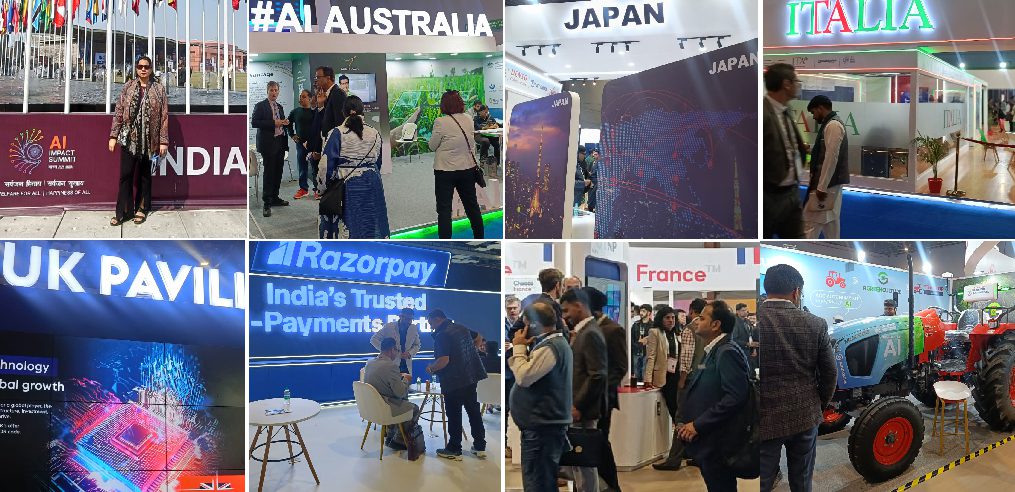
From February 16 to 20, India hosted the largest AI summit in the world in New Delhi, which drew a thousand delegates, including CEOs of leading AI start-ups and world leaders. The AI Impact Summit 2026 was the fourth consecutive summit in the global series previously held across the world to coordinate global Artificial Intelligence actions. India’s motto for global AI meeting was "Sarvajana hitaya, Sarvjana Sukhay" (welfare for all and happiness for all). And, truly abiding by the motto, India successfully promoted AI for inclusive progress, improving mankind, and safeguarding the environment. The framework of the summit was designed on three sutras—planet, progress, and people.
The AI conglomeration, with the support of 89 countries and international organizations, reflected on the broad recognition that it can promote in social progress and economic expansion. World leaders, including UN Secretary-General Antonio Guterres, French President Emmanuel Macron, Brazilian President Luiz Inacio Lula da Silva, Swiss President Guy Parmelin, and CEOs from foremost technology companies from around the world, were among those who graced the summit with their presence. Apart from the tech maestros, Sri Lanka President Anura Kumara Disanayaka, Bhutan Prime Minister Tshering Tobgay, Mauritius Prime Minister Navinchandra Ramgoolam, Croatia Prime Minister Andrej Plenkovic, Serbia President Aleksandar Vucic, Seychelles Vice President Sebastien Pillay, Estonia President Alar Karis, and Finland Prime Minister Petteri Orpo were among the list of distinguished attendees.
The AI Impact Summit surpassed expectation and broke world records with 250, 946 pledges in a span of 24 hours. It is a defining moment for the global AI ecosystem joining hands to build an ethical, inclusive and accountable AI led world ahead. However, outside the realms of technologically advanced AI exhibition, the summit held something more! In fact, not just diplomatic accessions, but a strategic recalibration. India AI Impact Summit was the first of its kind in the Global South. Unlike the 2025 AI Action Summit held in Paris, which focused on AI Safety and Innovation, this summit aimed to establish a new narrative centred on safe AI practices, inclusivity, and shared benefits. It recasted the AI agenda more as developmental paradigm over AI risk mitigation. Unlike America and other developed economies who have consistently shown hesitation in international centralized AI regulation and safety pacts, India shifted its focus towards how emerging economies can use AI to spur innovation and sustainable growth. The Summit that was themed on the seven chakras namely- Science; Human Capital; Economic Development and Social Good; Safe and Trusted AI; Inclusion for Social Empowerment; Resilience, Innovation and Efficiency; Democratizing AI Resources – prioritized ethical AI deployment while ensuring that the voices of underrepresented communities are heard in shaping future technologies. And this thematic inclusivity further proposes the need for “AI at a basic level” or a deployable intelligence, within reach, and rising above the barriers of language and low inclusivity. It highlights use cases, such as climate-resilient agriculture, predictive public health models, digitalized and service delivery.
AI Impact 2026: Shaping New Intelligent Debate
By convening AI Impact Summit in 2026, India seeks to shape the global AI governance discourse through a three-pronged strategy. The first being development and deployment which entails AI usage for developmental initiatives than solely for “risk mitigation”. Secondly, the summit featured south-south cooperation and capacity building in the developing economies where AI tools should be adapted as technological and economic necessity for preventing Global South from being a passive audience. Thirdly, India focused on a coalition through strategic bargain, most prominently bagging a deal with United States (US)-led Pax Silica initiative and signed a Joint Statement on the India-US AI Opportunity Partnership.
India looms large with more than 3 million AI mavens and well-trained technologists, India charts the path to bridge the gap between the implementation imperatives of the South and the innovation hubs of the West—and between the scale-driven, state-centric AI paradigm of China and the entrepreneurial ecosystems led by the United States. In Sam Altman’s words India is “full stack AI leader” possessing demographic strength and entrepreneurial spirit necessary to shape today’s AI dialogue. Participation of institutions such as the World Bank and United Nations in the AI impact showcases India’s position in setting up all-inclusive AI governance while underscoring its multilateral thrust. India’s approach to the AI governance policy is a derivative of its foreign policy, which focuses on building internal capabilities, diversifying partnerships, and strengthening technological sovereignty to avoid overdependence, rather than opting for neutrality or disengagement. This in turn allows us to amplify global South voices of Latin America, Southeast Asia, and Africa.
Key Outcomes of AI IMPACT 2026
AI Impact 2026 - The Diplomatic Side
Over the course of a six-day event, the AI IMPACT SUMMIT 2026 achieved a significant milestone for India, a nation whose computing capacity remains modest and is still striving to match the standards set by China. The summit established New Delhi as a key authority in global AI governance discussions, bringing together a diverse range of countries—including the United States, China, Russia, the United Kingdom, and France—under one roof, surpassing the scale of any previous summit. The broad spectrum of endorsements at AI India Impact, representing major economies and the Global South, demonstrates the consensus India has cultivated over the years.
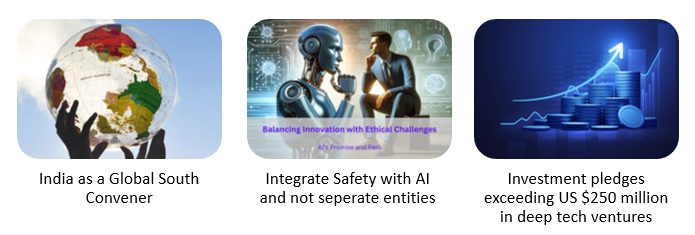
India’s governance and management had an impact that extended beyond the AI IMPACT SUMMIT 2026 itself, despite some technical challenges. The summit successfully united leading economies, a feat typically expected from countries such as the United States. Notable attendees included Alphabet CEO Sundar Pichai, OpenAI’s Sam Altman, Anthropic’s Dario Amodei, Google DeepMind CEO Demis Hassabis, and Microsoft President Brad Smith, alongside French President Emmanuel Macron, UN Secretary-General António Guterres, and numerous other heads of state. The meeting resulted in investment commitments exceeding $250 billion for infrastructure, alongside approximately $20 billion allocated for deep-tech venture capital investments. Additionally, AMD and OpenAI announced strategic alliances with the Tata Group.
The summit signals a profound shift in India’s global standing. New Delhi is demonstrating its capacity to organise, shape, and lead international AI governance efforts. It is no longer content with merely influencing technological development; sustained implementation beyond summit declarations will be essential to determine whether this shift in global AI governance is enduring.
Nevertheless, the message is clear: India aims to contribute to the creation of AI, not simply to secure a seat at the table.