



India – Mauritius Ties Deepen at Hyderabad House: A Strategic Maritime Partnership Reaffirmed
From Shared Heritage to AI Cooperation – Expanding the Arc of Indian Ocean Diplomacy
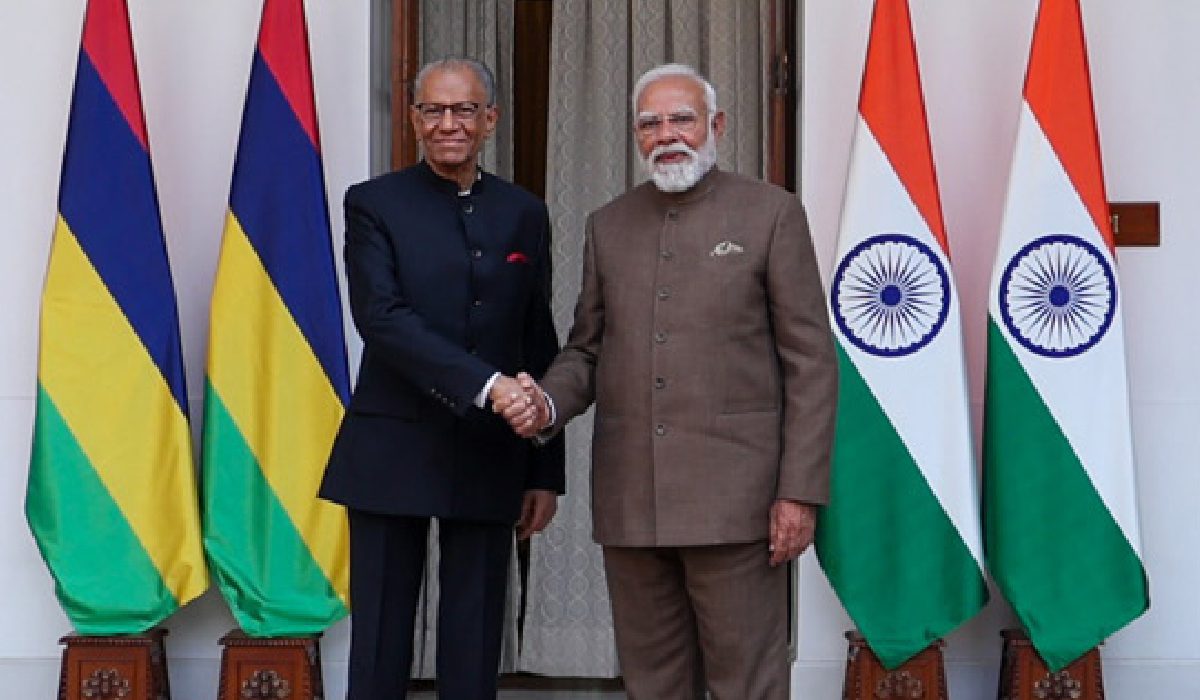
On 20 February 2026, Narendra Modi welcomed Navinchandra Ramgoolam at Hyderabad House in New Delhi, reaffirming one of the Indian Ocean’s most enduring and strategically significant partnerships. Held on the sidelines of the India AI Impact Summit 2026, the bilateral engagement demonstrated how India and Mauritius are aligning traditional diplomatic warmth with emerging technological ambition.
The meeting underscored that India – Mauritius relations have evolved beyond historical affinity into a structured and forward-looking strategic partnership. Rooted in deep civilizational links and a vibrant diaspora connection, the relationship today is increasingly defined by maritime cooperation, development assistance, digital innovation, and shared regional priorities. Hyderabad House – often the stage for India’s most consequential diplomatic conversations – once again became the setting for a dialogue that blended symbolism with substance.
At the core of discussions was the reaffirmation of the Enhanced Strategic Partnership between the two nations. Prime Minister Modi reiterated India’s commitment under its Indian Ocean vision framework, emphasizing that Mauritius remains a central pillar of India’s maritime outreach. In an era where the Indian Ocean has become a theatre of intensified geopolitical activity, Mauritius occupies a position of both geographic and strategic importance, serving as a key partner in maintaining regional stability and maritime security.
Economic cooperation featured prominently in the dialogue. Trade, investment flows, infrastructure collaboration, and capacity-building initiatives were reviewed with an emphasis on sustained implementation. India’s development partnership initiatives in Mauritius – ranging from metro projects to social infrastructure – reflect a model of cooperation based not merely on financing but on long-term institutional strengthening. Development diplomacy, in this context, becomes an instrument of trust-building rather than transactional engagement.
Notably, the AI Summit backdrop infused the meeting with a forward-looking tone. Both leaders explored collaboration in emerging technologies, digital governance, and innovation ecosystems. For Mauritius, positioning itself as a knowledge and financial hub in the Indian Ocean, technology partnerships with India offer scalability and expertise. For India, such cooperation reinforces its role as a provider of digital public infrastructure solutions to friendly nations. Technology is increasingly the new currency of strategic partnerships, and this engagement reflected that shift clearly.
Maritime security and regional peace were also central themes. As sea lanes of communication grow more vital to global trade and energy flows, coordination between India and Mauritius enhances collective security in the Indian Ocean Region. Shared perspectives on safeguarding sovereignty, promoting sustainable blue economy initiatives, and strengthening coastal surveillance cooperation signal a partnership attentive to both traditional and non-traditional security challenges.
The political optics of the meeting further highlighted continuity and confidence. Prime Minister Ramgoolam’s engagement in New Delhi reflects the stability of bilateral ties across political cycles, reinforcing the notion that India – Mauritius relations transcend party lines and are anchored in enduring national interests. This institutional resilience has long distinguished the partnership from more fluctuating diplomatic relationships in the broader region.
Beyond policy specifics, the Hyderabad House meeting conveyed a broader message: that India’s Indian Ocean diplomacy is both inclusive and innovation-driven. By integrating maritime cooperation with digital collaboration and development finance, New Delhi is shaping a comprehensive engagement model suited to 21st-century realities.
In a time marked by strategic competition and economic recalibration, the Modi – Ramgoolam dialogue stands as evidence that measured, trust-based partnerships remain the cornerstone of regional stability. For observers of Indian Ocean geopolitics, this engagement was not merely another bilateral meeting; it was a reaffirmation that India and Mauritius continue to chart a shared course – steady, strategic, and future-focused.