



Namibia’s Natural Resources – Very Significant and A vital role in its Economy
 Namibia is home to a population estimated to be 3,095,578 (www.worldmeters.info, as of 21 July 2025), and thinly spread across 824,292 square kilometers. The Country is classified as a semi-arid to arid country, with average rainfall of up to 700 mm per year, and its economy is primarily driven by four key sectors: Agriculture, Diamond mining, Tourism and the Retail sector. It is a Member State of the Southern African Development Community (SADC), and also a Member Country of the African-Asian Rural Development Organization (AARDO).
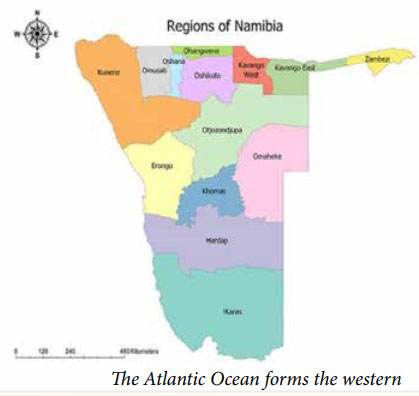
Namibia is divided into 14 Administrative Regions viz. Erongo, Hardap, Karas, Kavango East, Kavango West, Khomas, Kunene, Ohangwena, Omaheke, Mousasi, Oshana, Oshikoto, Otjozondjupa, and Zambezi, for governance and administration. The Atlantic Ocean forms the western boundary of Namibia, with a coastline of approximately 1,572 km.
About 70% of Namibia’s population depend on Agriculture for their livelihoods. The Government of Namibia has recognised the Agri-food Sector as an engine of growth for its economy, and therefore sees a need to address the challenges facing this Sector. The Agri-food Sector is made up of livestock farming of mainly Cattle, Goat and Sheep, Crop farming with (white) Maize, Pearl millet, Wheat, Rice, Sorghum, Horticultural products, such as Vegetables and Fruits, and significant marine resources, including valuable fish stocks. It is endowed with only 8% irrigated area and the rest being dryland cultivation.
Livestock production is the main agricultural business, and historically, contributed approximately 70% of agricultural output. Goat production plays a vital role, particularly for resource-poor households in rural areas. Namibia has identified pearl millet as its priority cereal, under the FAO’s “One Country, One Priority Commodity” Concept, for producing and developing its entire value chain (i.e. from primary production through processing until marketing), diversified and marketed, in both domestic and international markets.
The country is very rich in minerals viz. diamonds, uranium, zinc, copper, lead, gold, and fluorspar, and also has significant deposits of natural gas, wind, solar, and biomass energy sources. It possesses a thriving tourism industry based on its unique wildlife and landscapes.
Namibia’s Comprehensive Strategy for the Transformation of Agri-Food Sector (STAS) 2024
Namibia has released its Strategy for the Transformation of the Agri-Food Sector (STAS) 2025/26 – 2030/31 Report in 2024, which serves as an implementation tool for the Comprehensive Africa Agriculture Development Programme (CAADP), which an Agenda of the African Union (AU) 2063, and has 4 priority areas (Pillars) viz. Sustainable Land and Water Management, Market Access, Food Supply and Reduce Hunger, and Agricultural Research. Each Pillar of CAADP needs adoption of Digital Public Infrastructure (DPI) based on Ecosystem Architecture to facilitate Digital Transformation.
The STAS has four key pillars and its 21 Intervention Areas are very comprehensive, and optimally aligned with Namibia’s 6th National Development Plan (NDP6) Strategic Pillars viz. Pillar 1: Production, Productivity and Agri-Business (NDP’s Pillar 1: Economic recovery, transformation and resilience) – Intervention Areas (6), Pillar 2: Food and Nutrition Security and Human Capacity (NDP’s Pillar 2: Human development and Community resilience) – Intervention Areas (4, Pillar 3: Sustainable Resource Management (NDP’s Pillar 3: Sustainable development and environmental sustainability) – Intervention Areas (6), and Pillar 4: Enabling Environment and Responsive Institutions (NDP’s Pillar 4: Good governance and effective Public service delivery) – Intervention Areas (5).
The Northern Communal Areas Livestock Transformation Strategy 2019 states that “Namibia is a vast, diverse country, with challenges in agriculture varying significantly across different regions. It is thus essential that solutions are tailored to the specific needs of each area”. The Swakopmund Protocol on Protection of Traditional Knowledge (calling for conserving and recognising the value of indigenous technical knowledge in agricultural and environmental science) of Folklore is a regional treaty adopted by the African Regional Intellectual Property Organization (ARIPO), to protect traditional knowledge and cultural expressions in Africa.
It is pronounced that the STAS is framed within the context of the UN Agenda 2030 and its Sustainable Development Goals (SDGs) viz., SDG1 (no poverty), SDG2 (zero hunger), SDG5 (gender equality), SDG8 (decent work and economic growth), SDG13 (climate action), and SDG15 (life on land). As stated, the STAS 2024 provides clear directions, consistent over time, e.g. integration of Climate Smart Agriculture practices in all Value Chains, tailor activities to agro-ecological zones, introduce the food systems approach, and encourage regional market integration. It also lists out “Regional Priorities in the Agri-Food Sector” in Namibia’s 14 Regions, with bifurcation of Oshikoto Region into two sub- regions (Communal & Commercial), in page no. 84. The STAS recommends “digital transformation in agriculture” to enable improved farming practices with optimised input allocation and increased productivity, through Development of Information and Communication Technology (ICT) Infrastructure, in addition to other necessary required infrastructure to support agricultural growth such as transport (road, rail, airport and seaport), water, electricity, health (veterinary/phytosanitary), marketing and trade, and storage infrastructure.
Digital Networks for Digital Transformation in Namibia
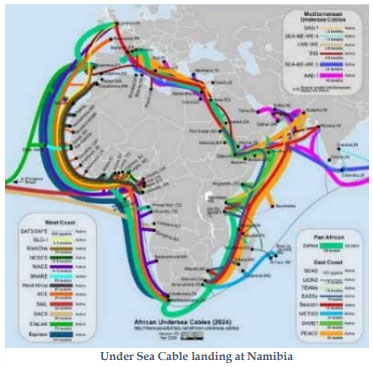 In 2024, Namibia enhanced its internet connectivity with the activation of the Equiano subsea cable at Swakopmund (Namibia). This cable, supported by Google, connects Namibia to Europe via Sesimbra (Portugal) and to the rest of Africa through Cape Town and Johannesburg (South Africa). Equiano connects to Cape Town (South Africa), with branching units to Lagos (Nigeria) and Lomé (Togo) and Rupert's Bay (St Helena) (www.submarinenetworks.com). The landing station for the Equiano cable was co-built by Telecom Namibia and Paratus Group and switched on in June 2023 (www.datacenterdynamics.com on 22nd August 2024). The Google Cloud has 14 Sub Sea Cable Investments and 134 Points of Presence for providing seamless integrated high speed internet connectivity to America, Europe, Africa, Asia and Australia (www.cloud.google.com).
Major Internet Service Providers in Namibia includes Telecom Namibia, Paratus Group and Africa Online. Mobile broadband is widely used in Namibia, with 4G network coverage estimated at 91.46% in 2025. While terrestrial internet options, especially fiber, are becoming more available in Namibian towns and cities, providing widespread high-speed connectivity to rural areas continues to be a challenge, as reported in various media publications. This can be facilitated by Starlink, if it starts its operations in Namibia.
Salient Features of the Digital Namibia Strategy 2021
The Digital Namibia Strategy 2021, also known as the National Digital Strategy, aims to transform Namibia into a digitally literate, innovative, and inclusive society by strategically leveraging digital innovations for national development. It emphasizes a collaborative approach involving government, educational institutions, and the private sector to build a robust digital infrastructure and foster innovation. Its e-Governance Roadmap 2024-26 outlined the Vision for Digital-First Services for All with 6 strategic Pillars: Governance and Leadership, Digital Identity, Register and Interoperability, Digital Public Services and Administration, Cyber Security and Data Protection, and Government Infrastructure and Platforms. Its National AI Strategy is focusing on four key sectors: Healthcare, Education, Agriculture, and Mining. The Agri-Food System Sector is likely to benefit from only through synergisation of Digital Namibia Strategy 2021 and its e-Governance Roadmap 2024-26 and AI Strategy, via AgriTech StartUps and Capacity building of Rural Youths and Farmers, at farm level.
The United Nations Industrial Development Organisation (UNIDO) has been the strong advocate of ISO Standards to promote “digital transform and Innovation ecosystem”. The ISO 56000 Series is on Innovation Management Standards (https://www.nsai.ie/) and the ISO 56002; 2019 is the first Global Standard for Innovation Management system. The idea is to use digital transformation to improve innovation management systems in organizations and companies within the framework of ISO 56002. More and more innovations are expected in the sectors like education, agriculture, healthcare and environment in the coming years to solve the challenges faced by the rural masses.
Early adoption of Innovation Management System Standards to facilitate Digital Transformation resulting in an Innovation Ecosystem, and the need for a Competency Development Programme for practioners are required to achieve Return-On-Investment (ROI) in Digital Governance (Moni Madaswamy, 2024) .
Unlocking potential, Empowering Smallholders and Creating jobs for Rural Youths: Pathway through Adoption of Digital Transformation and Innovation Management System
Like many other Africa Nations, Namibia relies primarily on Dryland Agriculture and Irrigated Agriculture only 8% of cultivable land. Various practices applied in Dryland Agriculture includes: Drought-Resistant Crops (e.g. Pearl Millet, Sorghum and drought-resistant varieties of Maize), Rainwater harvesting, Soil conservation (conservation tillage, crop rotation, and agroforestry help to improve soil structure, enhance water infiltration, and reduce soil erosion), water technologies (such as drip irrigation, sensor-based irrigation, soil moisture sensors, and wastewater recycling to optimize water use and improve efficiency), and also digital technologies (to crop disease surveillance), to help Namibian farmers make more informed decisions and optimize resource use.
It is learnt from published reports available on Internet, the Namibian Farmers are progressively being trained to adopting agro-ecological approaches, such as intercropping and conservation agriculture, helping to improve soil health, enhance biodiversity, and build resilience to climate change. There have been coordinated efforts to improve Dryland Agriculture by adopting Climate Smart Agriculture, Conservation Agriculture, Agro-forestry practices, Water Management, and Nuclear Techniques, to improve Water Use efficiency and Crop Yields. Through better soil and water management, farmers working with the IAEA in Namibia have increased their crop yields by up to 70% for crops like maize, tomatoes and peppers (ww.iaea.shorthandstories.com). The Namibia Climate Smart Agriculture Programme 2015-2025 has been aimed to enhance the resilience of farming systems to Climate Change.
For example, the CRAVE (Climate Resilient Agriculture in three of the Vulnerable Extreme northern crop-growing regions) Project, financed by the Green Climate Fund (GCF), covers a range of sectors, including Agriculture, Water resources, and Community-based Natural Resource Management. By enabling small-scale farmers to transition from subsistence to market-driven production, the project improved food security for more than 313,000 people in Namibia's vulnerable regions (www.reliefweb.int), illustrating the transformative power of targeted financing.
 Agricultural Cooperatives in Namibia (www.agra.com.na) play a vital role in supporting farmers and contributing to the country's food security. The Namibian Agronomic Board (NAB) is at the forefront of this transformation, promoting digital infrastructure and systems for better data management and informed decision-making. The other prominent stakeholders include Livestock and Livestock Products Board of Namibia (LLPB), Namibia Agricultural Union (NLU/NAU), Namibia National Farmers Union (NNFU), Namibian Emerging Commercial farmers Union (NECFU), AGRIBANK of Namibia, Previously Disadvantaged Namibian Farmers Union (PDNFU), Nutrition and Food Security Alliance of Namibia (NAFSAN), University of Namibia (UNAM), Namibia University of Science and Technology (NUST).
The main Agricultural University in Namibia is the University of Namibia (UNAM). UNAM's Neudamm Campus is specifically a hub for teaching and research in various agricultural fields. Additionally, the Namibia University of Science and Technology (NUST) also offers a Bachelor of Science in Agriculture. Agricultural schools play a pivotal role in the development of the next generation of Namibian farmers. The Agra Agricultural Academy for Namibia (A3N) (www.agra.i3a.africa), promoted by Agricultural Cooperatives, is an independent Agricultural Academy that provides a South African Qualifications Authority (SAQA) accredited training (Online and Offline), designed to meet the needs of students, emerging farmers, farm workers, and established farming enterprises in Namibia. In addition, A3N partners with schools and regional and local agricultural industries to address the skills shortage in the industry.
The Strategy for the Transformation of the Agri-Food Sector (STAS) has identified four Key Pillars and 21 Intervention Areas. Thus identified each Intervention Area needs to undergo “Digital Transformation and Innovation System to comply with Innovation Management System Standards 560002:2019” under the Namibian e-Governance Strategy Roadmap. In addition, Synergisation of both STAS 4 Pillars and 21 Intervention Areas, and Digital Namibia Strategy 2021 amply justifies the need for development of Informatics Network and Agricultural Commodity Value Chains, and Smart Rainfed Farming as an ecosystem through GRIN (Genomics, Robotics, Informatics and Nano Technology) Revolution in Namibia.
An unexploited huge potential for job creation, inclusion of small famers, income generation, and agricultural productivity increase, is to be achieved through Digital Transformation in Agriculture and Food System of Namibia, in an Ecosystem Approach. A Sustainable Agriculture and Food Farming System for Self-Reliant and Climate Resilient Agriculture requires intensive application of science and technology within a well-defined framework by adopting “strategic use” of Digital Technology in Farming System Life Cycle. Such approach has been recommended by the Ashok Dalwai Committee on Doubling Farmers’ Income by 2022 Report 2018 of the Government of India (Volume 12B – Chapter 10) through the following 7 Mission Mode Programme: -
- Digitalised Agriculture: Digital Technology and Innovation for Transformational Reforms in Agricultural Sector - SMART Irrigated Farming, Smart Rainfed Farming and Smart Tribal Farming
- Digitalised Agro-Met Advisories & Agricultural Risk Management Solution
- Digitalized Agricultural Resources Information System and Micro-Level Planning for achieving SMART VILLAGE & SMART FARMING
- Digitalized Value Chain for Agricultural Commodities (Agriculture, Horticulture, Livestock, and Fisheries etc.)
- Digitalised Access to Inputs, Technology, Knowledge, Skill, Agricultural Finance, Credit, Marketing and Agribusiness Management, to Farmers (Farming as a Service)
- Digitalized Integrated Land and Water Management System
- Digitalized Farm Health Management (Public Health, Plant health, Animal health, Soil Health, and Environmental health) for reduction of Farmers’ Losses.
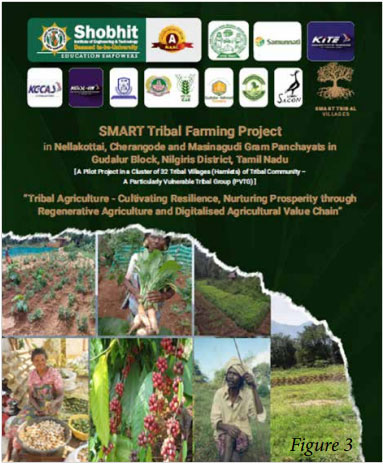
These seven Mission Mode Programs facilitate establishing AgriTech StartUps in a cluster of 10-15 Villages through Ecosystem Architecture at grassroot level, facilitating StartUps to StandUp, GrowUp and ScaleUp in SADC and AARDO Member Countries, through appropriate assessment and valuation at each stage. This framework will promote “Decision Science” in “Agricultural Science” through an Agricultural Informatics Programme. Agricultural Informatics and e-Governance Programme has enormous potential and opportunities as an important Research, Academic and Development disciplines for digital penetration in Villages through AgriTech StartUps for Namibia Landscape of Agriculture. Higher Education Institutions (HEI) with Data Science Courses / Agricultural Science Courses can join with Civil Society Organisations (CSO) to promote AgriTech StartUps for Agriculture 4.0 & Extension 5.0, in a cluster of 10-15 Villages in Namibia. Such Development Model (One HEI – One CSO) is under implementation for promoting Smart Tribal Farming in Tribal Villages, as pilot Initiatives in India (Figure-3).
Both the University of Namibia (UNAM) and Namibia University of Science & Technology (NUST) have Schools and Faculties offering Courses (UG, PG and Research levels) in the disciplines of Agriculture Science, Fisheries Science, Livestock Science, Natural Resources Science, Agribusiness, and Computer Science, Informatics and Engineering etc. The India-Namibia Centre of Excellence in Information Technology (INCEIT) provides Certificate courses in Ethical Hacking and Information Security, Big Data Technologies and Advanced Web Technologies.
Establishment of Centre for Agricultural Informatics and e-Governance Research Studies (CAIRS) and Centre for Agribusiness and Disaster Management Studies (CADMS) offering course at both UG and PG levels on “Digital Technology in Agriculture and Food Systems” focusing on 7 Mission Mode Programs, will facilitate unlocking vast potentials existing in Agriculture Landscape of 14 Regions in Namibia, through Agriculture 4.0. Agriculture Schools of Agricultural Schools of Agra Agriculture Academy of Namibia (A3N) has to operate Extension 4.0 centres for the development of the next generation of Namibian Farmers, Women Entrepreneurs (SHGs) and Rural Youths.
No doubt, there are challenges like limited connectivity, inconsistent power, high costs, and a lack of digital talent on the ground. These Challenges are required to be addressed through various ongoing government initiatives and partnerships to create an environment for flourishing more AgriTech Startups and youth engagement through Agricultural Informatics and e-Governance Programme as promoted in India.
Way Forward
Namibia's Agri-food sector holds immense potential for growth, food security, and job creation, particularly for smallholder farmers and rural youth across its 14 regions. Digital transformation through AgriTech Startups is a crucial pathway to unlock this potential and address the challenges faced by the sector. Some notable examples include AfriAgriFed, Fudlink Agricultural Technology, and AgriTech Namibia. By strategically aligning STAS 2024, Digital Namibia Strategy 2021 and e-Governance Roadmap 2024 with the innovative potential of AgriTech Startups, Rural Youths and resource poor Smallholder Farmers, it is possible to cultivate a thriving and sustainable agri-food sector that empowers its people, especially the rural youth, to build a brighter and more food-secure future. Like many Africa Nations, Namibia relies primarily on Rainfed (Semi-Arid and Arid) Agriculture. This condition amply justifies the need for development of Informatics Network and Agricultural Commodity Value Chains, and Smart Rainfed Farming as an ecosystem applying GRIN (Genomics, Robotics, Informatics and Nano Technology) Revolution.
The Way Forward, described below, provide measures for synergizing STAS 2025 and Digital Namibia Strategy 2021 and its e-Governance Roadmap 2024:-
- Establish Centre for Agricultural Informatics and e-Governance Research Studies (CAIRS) and Centre for Agribusiness and Disaster Management Studies (CADMS) in HEIs - UNAM and NUST to promote “Strategic Use of Digital Technology in Farming System Life Cycle” as an ecosystem approach through AgriTech StartUps, in 15 Regions/Sub-Regions of Namibia.
- Develop Agricultural Informatics Courses (Digital Technology Applications in Agri-Food System) at UG (B.Sc/B.Tech), PG (M.Tech, M.Sc), PG Diploma (1 Year) and Diploma (6 Months) in NUMA (Agriculture and Natural Resource Management), NUST (Agriculture Science, Computer Science and Engineering), A3N (Agriculture Schools) and INCEIT, to skillfully train Graduates of STEAM - Science, Technology, Engineering, Arts, Agriculture and Mathematics Disciplines, to generate Youths to participate in the ongoing GRIN Revolution elsewhere in the World
- Take Steps to synergize STAS 2025 and the Digital Namibia Strategy 2021 with the innovative potential of AgriTech Startups through Pilot projects, and Digital Public Infrastructure (DPI) based on Ecosystem Architecture to facilitate Digital Transformation.
- Promote AgriTech StartUps (AgriTech 4.0 and Extension 4.0) in a cluster of 10-15 Villages in association with NUAM, NUST, NAU, NNFU, NECFU, NAFSAN, LLPB, NAB, AgriBank of Namibia, A3N etc.
- Establish AgriTech StartUps and Scaling them up throughout the country, grouped under five categories, as recommended by the Proceedings of 113 International Webinars organised by Shobhit University India and AARDO New Delhi (2020 -2025) : (a) Digital Technologies & Rural Infrastructure, (b) AgriTech, Value Chains & Smart Farming, (c) Sustainability, Environment & Green Energy, (d) Entrepreneurship, Local Economies & Social Models, and (e) Education, Health & Skill Development.
- Adopt Pilot Projects in each Namibia Region to operationalise 7 Mission Mode Programs for empowering smallholder farmers through AgriTech StartUps
- Promote Digitalized Value Chain for Agricultural Produces (e.g. One Village One Product in Japan, One District One Product in India, Pearl Millet - One Country One Commodity of FAO in Namibia)
- Use of AI, Bigdata Analytics and Blockchain technologies to ensure optimal nutrition in Soil and Harvested food to minimise human diseases - OneHealth/EcoHealth (Health Informatics and Computing) Data system for each Village, through seamless integration of data generated from various Centres of Public health, Plant health, Animal health, Soil health, Fisheries health, and Environmental health.
- Undertake Digital Transformation and Innovation Ecosystem to comply with Innovation Management System Standards ISO 56002:2019
- Introduce Competency Development Programme on ISO 56000 for practioners to achieve Return-On-Investment (ROI) in Digital Governance.