





Africa–North America: Building a New Bridge for Professional Skills and Digital Governance
How professional education, AI governance and international standards can contribute to Africa’s institutional and workforce development
Africa’s rapidly changing economic and technological environment is creating a growing demand for professionals equipped to navigate digital transformation, cybersecurity, artificial intelligence and evolving international standards. At the same time, African universities, businesses, governments and civil society organizations are seeking stronger connections with international professional networks and sources of expertise.
Against this backdrop, a partnership between US Africa Initiatives (USAFI), LLC and PECB is seeking to develop new opportunities for professional learning, institutional capacity building and knowledge exchange between African institutions and North American professional networks.
The initiative focuses on areas including artificial intelligence, cybersecurity, information security, quality management and international standards. Its broader significance, however, lies in the potential to connect professional education with institutional development and workforce readiness.
Building professional capacity across continents
USAFI brings networks and experience in capacity-building initiatives, while PECB provides professional training and certification programmes related to international standards and management systems.
The partnership is intended to extend beyond individual professional certification by exploring connections among professional development, higher education, workforce preparation and institutional strengthening.
Its emerging relationships and networks include organizations and institutions in countries such as Ethiopia, South Sudan, Ghana and Kenya. References to institutions including Addis Ababa University, the University of Juba, Pentecost University and USIU/Kenya point to an effort to explore how professional learning can complement academic education and respond to changing employment requirements.
Such connections could become increasingly important as African economies seek to develop skills that are relevant not only to domestic markets but also to increasingly integrated global industries.
Artificial intelligence and the challenge of governance
Artificial intelligence is one of the initial areas of focus.
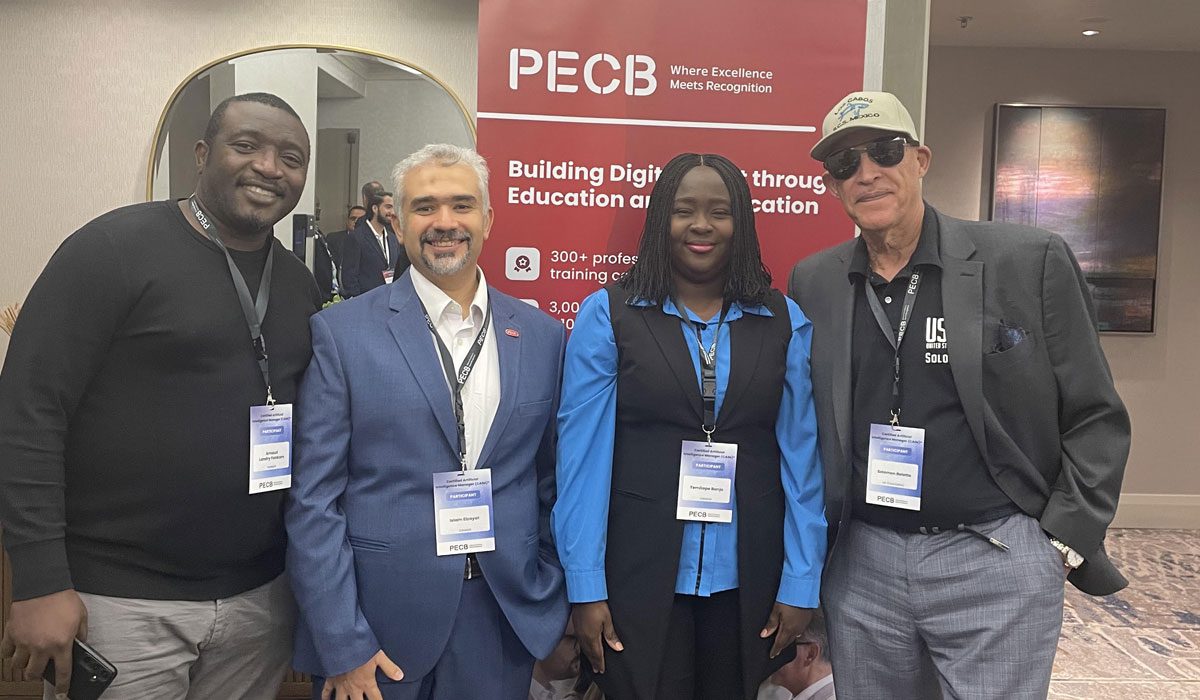
USAFI’s participation in PECB-certified Artificial Intelligence Management training in Toronto reflects the growing international interest in developing professionals who can understand both the opportunities and risks associated with AI.
One important reference point is ISO/IEC 42001, the international standard for Artificial Intelligence Management Systems. It provides a framework for organizations seeking to establish, implement, maintain and continually improve systems for managing AI.
For African institutions, AI governance is becoming increasingly relevant as artificial intelligence expands into education, healthcare, financial services, government, agriculture and private enterprise.
The challenge is not simply technological. Organizations also need professionals who understand governance, risk management, accountability, transparency, data protection and responsible implementation.
For developing economies, building this combination of technical and governance expertise could become an important component of long-term digital development.
Cybersecurity and organizational quality
The partnership also addresses professional areas beyond artificial intelligence.
Training pathways associated with PECB include ISO/IEC 27001, which focuses on Information Security Management Systems, and ISO 9001, which provides a framework for Quality Management Systems.
These areas address practical institutional challenges. As organizations increasingly depend on digital systems and data, information security has become an important element of organizational resilience. Similarly, quality-management systems can support more consistent processes, accountability and service delivery.
Professional pathways that include foundation-level programmes as well as Lead Implementer and Lead Auditor tracks may provide opportunities for students, young professionals, managers, technical specialists, organizational leaders and auditors to develop specialized competencies.
The effectiveness of such programmes, however, will ultimately depend on how well professional knowledge can be translated into practical improvements within institutions.
Connecting universities with the workplace
One of the potentially important dimensions of the initiative is its focus on higher education.
Universities remain central to Africa’s long-term human-capital development, but graduates increasingly need to combine academic knowledge with practical professional competencies.
Connecting university education with internationally recognized professional frameworks could provide students with additional exposure to workplace requirements in areas such as AI governance, cybersecurity, information management and quality systems.
For employers, such an approach could contribute to developing graduates who are more familiar with contemporary organizational standards and professional practices.
At the same time, professional training should complement rather than replace university education. The most sustainable approach is likely to be one in which academic knowledge, practical skills, local experience and international standards reinforce one another.
From individual certification to institutional transformation
The value of professional certification should ultimately be measured by more than the number of certificates issued.
AI-management expertise, for example, can contribute to stronger governance and risk-management systems. Information-security training can help organizations identify and manage digital risks. Quality-management expertise can strengthen organizational processes and service delivery.
This creates a potential connection between individual career development and institutional performance.
For African countries seeking to strengthen their digital economies, the development of such professional capacity could support both public and private institutions. However, accessibility, affordability and local relevance will remain important considerations.
International standards are most effective when they are adapted to real organizational circumstances and supported by professionals who understand the local economic and institutional environment.
A two-way Africa–North America learning bridge
The emerging USAFI–PECB cooperation also highlights a broader question: how can professional education contribute to stronger Africa–North America relations?
Knowledge exchange should not necessarily be viewed as a one-directional process in which expertise moves from North America to Africa. African universities, businesses, governments and professionals also possess valuable experience in working within diverse, rapidly changing and resource-constrained environments.
A meaningful professional-learning partnership can therefore create opportunities for two-way exchange.
For African institutions, stronger access to international professional networks can expand opportunities for skills development, certification and collaboration. For North American institutions and professional organizations, engagement with African partners can provide opportunities to understand emerging markets, local innovation and the continent’s evolving professional landscape.
Turning training into measurable outcomes
The long-term success of initiatives of this kind will depend on their ability to move from training programmes to measurable institutional outcomes.
This includes understanding local workforce requirements, developing accessible learning opportunities and ensuring that professional knowledge can be applied within universities, businesses and public institutions.
It will also be important to evaluate outcomes beyond participation numbers. Indicators such as employment opportunities, institutional improvements, stronger cybersecurity practices, improved quality systems and responsible adoption of AI could provide a more meaningful measure of impact.
For universities, partnerships that connect academic learning with professional standards could help strengthen the transition from education to employment. For organizations, they could contribute to building workforces capable of responding to technological and regulatory change.
Toward stronger professional cooperation
The USAFI–PECB partnership represents one emerging effort to connect African institutions and professionals with international expertise in areas that are increasingly important to the global economy.
Its significance extends beyond professional certification. At its most effective, professional learning can become a tool for strengthening institutions, improving workforce readiness and supporting responsible technological development.
Africa’s digital transformation will require investment not only in technology and infrastructure but also in people, institutions and governance systems.
The development of professional capacity in artificial intelligence, cybersecurity, information security and quality management can form part of that wider effort.
The next stage will be to ensure that international professional knowledge is accessible, locally relevant and translated into practical solutions. If that connection can be achieved, partnerships between African and North American professional networks could contribute to a deeper form of cooperation - one based not only on training, but on sustained knowledge exchange, institutional development and shared economic opportunity.
About the Author