

Beyond Controversy: Continuity, Revival and the Renewal of an Ancient Intellectual Legacy of Nalanda University
Introduction
The issue of restoration of Nalanda University is an exceptional case in the sphere of contemporary higher educational institutions. On the one hand, the legitimacy of a new university mostly depends on its present-day educational and research work. On the other hand, Nalanda is characterized as one of the leading centers of higher education in pre-modern Asia. In order to be legitimate, the New University should both grow and interpret what being the successor of ancient Nālandā Mahāvihāra means. The issue of interpretation becomes even more important in the light of accusations concerning the interpretation of the traditions of Indian and Buddhist knowledge, the causes of destruction of ancient Nalanda, and the academic atmosphere of particular students of the University in the sphere of social media. This accusation was based on an indirect statement made by a student. It was refuted by another student who claimed that it was not realistic and there were always different interpretations in classrooms. From this perspective, the accomplishments of the year have to be judged independently. Indeed, the internal documents from the University show that there has been tremendous progress regarding students, faculty, programs, and centers, including innovations such as the requirement of the course on “Nalanda Spirit”, Shastrārtha methodology, research centers, engagement of the local community, linguistics, and support sustainability programs. The central message of this report lies in the statement that it is necessary not to understand continuity with ancient Nalanda as an effort to replicate the Mahāvihāra of the 5th to 13th centuries in the 21st century. Rather, it can be understood as an effort to revive certain features of inquiry and education such as pluralism in inquiry and debate, international education, multilingualism in research, transregional knowledge networks, and socially engaged education.
Recently Raised Allegations and the Importance of Academic Methods
And precisely for these reasons is this recent issue so important. Among other things, the allegations raised on social media, from the conversation allegedly held between the students and certain academics in the university, are that some of these academics have suggested theories regarding the destruction of Nalanda, interactions between Hinduism and Buddhism, origins of debating methods, dating of Upaniṣads and Buddhist Śūnyatā and Advaita Vedānta. In addition, this allegation also mentioned that there was an unfair representation of all the traditions within academic research. This continues to remain an allegation from a secondary source. One of the present students too has questioned this perception of the university classroom.
The historical questions that are at stake in the controversy are indeed scholarly questions that can't be proven through assertion on social media. For example, while there are differing dates for different Upaniṣads in modern scholarship, the dates of the classical corpus of the Upaniṣads are dated differently in Oxford scholarship, which dates the classical corpus of the Upaniṣads from 800 BCE to 100 CE, but according to another Oxford summary, the early Upaniṣads are dated 900-300 BCE. It would be quite wrong academically to talk about the corpus of Upaniṣads being “post-Buddhist.” Similarly, the tradition of Advaita Vedanta cannot be considered as something that was invented only to counteract the Śūnyatā of Buddhism. The early medieval tradition of Śaṅkara's Advaita Vedanta was formed in a philosophical context where the interaction with Buddhism was very possible. However, Advaita Vedanta tradition refers to the Upaniṣads, Brahmasūtras and Bhagavadgītā as its sources of non-dualistic teachings, and Śaṅkara perceives himself as a scholar who has merely codified a tradition rather than invented it. Debate in philosophy wasn't reserved for any religious tradition either. Scholarly study of the field of Nyāya has revealed philosophical debates between Brahmanical and Buddhist philosophers.
The ancient Nalanda was certainly the case of the Buddhist Mahāvihāra, but the presence of the institution itself did not indicate its intellectual isolationism. According to UNESCO, the intellectual environment of Nalanda involved interaction with the contemporary knowledge systems, and the description of the ancient Nalanda syllabus includes not only Buddhism, but also grammar, logic, medicine and other Indian knowledge systems as well. The destruction of Nalanda calls for the same level of consideration. Though the description of UNESCO contains the information about the sack and desertion of the institution in the thirteenth century, it does not combine all the information on the destruction of the monastic institution into one sentence related to one individual. The destructive military expeditions to the major Buddhist institutions in Bihar took place during the Turkic conquest period, but there is an ongoing discussion concerning the chronological order of events, identification of particular sites mentioned in literature and violence/decline association. Hence, neither the denial of the destructive military expeditions, nor the mono-causal explanation of events meets the highest standard of history writing. And here the commitment to Vāda, to the primary sources, archaeological material, epigraphy and historiography becomes significant.
Emergence as a Broader Academic Ecosystem
Quantitative expansion is the first major change that has been observed in the uploaded document. This particular document mentions the expansion in the number of students from 250 in 2024 to more than 1,000; increase in the number of nationalities involved in the admission process from 36 to 79; increase in the number of faculty members from 20 in 2025 to more than 60; 36 additional faculty members; increase from 12 to more than 20 classes; and increase from reportedly non-functional three research centers to six centers. Some of these numbers have sufficient context in and of themselves. As mentioned in Indian Express in June 2025, Nalanda had grown from just 12 students when it was started to 1,270 students overall through various courses, and its regular classes had 402 students where 224 students were international students from 21 countries. In the consular notification of the Government of India for the 2026-27 admission cycle, there has been a description of the university with more than 1,200 students, out of which 637 were international students from more than 22 countries.
The differences among the particulars of the individual show the importance of a methodology-related issue that should be taken into account: “total students”, “regular students”, temporary students, online students and applicants cannot be mixed up. At the same time, there is no doubt that the case in question proves the necessity of a substantial rise in academic activities. The planned recruitment of 36 faculty members becomes particularly important in this connection. While it may be possible for a university to construct its facilities rather quickly, its intellectual resources will be contingent on the availability of the faculty members and their scholarly activities, high-level teaching and the depth of their subject matters. The constant advertising of the University for recruiting the faculty members in history, archeology, philosophy, economics, Hindi, international relations, Buddhism, and others become pertinent in this connection although the exact figure of the faculty members can only be found by auditing the records of the University. This becomes pertinent to the Nalanda Project in the sense that the prestige of the ancient Mahāvihāra was contingent on the existence of the scholars rather than the buildings.
Heritage Interpretation and the Tourist-Guide Programme
It was found that sixty tourist guides were trained in Rajgir, Gaya Ji and Nalanda, including material in English and Hindi on the history of ancient Nalanda. It was stated that the purpose behind this exercise was to bring the historical interpretation from the university classroom level to the mass audience visiting the place. This could be an important element of public scholarship. Nalanda not only has the character of an archaeological site but that of a civilizational symbol, tourist destination and modern educational institution. Thus, it could be that the training of local guides could be an effective medium of connecting the academic research with public history. But it should be ensured that any kind of program in public history should be based on very stringent standards of evidence because the guides provide a simplified version of the history to the visitors. Particularly, where there exist historiographic debates on the matter of end and destruction of Nalanda, it is essential for the University to clarify to the visitors what is archaeological evidence, what is contemporary evidence and what is traditional and what is the interpretation.
The “Nalanda Spirit” as a Common Intellectual Foundation
One of the most important programs mentioned in this document is the mandatory course Nalanda Spirit. The main idea of this course is to introduce students from different disciplines to the tradition of learning of Nalanda, tradition of knowledge of India, sources, archeology, inscription, classic texts, historiography, and Vāda. The program has become not only an aspiration but reality. In the published curriculum of Economics (2026-28) by Nalanda, the program Nalanda Spirit has become one of the mandatory courses within the credit framework along with Śāstrārtha/seminars. Vision of "Nalanda Spirit" according to Nalanda University is the following: openness, dialogue, sustainability, co-existence in the world and interaction with the neighboring community. Scholarly value of the course in question lies in its teaching method. If it becomes a narrative that students should only repeat, it will contradict its own scholarly tradition which it attempts to restore. However, if it teaches students to compare inscriptions with chronicles, archeology with literature, Buddhist texts with Brahmanical and Jain texts, colonial history writing with postcolonial criticism and Indian scholarship with international scholarship, it may well become a very useful course in history and historical methodology.
I have also been receiving extremely encouraging responses from my past students who are presently studying at Nalanda University and found the Nalanda Spirit course and the lectures of Professors of the University quite interesting. The introduction of such a course is definitely a great idea, and it is essential to study the course and then form an opinion regarding its intellectual approach. For those who are skeptical about the course, it is suggested that they take the help of the official website of Nalanda University and listen to the actual lectures to find out what was said. It is absolutely fine to criticize any academic course, but it has to be backed up by proper evidence. In view of the recent scandal caused by accusations, it becomes all the more necessary to introduce the Nalanda Spirit course.
Decolonization Through Curriculum
Nalanda University has initiated several programs at Masters level in subjects like Hindi, Sanskrit, Mathematics, Economics, and Science and Technology Policy Studies and the broad program of Nalanda is making the Indian traditions conform to the modern subjects. Some independent studies reveal that there has been a considerable expansion in the curriculum. In 2025, four new post-graduate programs have been introduced in Economics, Hindi, Mathematics, and Philosophy, which make the total number of post-graduate programs to twelve. In 2026, on the official admission form, various programs in Buddhist Studies & Comparative Religions, Hindu Studies, Historical Studies, World Literature, Ecology & Environment, Sustainable Development & Management, International Relations, Archaeology, Economics, Mathematics, Hindi, and Philosophy were listed. This is where the contemporary university re-enacts and does not mimic the ancient university of Nalanda. The disciplines of mathematics, economics, policy making, and sustainability constitute the structures of the modern disciplines. However, what remains continuous is the notion that knowledge must not be compartmentalized intellectually. The most appropriate means of achieving “decolonization” in such cases is neither to exclude the knowledge from Europe or the modern world nor in the extension of the knowledge repository, from Kautilya in modern political economy, from classical Indian mathematics to modern mathematics, from Indian linguistic philosophy to modern linguistics, from Indian ecology to climate science.
Śāstrārtha, Debate as Pedagogy
The revival of Śāstrārtha, which can be considered as the classical method of engaging in intellectual debate through structured debate, with its roots in an interdisciplinary event with participation from more than 200 students, followed by institutionalization into the curriculum and assessment process in 2026-27 onwards. One partial justification for this is visible in the existing curriculums. For example, in the Economics course for 2026-28, there is a clear indication of allocation of 4 credits to Seminars/Śāstrārtha component. Previous university-level events have shown inter-school debates on topics pertaining to sustainability, language, ethics and conflict between traditional and modern approaches. This could perhaps mark one of the best examples of genuine continuity of Nalanda Spirit. President Droupadi Murmu, while speaking at the convocation ceremony of the University in March 2026, has herself highlighted openness to various ideologies and debate/dialogue as the distinctive features of Nalanda in ancient times. For Śāstrārtha to move beyond the status of a symbolic representation of heritage, it needs to be evaluated on the basis of evidence, correct representation of the opposite point of view, reasoning, use of primary sources and capacity to switch sides due to better arguments.
Nalanda Tradition and Languages Series
One more manifestation of the reorientation of the University is the publication of its new Nalanda Tradition and Languages series beginning with Hindi in January 2026. As the uploaded document shows, language is considered both as a tool of communication and as a carrier of cultural memory and thought. The mentioned initiative is included into the University’s list of important academic accomplishments in April 2026. From the purely academic perspective, there are many reasons why it makes sense to treat language in such a way. There is a huge philosophical, historical, scientific, and literary legacy of India which cannot be simply translated into other languages. Many concepts from Sanskrit, Pali, Prakrit, Tibetan, Persian, and modern Indian languages have certain connotations which cannot be properly conveyed through literal translations into English. However, the historical experience of Nalanda teaches us that the decolonization of knowledge cannot be linguistic isolationism. The success of ancient Nalanda was based exactly on the exchange of ideas in different languages and across different frontiers. Therefore, the most appropriate strategy for the University would be multi-linguistic, rather than mono-linguistic: development of Indian languages along with the work with other Asian and world languages.
Anubandha-catuṣṭaya and the Recovery of Indigenous Methodologies
The Symposium on Anubandha-catuṣṭaya to be held this March 2026 at the University is an attempt to revisit the classical model based upon the perspective of the learner, the object of knowledge, the relationship of the knowledge to its method, and the purpose of dedication of the text or discipline. This is to emphasize what perhaps is one of the most intellectually rigorous aspects of the project of Decolonization: Not just an addition of Indian content into the unchanged university system, but the consideration of whether there would not be alternative modes of thinking within the intellectual traditions of India itself. This is a particularly difficult task for scholarship. Whereas classical concepts cannot be worshipped or viewed as relics of the past, they need to be philologically reconstructed, compared with other systems of knowledge, and examined in terms of their explanatory value.
Kautilya Global Centre for State Capacity
The Kautilya Global Centre for State Capacity is designed to make connections between classical Indian insights into governance and issues of current public administration and institutional effectiveness and capacity development. The document states that the Arthaśāstra, Thirukkural and history of Indian administration are utilized to develop an indigenous yet global perspective on governance. The Centre has already moved from conception to reality. It was formally established in May 2026 after the third convocation of the University, and in all public debates since then state capacity, coordination of institutions, innovation and knowledge exchange between South countries became the main focus of discussion. The Centre serves as a good example of reimagining. A twenty-first century institution should not use the Arthaśāstra directly in its analysis of modern democratic administration. It could, however, subject Indian statecraft theories to the same comparative scrutiny as Weber’s theory, public choice theory, institutional economics or modern governance literature.
New Research Centers and South–South Cooperation
Centre for Southeast Asian Studies and Centre for Rural Economy and Sustainable Transformation in the Global South as the two new institutes that will act as pillars in engagement with the region and the Global South respectively. The Southeast Asian institute is particularly linked to history. Prime Minister Narendra Modi launched the Center for Southeast Asian Studies during the 22nd ASEAN-India summit held in October 2025. The institute was later inaugurated at the convocation ceremony held in March 2026 of the University. In the context of historical perspective, the Nalanda network has been trans-Asian in nature. Although Chinese pilgrims such as Xuanzang and Yijing have been major transmitters of Indian Buddhist knowledge, thoughts and concepts coming out of the prestigious Nalanda have traveled all the way to Tibet and into Southeast Asia. Thus, collaboration with ASEAN organizations is not just symbolic in nature, but will also lead to the revival of the historical tradition of Nalanda being an interface between India and Asia. The Centre for Rural Economy and Sustainable Transformation in the Global South (CREST) plays the same role but in the realm of rural development and transformation in the Global South. The success of CREST needs to be judged on the basis of its research, experiments, data collection and publications in peer-reviewed journals.
Restoring Vāda and Ṭīkā to Teaching and Assessment
Nalanda University tried to revive the tradition of Vāda (Reasoned Intellectual Disputation) and Ṭīkā. It is significant from the theoretical point of view. While modern institutions of higher education might boast of promoting critical thinking skills, the means used by them for assessing these skills include lecture, examination, and reproduction of an existing viewpoint. Traditions of Vāda and Ṭīkā offer good examples of other ways: in order to criticize something, one has to understand it; in order to make a commentary, one has to analyze the text before interpreting it. However, these two methods should not be considered exclusively Buddhist or Hindu. There were long traditions of disputation among Buddhist, Jain, and Brahmanical schools in Indian classical philosophy. Research done in the field of Nyāya philosophy shows that arguments were developed as a consequence of an interaction between various schools of thought.
Sahabhāgitā: Reconnecting the University with Its Neighbourhood
Possibly, the most socially focused initiative is Sahabhāgitā. This project was launched in July 2025, and it creates connections between the university and nearby villages through agriculture, schools, women’s livelihoods, and the localization of Sustainable Development Goals. This project covers such aspects as organic farming, composting, education, career support, teachers’ training, Bawanbooti weaving, embroidery and women’s self-help group supported by the University. More than fifty activities have been mentioned and conducted in nearby villages like Pilkhi, Mahadeva, Jatti, Kubdi, and Mahualla. The creation of Sahabhāgitā SamVāda and participation of five villages since July 2025. Later on, it is written about the creation of Nalanda University Self-Help Group for women, working with farmers, visiting schools, teachers’ activities, and sustainability education. This project raises a very crucial issue concerning the nature of contemporary universities – whether they have the right to discuss their civilizational significance if they themselves are socially isolated from the communities around them. The traditional monastic learning institutions were integrated into patronage systems, pilgrimage economies and societies. However, the present-day reality is quite different and the project of Sahabhāgitā makes us rethink the idea of a university as an institution which is not only located within a certain community, but is also socially responsible to it.
LEAP: Access, Self-Reliance and Experiential Learning
LEAP (Learn, Earn, and Pioneer) is a form of financial assistance programme for students along with their participation in various activities within the University, which include such areas as technology, horticulture, library, sustainability, and wellness systems. In the internal document, the idea of the programme has been interpreted using the idea of ātma-nirbhartā, looking at the programme not only as a financial assistance but also as experiential learning. It can be seen from the existing University student portal that LEAP is running in all the Schools of the University. The idea has academic significance beyond the immediate context. Those Universities that care about equality have come to realize that financial deprivation not only makes it impossible for the students to pay their tuition fee but also deprives them of participating in other academic experiences. The programme can solve the problem if designed in a way that it will allow students to be of help to themselves and participate in academic activity without being made cheap labour.
Nalanda Cultural Centre and the Pluriversal Campus
The Nalanda Cultural Centre has been established as a student-centered forum for musical, theatrical, meditative, dancing and other types of performance arts, as well as artistic and cultural festivals. This also applies to cultural events that take place during the national holidays and cultures of the international student population of the University. The speech made by the University’s Vice Chancellor in August 2025 regarding Nalanda International Cultural Centre referred to it as “a living laboratory,” that will seek to integrate music, theatre, storytelling, crafts, ecology and knowledge of nature, together with student clubs that specialize in debate, poetry, photography, expeditions and many other activities. The above issue is especially important in relation to Nalanda’s historical cosmopolitanism. There is no reason why civilizational self-confidence and international openness cannot go hand in hand. What distinguished the ancient Nalanda University was the fact that the Indian knowledge tradition was intellectually rich enough to bring students from abroad. A new Nalanda should remain as much connected to India as welcoming to the Vietnamese, Bhutanese, Sri Lankan, African and European cultures, etc.
Nalanda Development Dialogue and a Global South Perspective
The first Nalanda Development Dialogue that took place in March 2026 had the objective of creating an environment where scholars, policy makers, and practitioners would study the subject of development using theories based on perspectives from India and the wider Global South. There is a record of this event in the university’s official journal published in April 2026. This can be described as an innovative perspective on the relevance of Nalanda in the world today. In the ancient past, the Nalanda used to be a center within which scholars and ideas were exchanged among India, Tibet, China, Southeast Asia, and other parts of the world. The current Nalanda University does not have to be the same kind of scholarly network of Buddhism; it could be a network that facilitates the production and exchange of knowledge regarding development between the countries of Asia, Africa, and Latin America. This idea would become intellectually stimulating if the “Global South” itself is not homogenized. The experiences of development in India, Southeast Asia, Africa, and Latin America are distinctly different from one another.
Dharma and Global Ethics
The international conference that was organized in November 2025 on “Dharma and Global Ethics: Lessons from the Indian Intellectual Tradition” is an example of the way scholars and policy makers have come together to discuss the possible role of the intellectual traditions of India in dealing with the present-day problems related to ethics, society, and sustainability. According to the information from the University, the conference took place on 28 November 2025 and dealt with questions of Dharma, Lokasaṃgraha, sustainability, ethics, and Asian civilizations’ traditions. Here, the question of revival can be seen not in antiquarian terms, but rather in terms of conceptual renewal. The academic task in this case is not about replacement of Western ethics with Dharma but about the equal participation of new concepts from Indian traditions in global ethical discourse. Programs on Rāja Ṛṣabhadeva in connection with Jainism have also played a significant part because the intellectual tradition of ancient Bihar has never been limited to one tradition. Modern Nalanda must have this intellectual potential.
India Think Tank Forum and Civilizational Resilience
In January 2026, the University held its eighth India Think Tank Forum, where the topic of discussion was India in the Changing World with special emphasis on “inner resilience.” As per the document that has been uploaded, there is an increasing trend of formulating policies on the basis of intellectual traditions which may not always place the Western paradigms as the default universal stance. The event is also included in the important events list of the year 2026 at the University. The importance of the event lies in bringing into context the study of the humanities and civilizations along with the issues of policy today. It was through this interface between philosophy and ethics, logic, governance, medicine and society that the tradition of the ancient Nalanda gained respect intellectually. The same is true of its revival.
Convocation, Internationalism and Symbolic Institutional Culture
There is yet another instance of institution rethinking through the convocation rituals of the university. In this document, there is a mention of the second convocation that took place on 31 March 2026 and then comes the convocation ceremony of the next graduating class which is understood in some sense through the requirements of the international students of the university. Furthermore, Viśvamitrālaya and the usage of Bhagalpur Tussar or “peace silk” in the academic gown are pointed out as examples of establishing a link between the university ritual and the local craftsmanship through the concept of ahiṃsā. The Second Convocation ceremony itself is very well-documented. President Droupadi Murmu attended the ceremony on 31 March 2026 and talked about the fact that the ancient Nalanda was open to different ideas and dialogues. More than half of the students in the graduating class of 2026 are international ones coming from more than thirty different countries. Another aspect of the ceremony was the inauguration of a new auditorium named 'Viśvamitrālaya' which has a capacity of 2,000 seats. Third convocation was conducted in the month of May 2026 and in this convocation 221 students from 14 different nations were awarded their degrees. This ritual is important because the internationalism of Nalanda is part of its legacy. Without internationalism in Nalanda, the institution will lose one of the most essential parts of its legacy if it is recreated in the modern times.
Net-Zero Nalanda and Ecological Reimagining
The issue of sustainability is another one that consumes much of the attention in Nalanda University. Examples of such include fossil fuel vehicle use restriction, distribution of over 200 bicycles, student involvement in mushroom cultivation and fish farming, as well as sustainability expansion into executive education programs. Environmental issues in Nalanda University have been long-standing prior to the past year and are an integral part of the architectural infrastructure of the university. The permanent campus of the university operates on solar power generation, wastewater harvesting, water processing, water bodies, and the Net-Zero design approach. In October 2025 Nalanda University has introduced battery-powered vehicles in order to transition from dependence on fossil fuels to fossil fuel-free mobility options. The attempt to connect the approach to the ecological tradition of India is conceptually justified, although should remain a part of analytical reasoning rather than purely rhetoric. The idea of the Net-Zero concept is a contemporary way of climate policy formulation and utilizes contemporary calculations of emissions, energy consumption, and resource flow. Indian philosophical tradition may provide certain ethical guidance on restraint, interconnectedness and relation of the human to nature; however, this should be complementary to environmental science.
Assessing the Claim of Intellectual Decolonization
Overall, all of the activities during 2025-26 seem to suggest an effort made by the University to develop its own intellectual identity. The document that has been posted here talks about the phrase “Decolonization” repeatedly in connection with the above process. But for an international university like ours, Decolonization can never mean just a replacement of one dogmatic intellectual system with another. It is so because even the Nalanda tradition does not support such a process. Its importance lies in the fact that it developed because of the competition between various schools, mobility of the scholars and dialectical thought. So, an intellectually sound process of Decolonization at Nalanda requires four points.
The first one is that of source recovery, whereby there will be increased use of sources written in Sanskrit, Pali, Prakrit, Tibetan, Persian, Chinese, and other regional languages rather than the interpretation of those sources through colonial or contemporary English language. The second is that of epistemological pluralism in terms of Indian categories of reasoning, ethics, statecraft, economics, ecology and pedagogy and these ought to be explored and challenged dominant Western theories. The third is that of critical reciprocity, whereby indigenous traditions have to be examined and critiqued just as much as the western ones. Decolonization cannot pretend to be academic if all it does is to turn the tables. Fourth is that of Vāda in that different interpretative traditions have to be acknowledged and brought into place. Students have to be exposed to the best arguments of the opposing school of thought and not any straw-man arguments against it. This takes form in practice through the curricula at the university level whereby there are modules on historiography, historical methods, Asian historiographical traditions, Itihāsa-Purāṇa tradition, Marxist and Subaltern historiography and different theories of the destruction of Nalanda.
What the Recent Controversy Should Lead To
These latest accusations cannot be simply brushed aside simply on the basis that they emanated from social media or that they originated from a student; universities require a better quality of evidence. Radical academic transparency is the way forward. The course descriptions, reading lists, research profiles of the professors as well as the academic goals of Nalanda Spirit courses should all be publicly accessible. For issues regarding the past that remain controversial, the syllabus needs to include the main scholarly positions alongside the sources that support them. Guests should be seen as academic interventions, and not as official policies of the university. There must be encouragement for students to engage in dialogue with the guest speaker. In a situation where a student feels that a particular position has no historical legitimacy, there must be a scholarly debate in which the student is able to present his evidence without any fear of being retaliated against. This will ensure that the controversy becomes the kind of debate or Śāstrārtha that Nalanda University wishes to recreate. The best possible response to accusations of intellectual bias is certainly not counter-accusations by the institution. It is an environment in which propositions can withstand evidence.
Revival of Ancient Indian Intellectual Tradition
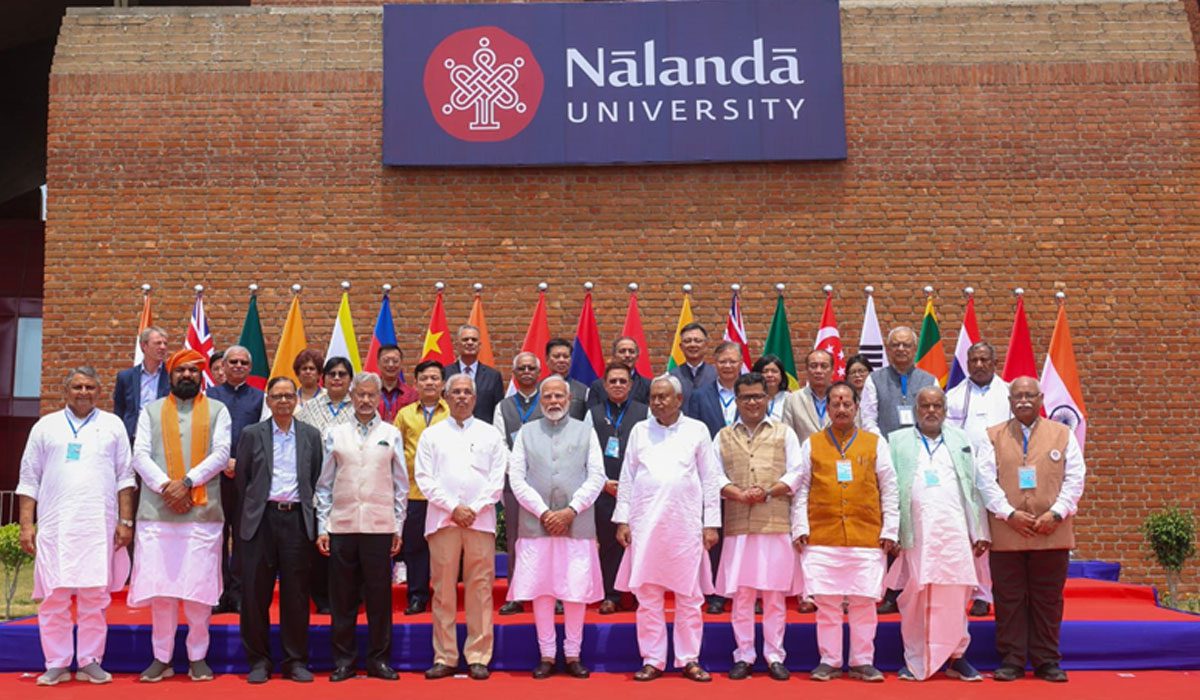
The Ancient Nalanda Mahāvihāra and the Nalanda University are two distinct historical entities. The fact is what has to be kept in mind when dealing with a case that is academically sound. As per UNESCO, the ancient ruins represent the archaeological remnants of a monastic and scholarly establishment which was prevalent since around 3rd century BC to 13th century AD, with the process of teaching knowledge being sustained for several centuries. According to UNESCO, the impact that the Nalanda Mahāvihāra had on the subsequent ones in South and Southeast Asia, along with pedagogical practice through discourse and debate also remains intact. On the other hand, the Nalanda University was established as per the Nalanda University Act, 2010. It emerged from extensive discussions held at the East Asia Summit and was created to renew ties between South and East Asia, with the assistance of an international institution, which would deal with intellectual, philosophical, historical and spiritual studies. According to the Ministry of External Affairs, the entire idea emerged from the discussions at East Asia Summit since 2007. Universities are considered international, secular, and autonomous institutions of learning with continental vision. The inauguration of the permanent Rajgir campus of the university on 19 June 2024 became the physical premise for entering into a new era of development of the university. The design of the campus was done through the collaboration between India and other countries who are members of the East Asia Summit, and Net-Zero strategy was chosen based on the use of solar energy, water recycling, and many water bodies. Therefore, revival should be considered from three interconnected perspectives. Continuity implies values and approaches that can be realistically associated with the Nalanda of the past times. Revival implies deliberate actions to revive the intellectual approach and civilization linkages. Reimagining implies making them relevant to the modern university working in the modern academia and science research.
To sum up
There is enough data which proves that Nalanda University has been witnessing a major transformation since 2025-26 in terms of growth in numbers of students enrolled and programs offered, improved focus on recruitment of faculty members, launching of new courses and research institutions, increased focus on international engagement and in the Global South, and initiatives such as Nalanda Spirit, Śāstrārtha, language courses, Kautilya Centre, CSEAS, Sahabhāgitā, LEAP and Net-Zero campus initiatives which indicate efforts to have a distinct identity as compared to a typical postgraduate university. Moreover, Nalanda University has received both independent recognition on a national as well as an international platform. According to President Droupadi Murmu’s speech of March 2026, the greatness of ancient Nalanda lied in its openness to different ideas, reasoning, empathy, debate and dialogue. Even Prime Minister Narendra Modi spoke about the need to awaken and live the 'Nalanda Spirit'.
Yet the measure of revival should not simply be symbolic in nature. The ancient Nalanda attained the status of being known as such due to all these years of having been considered as a place for learning by scholars from all across Asia. This modern university would be judged according to the same standards – namely, the quality and freedom of faculty, productivity of research, publication, student body, use of sources, freedom of thought, relations between the international community and the willingness to consider even difficult questions. Thus, in this respect, these allegations would be both a challenge to the reputation of the University and a great intellectual opportunity. As allegations like these present exactly the kind of question to which the University needs to give an answer: how to continue living up to a tradition of inquiry? The answer should not be found either in avoiding the controversy, or in accepting unverified accusations. It should be in living up to the intellectual tradition of inquiry that the University seeks to restore – Vāda, sources, textual criticism, interpretation and correction.
From such an angle, the idea of the contemporary Nalanda should not pursue any reproduction of the ancient institution, because it would be nothing but an attempt to imprison one’s memories in stone. The task of the modern project is to revive the intellectual confidence that allowed the existence of the Mahāvihāra, but at the same time, it has to be open for the world with which the ancient institution had built up its connection. It means that the relationship between the two is to be understood only from the point of continuity through reimagination. In recent years, the Nalanda University has presented several signs of progress concerning admissions policy, courses, and the attractiveness of this option for foreign students who study in India. The success has to be praised, but it is necessary to remember that criticism is welcome. The revival of the Nalanda University has to mean the revival of the integrity of intellectuals, discussions, and education. It includes respecting all the traditions and evaluating an institute or a teacher based on the facts.
Based on the above facts, one may argue that events of the last year constitute significant moves toward formation of such a university. First of all, the size of the expansion is impressive; secondly, incorporation of Indian traditions of education in curriculum and educational approach is sufficiently extensive; thirdly, resurrection of the institution of debate is particularly encouraging; and fourthly, the combination of internationalization, engagement with the local community and ecological sustainability is a promising attempt at interpreting the legacy of Nalanda for the new millennium. The true challenge is to see if these attempts at creating an institution of scholarship will bear fruit. Nalanda is an institution of huge symbolic capital, but at the same time an institution of great scholarly responsibility. Each time Nalanda is cited as the scholarly example, the greater responsibility to emulate the qualities which made it a long-lived institution falls on the University: scholarship without intimidation, tradition without isolation, debate without hostility and research based on facts rather than statements.
About the Author