




Turning Waste into Wealth: India and Norway Join Forces for Greener Construction Technologies
CSIR, SINTEF and Norwegian research partners explore innovative solutions to transform industrial and construction waste into valuable building materials, advancing the circular economy and sustainable development.
India and Norway are exploring new avenues of scientific and technological cooperation to transform industrial and construction waste into valuable resources, opening fresh opportunities for sustainable infrastructure development and environmentally responsible construction.
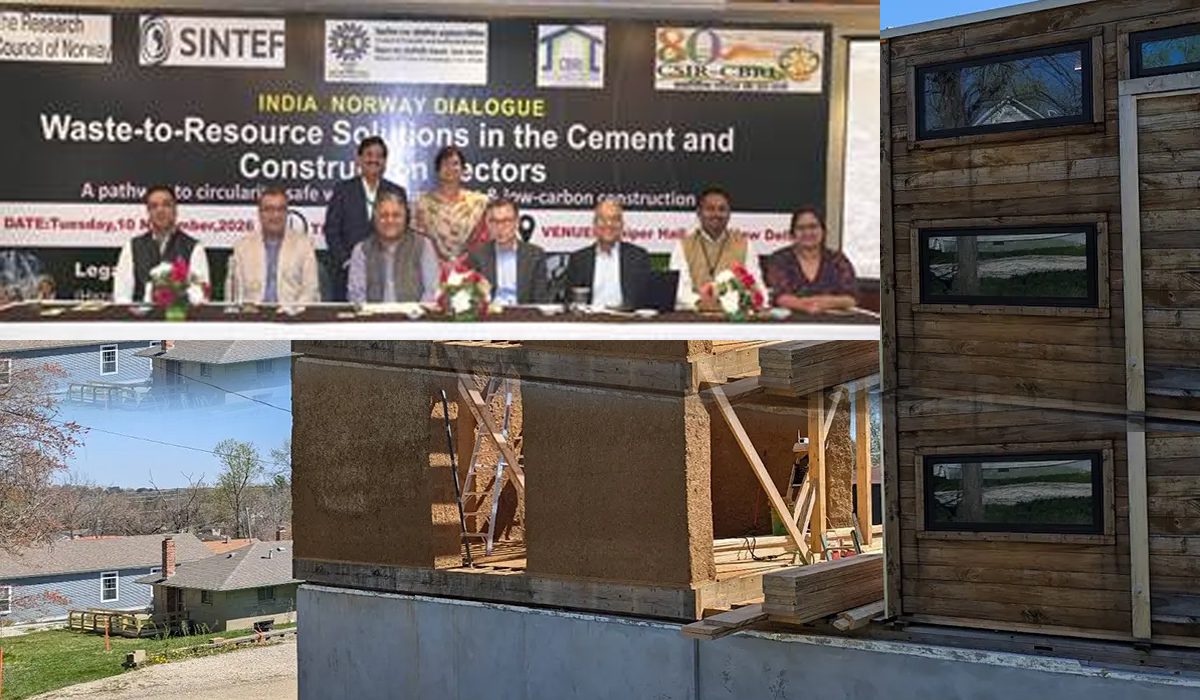
The initiative took centre stage at the India–Norway Dialogue on “Waste to Resource Solutions in the Cement and Construction Sector”, held on 10 November 2026 at the India Habitat Centre in New Delhi. The dialogue was jointly organised by India’s Council of Scientific and Industrial Research (CSIR), Norway’s research organisation SINTEF and the Research Council of Norway.
Bringing together scientists, research institutions, regulatory authorities and representatives from the cement and construction industries, the event focused on developing practical technologies for waste recovery, recycling and resource-efficient construction.
The discussions come against the backdrop of the India–Norway Green Strategic Partnership, established during Prime Minister Narendra Modi’s visit to Norway in May 2026, with circular economy, clean technology and scientific research identified as important pillars of bilateral cooperation.
A major focus of the dialogue was the transition from a traditional linear economic model towards a circular economy, where industrial by-products and discarded construction materials can be converted into useful resources rather than ending up as waste.
Experts explored opportunities to utilise construction and demolition waste, steel slag, fly ash, red mud, copper slag and plastic waste in road construction, geopolymer concrete, specialised aggregates and other value-added construction products.
Another important area of discussion was the environmentally responsible treatment of hazardous waste. Specialists from SINTEF and CSIR-NEERI examined the potential of cement kiln co-processing to treat suitable hazardous materials, including Persistent Organic Pollutants (POPs) and DDT- and PCB-contaminated waste. The discussions highlighted the importance of controlled industrial trials, emission monitoring, appropriate technical standards and regulatory compliance.
Research contributions from CSIR-CRRI and CSIR-AMPRI also demonstrated opportunities to develop innovative construction materials using industrial residues and other waste-derived resources. International experiences in construction waste recycling, including mobile recycling facilities and improved aggregate processing techniques, were also discussed.
Looking ahead, the dialogue identified several priorities for joint action, including developing two to three India–Norway research proposals, launching pilot-scale hazardous waste treatment projects, preparing technical guidelines for contaminated waste disposal and strengthening partnerships between industry and academic institutions.
The initiative reflects a shared commitment to bringing scientific research closer to practical industrial applications. Through technology exchange, collaborative research and innovation, India and Norway aim to advance resource-efficient construction practices and promote a more sustainable industrial future.
The dialogue marks another step in strengthening the Green Strategic Partnership between the two countries, demonstrating how international scientific cooperation can help turn environmental challenges into opportunities for sustainable growth.