




Transformative Agri-Food and Blue Economy Models for National Food Security, Rural Livelihoods, and Sovereign Resilience in Sri Lanka
Abstract
This paper details a comprehensive structural transformation framework designed to transition the national economy of Sri Lanka from short-term crisis mitigation to long-term sovereign resilience. At its core, the study introduces Transformative Agri-Food and Blue Economy Models for National Food Security, Rural Livelihoods, and Sovereign Resilience in Sri Lanka, positioning these combined structures as the primary engines for macroeconomic stabilization. Rather than treating terrestrial farming and maritime systems as isolated sectors, this framework bridges them into a unified policy ecosystem. These models leverage data-driven precision tools across land assets while aggressively unlocking the untapped economic, energy, and protein potential of Sri Lanka’s massive ocean parameters.
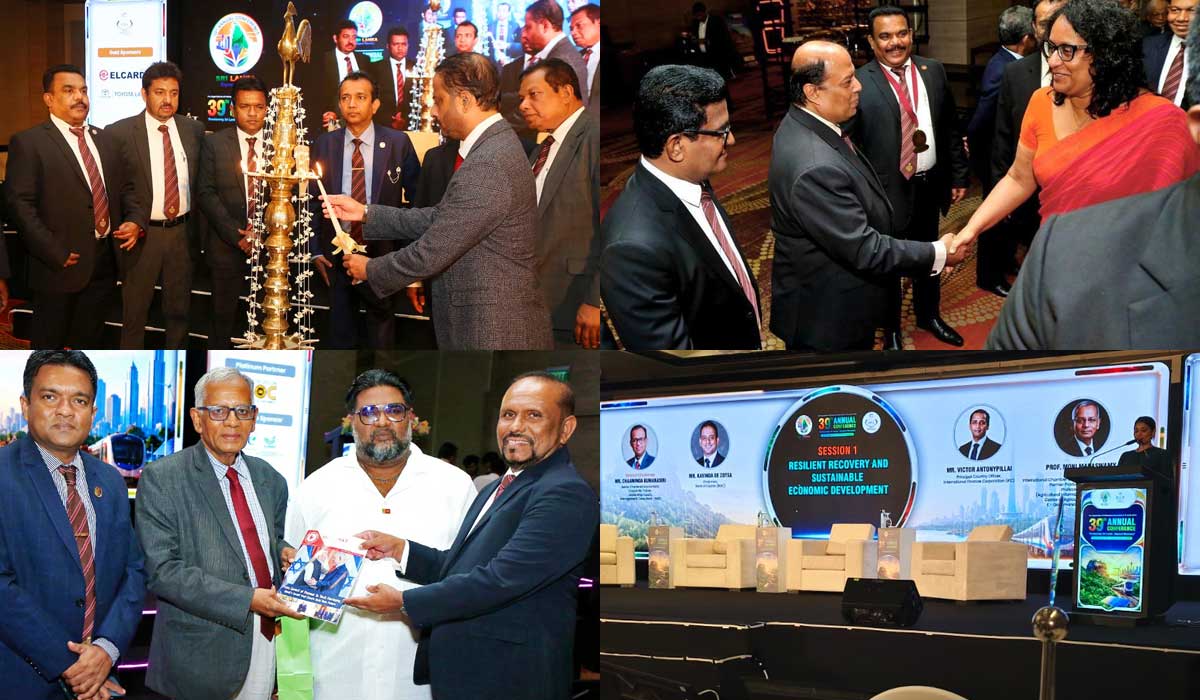
Drawing from the strategic mandates established at the 39th Annual Conference of the Organisation of Professional Associations (OPA) of Sri Lanka under the paradigm "Envisioning Sri Lanka – Beyond Recovery," and integrating the master 10-point architectural roadmap designed by Professor Moni Madaswamy, this study examines the profound productivity mismatches within the primary sector. Specifically, we analyse the structural gap wherein over 30% of the national workforce yields barely 7% of the Gross Domestic Product (GDP).
To rectify this asymmetry, we present an integrated operational blueprint centred on four foundational pillars: Blue Economy Integration, Inclusive Growth, Resilient Baselines, and Technology-Driven Execution. Governed by the One Health paradigm—which asserts that human biological immunity is biochemically bound to soil and aquatic vitality—this framework outlines a scalable path toward national self-sufficiency, digital village commerce, blended asset mobilization, and international leadership in climate-smart infrastructure by the year 2030.
1. Introduction: The Strategic Vision
Socio-economic shocks require a fundamental re-evaluation of national economic design. Traditional macroeconomic stabilization efforts typically prioritize short-term liquidity, debt restructuring, and fiscal consolidation. However, true stabilization cannot be achieved merely by returning to pre-crisis vulnerabilities.
As articulated by Professor Moni Madaswamy and supported at the 39th OPA Annual Conference in 2026, Sri Lanka faces a critical historic turning point. The strategic vision shifts the national objective away from defensive crisis management toward the proactive construction of a resilient, insulated baseline. This framework defines a clear roadmap spanning 2026 to 2030, establishing a future where structural anti-fragility protects national sovereignty against external supply shocks, institutional inefficiencies, and climate change.
2. The Core Strategic Baseline: The 10-Point Master Framework
The structural overhaul of Sri Lanka's primary economy operates through a highly integrated, 10-tiered macro framework designed to systematically guide the nation from basic digital adoption to comprehensive digital sovereignty.
- Strategic Vision: Grounded in Professor Moni Madaswamy's overarching techno economic architecture.
- Correcting Structural Imbalances: Directly addressing the productivity chasm between labour input and GDP output.
- The Digital Agriculture Framework: Deploying the seven specialized programmatic pillars for a data-driven economy.
- The Central Lifeline: Establishing an integrated farm-health telemetry ecosystem driven by the One Health paradigm.
- Academia & STEAM Human Capital: Activating a network of 17 public and private universities to cultivate specialized talent.
- 1,400 Village AgriTech Startups: Creating decentralized computing and innovation edge labs within the heart of rural communities.
- Commodity Networks & Mushnomics: Organizing 9 specialized commodity systems backed by circular, waste-to-wealth energy structures.
- Fisheries & The Blue Economy Engine: Maximizing offshore potential through satellite tracking and Marine Spatial Planning.
- Real-Time Data & Trustworthy Governance: Transitioning public services under the strict mandate of ISO 56002:2019 compliance.
- Global South Leadership: Establishing the ICISA platform to secure blended capital and act as a knowledge beacon for SIDS nations.
3. The Sovereign Agricultural Informatics Paradigm
Agricultural Informatics emerges directly from Agricultural Engineering (AE), Agricultural Statistics (AS), and Agricultural Economics (AgEc) as its core structural base. By synthesizing these foundational pillars with the emerging powers of Data Science and Information Science, Agricultural Informatics transforms domain knowledge in Agriculture and Allied Sectors through Agricultural Sciences into actionable Agricultural wisdom.
Through this integration, Agricultural Sciences becomes a dominant, field-level force—positioned directly alongside the farmer, the farm, the animal, the pond, and the end consumer.
This synthesis creates an active, round-the-clock (24× 7) decision-support ecosystem tailored specifically to the operational needs of small and marginal holders across Sri Lanka. By eliminating topsoil degradation, monitoring real-time ecosystem health metrics at the edge, and scaling low-cost interventions across plant, animal, soil, and aquatic vectors, this integrated framework establishes a sustainable pathway for national resilience. As structured pilot deployments generate the requisite empirical and clinical evidence, Agricultural Informatics provides the definitive operational roadmap to secure food, nutrition, health, and economic security—turning the national vision of Sri Lanka into an edge-verified reality through Higher Education Institutions (17 Public and Private Universities).
4. Diagnosing the Structural Asymmetry: The Primary Sector Gap
The primary structural bottleneck in the domestic economy lies in the extreme misallocation of labour relative to economic output within the primary sector (agriculture and coastal production).
- Workforce Engagement: >30% of the national workforce is tied to primary sector labour.
- GDP Contribution: This massive labour allocation results in barely ~7% of the national Gross Domestic Product.
- Systemic Weaknesses: The sector remains crippled by high post-harvest losses, lack of digitized cold-chain logistics, and severe vulnerability to extreme climate shocks.
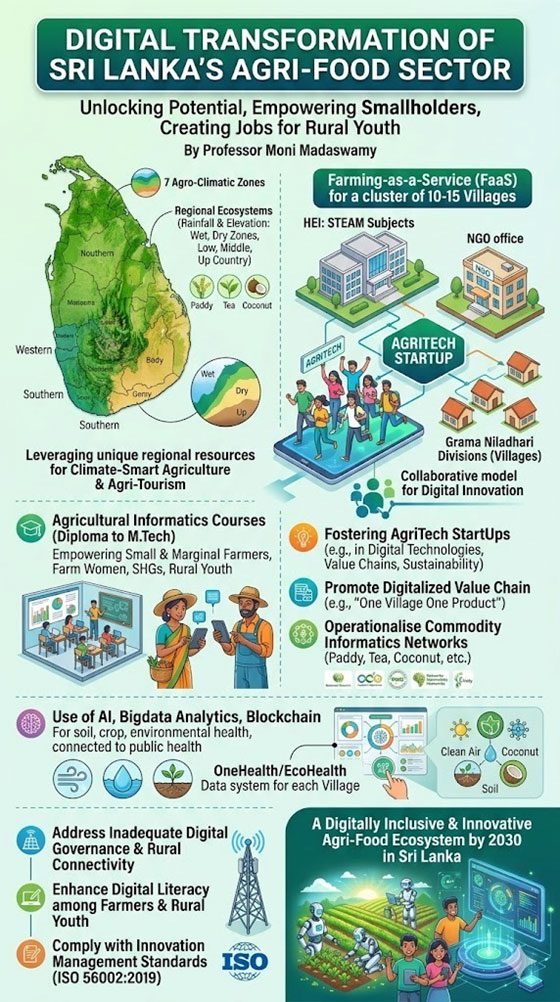
5. Agro-Climatic Intelligence & Regional Resource Optimization
To bridge the primary sector gap effectively, the master strategy moves away from blanket policies. Instead, it introduces precise, data-driven interventions tailored to the natural geography of the island:
- The 7 Agro-Climatic Zones: The framework maps out and codes Sri Lanka’s unique Agro-Climatic Zones, managing them by their specific regional ecosystem profiles. These profiles are defined by unique combinations of rainfall patterns and elevation categories (Wet, Dry, and Intermediate Zones cross-referenced with Low-Country, Mid-Country, and Up-Country topographies).
- Targeted Regional Cultivation: Value chain tracking systems align crops directly with ideal growing conditions (e.g., dedicated optimization zones for Paddy, Tea, and Coconut).
- Dual-Engine Monetization: By matching these distinct regional landscapes with digital connectivity, the framework drives simultaneous development in Climate-Smart Agriculture and regional Agri-Tourism.
6. The Digital Agriculture Framework: Seven Pillars
To transition the agricultural landscape into an automated, highly protected ecosystem, the framework adapts the core architectural principles formulated in the Government of India’s Inter-Ministerial Committee Report on Doubling Farmers' Income (DFI-2018). Tailored systematically for Sri Lanka's rural infrastructure, the strategy deploys seven specialized structural mission modes:
- Digitalized Agriculture: Accelerating the adoption of Artificial Intelligence (AI), automated machinery, Internet of Things (IoT) sensors, and modern tech infrastructure directly within fields to elevate baseline output. Crucially, this pillar is architected as an all-inclusive system covering the country's three structural agricultural realities:
- Irrigated Agriculture: Optimizing water-use efficiency, command area tracking, and automated sluice scheduling grid frameworks.
- Rainfed Agriculture: Deploying precision soil-moisture telemetry, root-zone sensor networks, and adaptive dry-zone agronomy software.
- Tribal Agriculture: Preserving indigenous land knowledge while introducing low-cost, decentralized technical tools, chemical-free input tracking systems, and direct village market portals.
- Digitalized Agro-Meteorological Advisories: Deploying hyper-local weather forecasting grids and micro-climate analytics to insulate producers from extreme weather events.
- Digitalized Agricultural-Resource Information Systems: Integrating advanced geographic information systems (GIS) and spatial planning tools to optimize crop distribution.
- Digitalized Agricultural Value Chains: Establishing direct digital producer-to-market platforms, removing inefficient intermediaries, and eliminating logistics leaks.
- Digitalized Access to Inputs, Finance & Markets: Streamlining rural access to high-quality crop inputs, digital micro-credit lines, weather-indexed insurance, and transparent banking channels.
- Digitalized Integrated Land & Water Management: Monitoring critical environmental resources through tech systems focused on aquifer recharge, watershed monitoring, and soil organic carbon tracking.
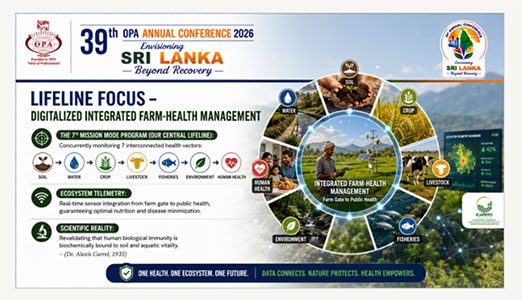
- Digitalized Integrated Farm Health Management System: Serving as the comprehensive baseline programmatic lifeline. This module builds real-time telemetry pipelines to simultaneously manage, track, and remediate 7 core health vectors:
Soil Health -> Water Health -> Plant Health -> Livestock Health -> -> Fisheries Health -> Environment Health -> Human Health (Allopathy + AYUSH)
Note: The Human Health vector systematically synthesizes mainstream Allopathic medicine with AYUSH systems (comprising Ayurveda, Yoga & Naturopathy, Unani, Siddha, and Homoeopathy) to form a unified medical and predictive preventative telemetry grid.
7. The Central Lifeline: Integrated Farm-Health Management
Serving as the strategic centre of the entire architecture, the 7th Pillar establishes a "Central Lifeline" that connects agro-industrial outputs with public safety through a real-time ecosystem telemetry framework:
- Ecosystem Telemetry: Deploying a unified OneHealth / EcoHealth Data System to concurrently monitor the 7 interconnected health vectors established in the framework block.
- Scientific Grounding: Grounded in the One Health paradigm, which recognizes that human biological immunity—whether protected through Allopathy or optimized via alternative AYUSH medical frameworks—is biochemically bound to soil vitality, clean air, and aquatic health (cf. Dr. Alexis Carrel, 1935).
8. Academia, Human Capital, & Decentralized Startups
The technical modernization of the primary economy requires a strong institutional foundation, a highly specialized workforce, and decentralized regional execution.
- University Network Nodes: Activating the network of 17 Public and Private Higher Education Institutions (HEIs) to serve as local operational nerve centres.
- The Global 'GRIN' Revolution: Training STEAM graduates to join the international agricultural technology shift by building core fluencies across four high-tech quadrants: Genetics, Robotics, Informatics, and Nanotechnology.
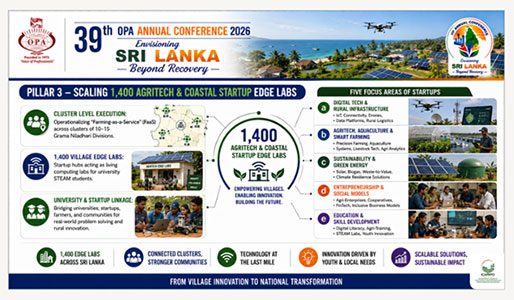
- 1,400 Village Edge Labs: The framework coordinates networks linking HEIs, non-governmental organizations (NGOs), and rural enterprise zones to drive development across 1,400 localized AgriTech Startups, bringing digital innovation straight to the last mile.
- Farming-as-a-Service (FaaS): Organizing local labs into flexible FaaS models across clusters of 10 to 15 Grama Niladhari Divisions to share high-cost technological assets among smallholders.
9. Commodity Networks, Mushnomics, & The Blue Economy Engine
The framework deploys dedicated data tracking, processing, and distribution networks across both land commodities and marine wealth.
- Land Commodities & Circularity: Managing Staples, Horticulture, and Plantation crops via digital networks. This includes Mushnomics, a circular economy framework that processes crop residues and biomass into organic inputs, protein, and biogas.
- The Blue Economy Engine: Given that Sri Lanka's Exclusive Economic Zone (EEZ) is nearly 8x larger than its landmass (alongside 12,000+ inland reservoirs), the strategy deploys Marine Spatial Planning (MSP), seaweed mariculture, satellite oceanography (SST/Chlorophyll mapping), and standard financial structures for Blue Carbon Credits to generate global carbon offsets.
10. Real-Time Data & Trustworthy Governance
To transition this framework into a lived reality, the strategy targets and resolves long-standing administrative and infrastructural limitations:
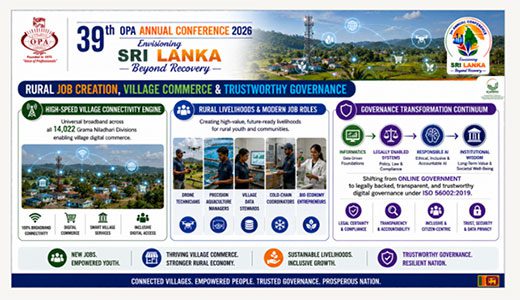
- Digital Governance Shift: Shifting from simple online government to legally backed, transparent, and trustworthy digital governance under ISO 56002:2019 compliance.
- Key Components: Enforcing strict legal certainty, blockchain transparency, citizen-centric services, data privacy, and accountability across all digital value chains via the "One Village One Product" (OVOP) network design.
11. Global Positioning & Blended Capital Frameworks
The final strategic architecture scales these domestic achievements into the global arena, generating programmatic funding channels while securing Sri Lanka's position as an international leader in sustainable engineering.
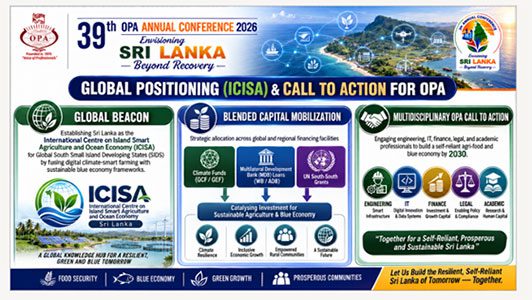
- Global Beacon (ICISA): Establishing the International Centre on Island Smart Agriculture and Ocean Economy (ICISA) in Sri Lanka to serve as a research hub for Global South Small Island Developing States (SIDS).
- Blended Capital Mobilization: Tapping directly into international assets via the Green Climate Fund (GCF), the Global Environment Facility (GEF), and Multilateral Development Bank (MDB) loans from the World Bank (WB) and Asian Development Bank (ADB) to fund infrastructure without adding to sovereign debt.
12. Relevance to the Global South & Small Island Developing States (SIDS)
The transformational roadmap conceptualized within this framework holds structural relevance across the broader Global South and Small Island Developing States (SIDS). The socioeconomic asymmetries, ecological vulnerabilities, and institutional frictions targeted by this model represent shared macro-systemic challenges that require uniform technical modernizations.
- Breaking the Low-Yield Labor Trap: Developing economies routinely encounter low primary sector productivity loops, anchoring huge blocks of human capital to highly volatile, low-margin traditional operations. The integration of the Agricultural Informatics Paradigm provides a model to upskill rural segments into precision operators, changing them from manual field labourers into high-value data stewards.
- Climate-Adaptive Defences: The Global South faces the absolute brunt of extreme climate shifts—soil organic layer degradation, monsoonal disruptions, and volatile marine thermal currents. Top-down, generalized frameworks fail at the regional scale. Utilizing localized, data-driven parameters across unique Agro-Climatic Intelligence Zones establishes an engineering baseline capable of supporting edge-verified, predictive agricultural manoeuvres.
- Decentralizing Infrastructure via Edge Hubs: Conventional economic models lead to high metropolitan centralization, forcing rural decay and mass urban migration. Replicating the 1,400 Village Edge Labs and Farming-as-a-Service (FaaS) delivery models offers a concrete template for distributing physical computing assets, connectivity infrastructure, and specialized enterprise networks evenly across regional zones.
- The Quintuple Helix & 5W1H Execution Matrix: This framework provides a structured execution template for grass-roots digitalization. By utilizing the Quintuple Helix Innovation Model, local programs seamlessly weave together HEIs, government policies, industries, civil societies, and local environmental systems into a collaborative pipeline. This architecture is operationalized via the 5W1H Framework (What, Where, When, Why, Who, How), turning abstract data networks into highly localized guidelines for the farmer, the farm, the livestock grid, the production pond, and the consumer.
- Bottom-Up Regional Agronomy Integration: Rather than restricting digital infrastructure to narrow individual identification indexes, the strategy prioritizes a comprehensive bottom-up approach. It systematically collects Agronomy Data from the entire ecosystem (including regions outside individual farmers' fields). By anchoring these resources into an Edge Computing network managed by the 1,400 Village Labs, the model protects hyper-local environmental data and guarantees true technology sovereignty.
- Sovereignty Over Supply Networks: Dependence on volatile international trade networks exposes developing territories to severe external pricing pressures and foreign exchange turbulence. Merging unified Sector-Wide Informatics Platforms with specialized trade vehicles like ICAPIFPO bridges local production with direct global market pathways, protecting food security and safeguarding domestic maritime wealth.
13. Corporate Service Ecosystem (ICAPIFPO)
The strategic implementation of this multi-layered framework is driven commercially and institutionally by the International Chamber of Agricultural Plantation, Industry & Farmer Producer Organization (ICAPIFPO). Operating under the directive "Empowering Farmers. Transforming Agriculture. Together We Grow, Together We Prosper," the operational services and steering leadership are structured as follows:
- Farmer Producer Organization (FPO) Development: Aggregating smallholder and marginal producers into robust corporate clusters to command economies of scale.
- Agricultural & Plantation Consultancy: Injecting crop agronomy data and specialized management consulting lines to optimize estate and smallholder land yields.
- Modern Farming & Smart Agriculture Solutions: Deploying targeted drone telemetry, autonomous field assets, and remote crop monitors into regional production systems.
- Value Chain & Supply Chain Development: Eliminating value loss by optimizing route planning and establishing temperature-tracked storage nodes.
- Export & International Trade Facilitation: Navigating sanitary, phytosanitary, and trade barriers to open seamless paths into high-value overseas channels for local producers.
- Farmer Capacity Building & Training: Providing ongoing on-site training to upskill traditional human capital into certified technical operators.
- Investment & Agricultural Plantation Development: Mapping and channelling private corporate venture funding directly into rural startup incubators.
- Sustainable Agriculture & Green Initiatives: Ensuring that all localized agribusiness setups comply with environmental conservation goals through organic input transformations and alternative bio-gas grids.
The accountability and rollout of the ICAPIFPO transformational matrix are overseen by a multidisciplinary board of international professionals.
14. Acknowledgements
The author expresses sincere gratitude to Dr. H. E. M. N. Sardar Ali – Founder & Director General, Dr. Sunil Abeyaratne -President, Mr. Nilanga Karunarathne – Chairman, of ICAPIFPO for generously sponsoring participation and supporting the dissemination of this transformational framework in the Conference." Special, elevated recognition is due to Shri Kunwar Shekhar Vijendra, Hon'ble Chancellor of Shobhit University Meerut for his proactive, far-sighted, and consistent support in promoting Agricultural Informatics as a core structural R&D, Academic, and e-Governance programme.
Furthermore, the author acknowledges the Chancellor's historic decision to sign strategic Memorandums of Understanding (MOUs) with the African-Asian Rural Development Organization (AARDO) and the Centre on Integrated Rural Development for Asia and the Pacific (CIRDAP) to institutionalize and scale "Agricultural Informatics" within Higher Education Institutions (HEIs). Through this visionary initiative, Shobhit University Meerut stands as the first academic institution in the entire Global South to establish a dedicated, centralized Centre for Agricultural Informatics and e-Governance Research Studies (CAIRS) within its campus, forging the baseline roadmap for regional data sovereignty.
15. Conclusion
The structural stabilization of the national economy requires transitioning away from defensive crisis response toward a proactive, automated, and insulated baseline. By systematically channelling raw agricultural inputs through the structural pipeline—FARM → DATA → KNOWLEDGE → ENTERPRISE → VALUE CHAIN → BLUE ECONOMY → JOBS → RESILIENCE—this master architecture establishes a self-reinforcing economic loop that bridges the primary sector productivity gap, transforms traditional manual labour into future-ready technical roles, and converts raw ecosystem telemetry into protected national wealth.
Ultimately, this Strategic Framework for Sri Lanka’s Digital Agri-Food Transformation (2030), driven by the DFI Foundation, unified by the One Health Telemetry framework, and structured under Professor Moni Madaswamy’s 7-tiered design, provides a definitive roadmap for structural economic reform. By systematically correcting the primary sector gap, training a GRIN-fluent youth workforce, and managing land and ocean capital through legally sound digital governance, Sri Lanka can build an insulated baseline. Through disciplined policy execution, professional collaboration, and open infrastructure investments, the nation can secure its economic sovereignty and build a Digitally Inclusive & Innovative Agri-Food Ecosystem by 2030 in Sri Lanka.