


Piyush Goyal: India and Egypt to Decide Within Months Whether to Pursue a PTA or FTA
India sees significant potential to expand its economic partnership with Egypt, particularly through complementary agricultural and industrial capabilities, with Indian companies looking to source high-quality Egyptian cotton for textile exports to global markets, according to India’s Minister of Commerce and Industry Piyush Goyal.
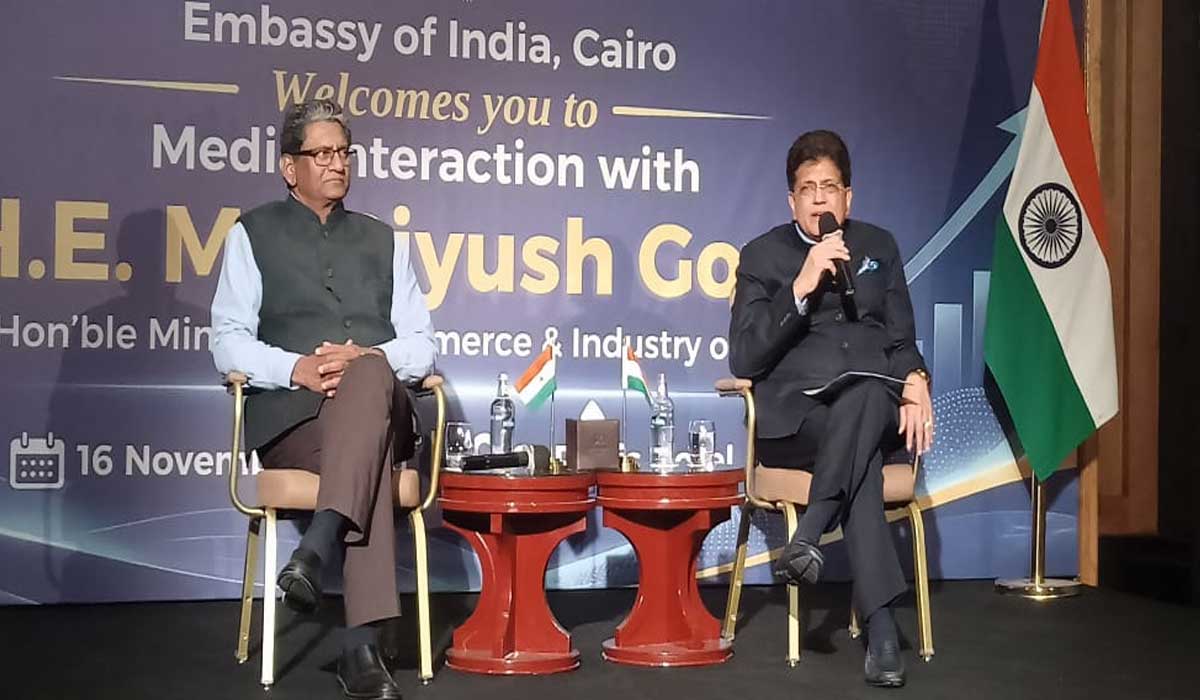
Speaking at a press conference during his visit to Egypt, Goyal said the two countries could build on their existing trade relations by identifying products and sectors in which each side has a competitive advantage, while working towards doubling bilateral trade to US$12 billion over the next five years.
He described the current trade volume of approximately US$6.5 billion as only “the tip of the iceberg,” saying the potential for further growth was substantial and could even exceed the target.
Egypt and India explore a new trade framework
Goyal identified the decision to establish joint working teams to examine the potential for a preferential trade agreement (PTA) or a free trade agreement (FTA) as one of the most significant outcomes of his visit.
The teams will assess the potential benefits of an agreement for both countries and prepare the terms of reference before deciding whether to begin with a preferential trade arrangement and subsequently move towards a more comprehensive agreement, or proceed directly with a free trade agreement.
He said both sides hoped to complete this assessment and take a decision within the next three to four months, adding that the two countries were committed to strengthening their strategic partnership and expanding bilateral trade.
The minister also said that sector-specific business delegations would be exchanged over the next 12 months to identify areas where Egyptian and Indian industries complement each other. The initiative is intended to help companies from both countries establish partnerships, expand commercial relations and develop joint business opportunities.
Goyal said the two sides had also agreed to appoint designated contact officers at Invest India and Egypt’s General Authority for Investment and Free Zones (GAFI) to guide and support investors seeking opportunities in each other's markets.
In addition, designated officials within the relevant ministries will work to address obstacles affecting trade. A future preferential or free trade agreement could also help tackle non-tariff barriers, he noted.
Egyptian cotton and Indian agricultural exports
Agricultural trade was among the issues Goyal described as requiring particular consideration, given the sensitivities surrounding the sector in both countries.
He said India and Egypt had agreed to respect each other's agricultural priorities and focus on products where trade opportunities could deliver immediate and mutual benefits.
As an example, he pointed to Egypt's imports of beef and wheat, saying India could become a source of these products, helping Egypt contain inflation and secure more competitive prices.
On the other hand, Goyal highlighted the potential for Egypt to increase its exports of high-quality cotton to India, particularly for use in garments manufactured in India and subsequently exported to markets such as the United States and Europe.
He explained that this arrangement could generate economic activity in both countries, as Egyptian cotton would be processed into export-oriented garments in India, without adversely affecting Indian cotton farmers.
The minister stressed that trade arrangements should be developed in a way that takes account of the interests and sensitivities of both sides, rather than applying a uniform approach to all products.
India sees Egypt as a gateway to regional markets
Goyal said Indian businesses increasingly view Egypt as a strategic location from which to serve not only its large domestic market but also wider markets across Africa and West Asia.
He highlighted the country's geographical position as an important advantage that could help make Egypt a regional manufacturing and export base for Indian companies.
He also pointed to opportunities for Egyptian and Indian businesses to work together to serve the Gulf Cooperation Council (GCC) markets.
India already has free trade agreements with Oman and the United Arab Emirates and is negotiating a broader agreement with the six GCC member states, which Goyal said could be concluded within the coming year or year and a half.
He said companies from Egypt and India could identify areas in which they could jointly supply products and services to Gulf markets, while Egyptian companies could also work with Indian partners to benefit from the opportunities available there.
Goyal noted that the large Indian population across the six GCC countries, estimated at nearly 10 million people, represents an important link between India and the Gulf region.
Opportunities in automotive manufacturing and transport
Discussing industrial cooperation, Goyal said Egypt had potential to develop its automotive manufacturing sector through a gradual process of localization, beginning with vehicle assembly and moving towards the production of components as demand grows.
He said this would be a long-term process that could take several years or even decades, drawing on India's own experience in developing its automotive industry. He added that some Egyptian businesspeople he had met had expressed interest in localizing automotive production in Egypt.
On the aviation sector, the minister said India had begun developing its civilian aircraft manufacturing capabilities and was expanding cooperation with companies from Canada, Brazil and France. He cautioned that building a domestic aircraft industry was a complex process that would require considerable time and experience.
Goyal also discussed air connectivity between the two countries, noting that there were nine direct flights from India to Egypt, operated by EgyptAir, while limited aircraft availability in India remained a constraint. He said India was working to expand its aircraft fleet, alongside efforts to develop domestic manufacturing capabilities.
During his discussions with Egypt's Minister of Transport, Kamel El-Wazir, the two sides explored opportunities in developing and operating seaports, shipbuilding, expanding domestic production of locomotives and railway rolling stock, and electric mobility.
Goyal said these areas could support Egypt's domestic economy, strengthen its self-reliance and generate new employment opportunities.
Investment opportunities across multiple sectors
The minister said discussions during the visit covered a broad range of sectors, including pharmaceuticals, hospitality, engineering, automobiles, medical devices, fertilizers, renewable energy and other forms of clean energy, as well as artificial intelligence and data centers.
He said India saw considerable scope for bringing new technologies and investment into Egypt, adding that both sides had agreed to work towards expanding trade and investment in sectors of mutual interest.
On investment incentives, Goyal stressed that each country determines its own policies and that incentives should be tailored to the requirements of individual sectors.
He cited India's approach, which includes separate policies for sectors such as green energy and textiles, alongside a general framework for other industries. He said there was no single incentive model that could suit every business or investment, and that decisions on tailored concessions rested with the relevant local authorities.
He also praised Egypt's efforts to attract investment, saying Indian businesses were increasingly considering the country as a gateway to Africa and a large domestic market, as well as to West Asia.
Local currency settlement to facilitate trade
Goyal also highlighted the recent connection between the Egyptian pound and the Indian rupee through arrangements involving the two countries' central banks, allowing trade transactions to be settled in local currencies.
He said the mechanism could reduce currency-conversion costs and exchange-rate risks associated with using international currencies, while speeding up payments between importers and exporters.
According to the minister, this would make bilateral trade more competitive and facilitate faster financial transactions between businesses.
Business engagement and start-up cooperation
Goyal said his visit included the largest Indian business delegation ever to travel to Africa, with representatives of start-ups from different sectors.
Alongside the sixth India-Egypt Joint Business Council meeting, the visit featured an India-Egypt Business Forum attended by nearly 250 companies from both countries, as well as the first India-Egypt Start-up Forum, which brought together more than 50 start-ups.
Several memorandums of understanding were signed between companies, while participants explored further opportunities for cooperation.
The minister also said India had invited Egypt to send a business delegation to the upcoming Vibrant Gujarat trade and investment summit in 2027, expressing hope that Egyptian ministers and business representatives would take part.
Beyond trade and investment, discussions also covered opportunities for cooperation in education, cultural exchange and strengthening people-to-people relations.
Egypt and India call for peace in West Asia
Addressing the ongoing conflict in West Asia, Goyal reiterated India's longstanding position in support of peace, saying dialogue and diplomacy were the only way forward.
He said India had consistently called for an early end to the conflict and a swift resolution of outstanding disagreements, adding that Egypt shared a similar position and that both countries were making efforts to help restore peace as soon as possible.
Concluding his remarks, Goyal described his visit to Egypt as an excellent experience and expressed his wishes for the country's continued success, voicing confidence that relations between Egypt and India would grow stronger in the years ahead.
About the Author