




From the Nile to the Indo-Pacific: How Aswan Fits into Indonesia’s Expanding Vision for Africa?
At a time when growing attention is being paid to the expanding partnership between India and Indonesia within the framework of the Indo-Pacific, another dimension of Indonesia’s foreign engagement is taking shape on the opposite side of the Indian Ocean. In this evolving strategy, Egypt occupies a pivotal position, while Aswan emerges as far more than a historic city—it stands as a strategic gateway linking North Africa with the African continent's interior.
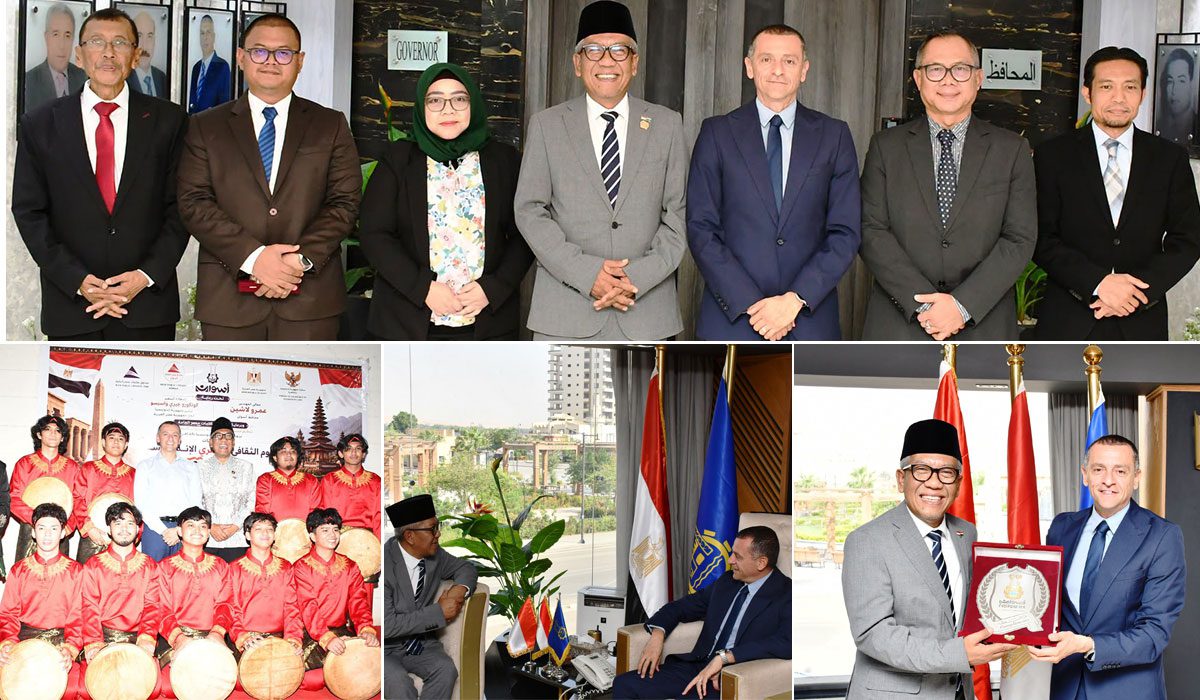
During his visit to Aswan last July, Indonesia’s Ambassador to Egypt, Kuncoro Giri Waseso, held discussions that extended well beyond diplomatic protocol. His meetings covered trade, investment, tourism, and cultural cooperation, in addition to exploring the establishment of a sister-city partnership between Aswan and an Indonesian city. The visit also featured an Egyptian-Indonesian Cultural Day, conveying a message that went beyond heritage and the arts: Jakarta is seeking to strengthen its presence in Africa through both economic engagement and cultural diplomacy.
Although Egyptian-Indonesian relations span more than seven decades—dating back to Egypt’s early recognition of Indonesia’s independence and its support for the Indonesian national liberation movement—the relationship has entered a more pragmatic phase in recent years, driven by economic and geopolitical shifts that are reshaping partnerships across the Global South.
Aswan: A Gateway to Africa
Indonesia’s interest in Aswan extends well beyond its status as home to iconic sites such as the Abu Simbel and Philae temples. The governorate's strategic location makes it a vital gateway to Sudan and African markets, positioning it at the heart of Egypt’s vision to transform the country's south into a regional logistics and trade hub serving the African continent.
During his meeting with Aswan Governor Amr Lashin, the Egyptian side highlighted the governorate’s investment opportunities, including its mineral resources—particularly phosphate reserves—its agricultural products such as dates, mangoes, and aromatic plants, as well as its river ports and infrastructure projects designed to facilitate trade with Africa.
For Indonesia, which is seeking to diversify its export markets and expand its economic footprint across Africa, these assets represent an opportunity to build partnerships that extend beyond the Egyptian market to the continent as a whole.
Soft Power as a Diplomatic Instrument
The Egyptian-Indonesian Cultural Day held in Aswan was far more than a ceremonial event; it reflected Jakarta’s growing reliance on cultural diplomacy as an instrument of foreign policy.
Artistic performances, heritage exhibitions, and youth activities hosted at the Egypt Public Library in Aswan underscored the idea that cultural exchange is no less important than economic agreements. By fostering people-to-people connections, such initiatives create a more sustainable foundation for cooperation in education, tourism, and investment.
This approach is particularly significant for Indonesia, which views its rich cultural diversity as one of its most valuable soft power assets within both the Islamic world and the Global South.
The Indonesian ambassador to Cairo emphasized that, following the signing of the Strategic Partnership Agreement between Indonesian President Prabowo Subianto and Egyptian President Abdel Fattah El-Sisi, both countries are committed to opening new avenues of cooperation across cultural, economic, and other sectors. Under this vision, Egypt is expected to serve as Indonesia’s gateway to Africa, while Indonesia will act as Egypt’s gateway to Asia and the Pacific.
The ambassador also noted that Indonesia intends to explore broader trade opportunities, particularly in the phosphate sector, while coordinating with Aswan Governorate to expand cooperation across various fields.
He further pointed out that Indonesia ranks among the leading foreign investors in the Egyptian market through a range of investment projects, alongside steadily growing tourism exchanges between the two countries. He expressed hope that more Indonesian visitors would travel to Aswan, contributing to the governorate’s tourism sector and further strengthening cultural ties between the two peoples.
Where Does India Fit into This Picture?
At first glance, the Indonesian ambassador’s visit to Aswan may appear to be purely a bilateral matter between Cairo and Jakarta. In reality, however, it fits into a broader Asian context in which India also plays a significant role.
Despite differences in their respective priorities, both India and Indonesia share a common vision of strengthening Asia’s engagement with Africa through trade, investment, development cooperation, and maritime connectivity. As two of the Global South’s leading emerging powers, both countries are members of the G20 and are actively expanding their partnerships across Africa amid intensifying international competition on the continent.
Within this context, Egypt assumes even greater strategic importance. It is not only one of Africa’s and the Arab world's largest markets, but also a critical gateway through the Suez Canal, while Aswan provides a direct geographical link to the African interior.
While India has expanded its presence in Africa through investments in infrastructure, technology, healthcare, and education, Indonesia has pursued a somewhat different approach, placing greater emphasis on trade, food industries, and cultural diplomacy. Although their methods differ, their ultimate objective is remarkably similar: building deeper, long-term partnerships across Africa beyond the traditional frameworks that dominated for decades.
Towards a Broader Asia-Africa Partnership
As Indonesia marks the 81st anniversary of its independence, the visit to Aswan represents more than a routine diplomatic engagement. It reflects Jakarta’s broader vision of expanding its network of African partners while leveraging Egypt’s strategic position as a bridge between the Arab world and the African continent.
More broadly, these developments carry a wider message. As India and Indonesia continue to emerge as influential Asian powers, competition for influence in Africa is no longer measured solely by the scale of investment. Increasingly, it is defined by the ability to forge local partnerships, strengthen cultural ties, and establish sustainable, long-term economic interests.
From this perspective, Aswan—a city historically associated with Egypt’s southern frontier—may now be poised to become a new meeting point between Asia and Africa, serving as a bridge that connects the development visions of Cairo and Jakarta, and perhaps New Delhi as well.
About the Author