



Xi Jinping’s Historic Visit to Egypt: Forging a New Chapter in a 70-Year Partnership
Xi Jinping’s state visit to Cairo marked seven decades of diplomatic ties while setting out an ambitious agenda spanning industry, technology, trade, infrastructure and coordination across the Global South.
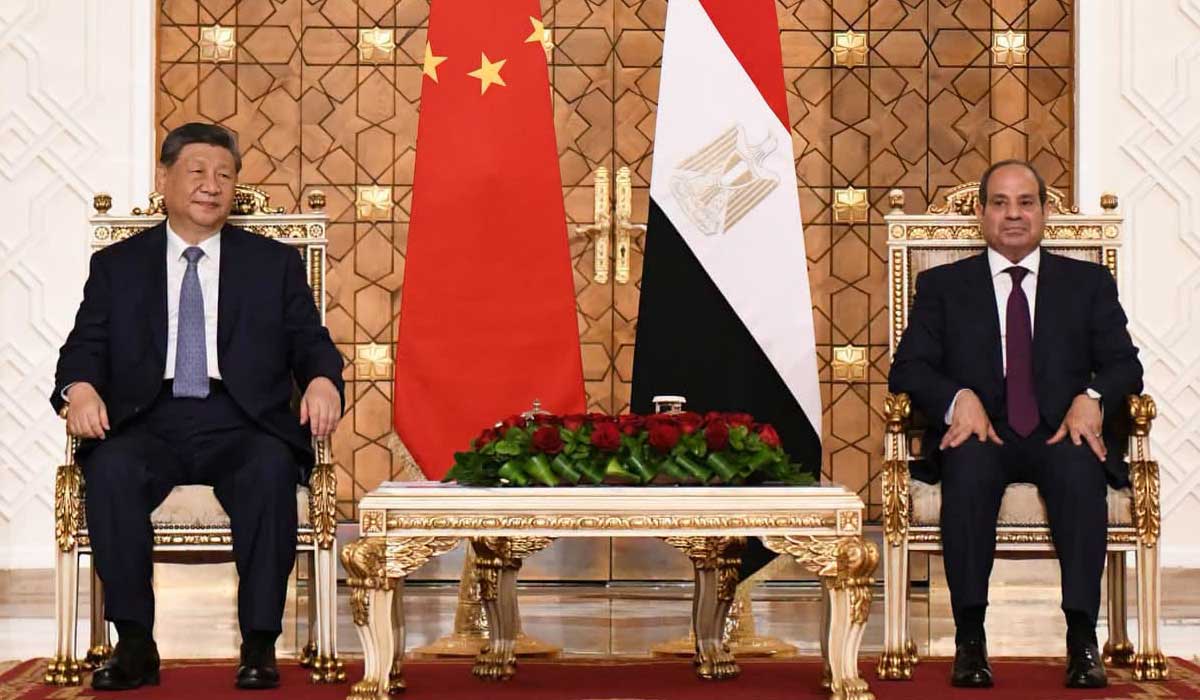
When Chinese President Xi Jinping arrived in Cairo on September 1 for a state visit to Egypt, the occasion carried significance beyond the ceremonial celebration of an established diplomatic relationship. Seventy years after Egypt became the first Arab and African country to establish diplomatic relations with the People’s Republic of China in 1956, the two countries are seeking to take their partnership into a new phase—one increasingly defined by industrial localization, advanced technology, investment and coordination on global affairs.
Xi’s September 1–2 visit, held against the backdrop of the 70th anniversary of diplomatic relations, brought together two countries that have progressively expanded their relationship from political and diplomatic cooperation into a broad strategic partnership.
That partnership was elevated to the level of a comprehensive strategic partnership in 2014. A decade later, Cairo and Beijing are now seeking to give that framework greater economic and technological depth while strengthening their coordination on regional and international issues.
From diplomatic ties to strategic interdependence
The history of Egypt-China relations has given the two countries a distinctive position within the Arab-African-Asian diplomatic landscape.
Egypt was not only the first Arab country to recognize the People’s Republic of China, but also the first African country to establish diplomatic relations with Beijing. Over seven decades, the relationship has evolved alongside major changes in the international system, with both sides emphasizing principles of mutual respect, non-interference, mutual benefit and support for developing countries.
During Xi’s visit, President Abdel Fattah El-Sisi described the anniversary as an opportunity to look at how the relationship could respond to a changing international environment. He highlighted the progress achieved since the establishment of the comprehensive strategic partnership in 2014, particularly in areas where both countries see localization of industry and technology transfer as priorities.
The emphasis is significant. Rather than focusing exclusively on expanding trade volumes, the current agenda increasingly centers on what Egypt and China can build together.
The next phase: manufacturing, technology and the Suez Canal
One of the most consequential announcements during the visit was the agreement to launch the third phase of expansions of the China-Egypt industrial zone in the Suez Economic Zone.
The new phase is expected to open additional space for cooperation in strategic sectors, including renewable energy, automotive manufacturing, textiles and chemical fibers.
The development reinforces the role that the Suez Canal Economic Zone has come to play in Egypt’s economic strategy. Positioned at the intersection of major maritime trade routes and linking Asian, African and European markets, the zone is being developed as more than a logistics hub. Cairo increasingly sees it as a platform for manufacturing, investment and exports.
For Chinese companies, Egypt offers a combination of geographic location, access to regional markets and an expanding industrial infrastructure. For Egypt, deeper Chinese investment can support its objective of increasing domestic manufacturing capacity, attracting technology-intensive industries and integrating local production into international supply chains.
The bilateral agenda is also moving toward more technologically advanced sectors.
The joint statement issued following the visit identified areas ranging from electric vehicles, shipbuilding and renewable energy to cloud computing, data centers, semiconductors, cybersecurity, space applications and remote sensing.
Such areas represent a significant expansion from the traditional focus on infrastructure and construction. They also reflect the growing importance of technological capabilities in shaping economic competitiveness.
Beyond infrastructure: a new industrial equation
Chinese participation in major Egyptian infrastructure, transportation and energy projects has been one of the most visible dimensions of bilateral economic cooperation.
The new agenda, however, points toward a broader economic equation in which Egypt seeks to benefit not only from Chinese capital and infrastructure expertise, but also from technology transfer, skills development and localized production.
The two governments have agreed to deepen the alignment between Egypt Vision 2030 and China’s Belt and Road Initiative, with the stated objective of helping Egypt develop into a regional hub for industry, logistics, clean energy and the digital economy.
This alignment could give the bilateral relationship a more strategic economic dimension.
Instead of simply connecting Chinese companies to the Egyptian market, the model envisages Egypt as a potential bridge between Asia, Africa and Europe, with Chinese investment contributing to production and services that can serve markets beyond Egypt itself.
The focus on electric vehicles, renewable-energy equipment, desalination, advanced technologies and critical-mineral supply chains suggests that the partnership is also being shaped by global shifts in energy, manufacturing and technology.
Trade and finance: seeking a more balanced relationship
Trade remains another important component of the relationship, although both sides acknowledge the need for greater balance.
During the visit, the two countries agreed to encourage wider use of local currencies in trade and investment and welcomed the renewal and expansion of their currency-swap arrangement.
The two governments also agreed to encourage greater access for Egyptian products to the Chinese market and to continue consultations on the Early Harvest Agreement.
These measures point to a broader effort to make bilateral economic relations more resilient and diversified.
For Egypt, expanding exports to China remains an important objective in addressing trade imbalances. For China, Egypt represents a strategically located market and production base at a time when Beijing continues to strengthen economic links with Africa and the wider developing world.
The financial dimension is also gaining importance, with both sides highlighting cooperation involving Chinese panda bonds, local-currency arrangements and financing for infrastructure, industrial investment and green and digital transformation.
Tourism and culture: the human dimension
Economic cooperation was only one part of the agenda.
The visit also highlighted tourism, culture, education, scientific research and youth exchanges as important components of the relationship.
China expressed support for increasing the number of Chinese tourists visiting Egypt, as well as cooperation in hotel development and resort management.
The cultural dimension was particularly visible when President Xi and his wife, Peng Liyuan, visited the Grand Egyptian Museum alongside President El-Sisi and his wife, Entissar El-Sisi.
The visit offered a symbolic meeting between two ancient civilizations. Xi expressed his admiration for Egyptian civilization and praised the Grand Egyptian Museum as a major cultural institution reflecting the importance of Egypt’s contribution to human history.
The symbolism was particularly relevant in a year marking not only seven decades of diplomatic relations but also China’s designation of 2026 as the Year of China-Africa Cultural and Human Exchanges.
For both countries, cultural diplomacy complements the expanding economic relationship by creating a broader foundation for people-to-people ties.
Egypt and China on the regional stage
The significance of Xi’s visit also extended well beyond bilateral relations.
Cairo and Beijing used the occasion to reinforce their political coordination on major regional and international issues, including the conflicts and crises affecting the Middle East and Africa.
The two sides reiterated support for diplomatic solutions to international disputes and emphasized the importance of de-escalation in the Middle East.
The Palestinian issue occupied a prominent place in their discussions. Both countries reaffirmed support for a two-state solution, the establishment of an independent Palestinian state along the June 4, 1967 borders with East Jerusalem as its capital, and the rejection of plans to forcibly displace Palestinians.
They also called for maintaining the ceasefire in Gaza and facilitating the unrestricted delivery of humanitarian assistance.
The two governments discussed the security of the Red Sea and the Horn of Africa, stressing respect for the sovereignty and territorial integrity of regional states and the importance of ensuring freedom of navigation and international trade.
They also expressed support for efforts to end the war in Sudan and launch an inclusive political process under Sudanese ownership.
These positions highlight an important feature of the Egypt-China relationship: bilateral cooperation is increasingly intertwined with their respective roles in regional diplomacy.
A partnership shaped by the Global South
Perhaps the broader strategic message of the visit lies in the two countries’ shared emphasis on the role of developing countries in the international system.
Egypt and China agreed to strengthen coordination in international organizations and forums, including the United Nations, BRICS and the Shanghai Cooperation Organization, while cooperating on issues such as climate change, food security, energy and the digital economy.
The two sides also called for greater representation of developing countries in international decision-making and reform of global institutions, including international financial institutions.
For Cairo, closer coordination with Beijing offers an additional avenue for pursuing a foreign policy centered on strategic balance and diversified international partnerships.
For Beijing, Egypt occupies a distinctive position as a major Arab and African state, a key player in the Middle East and a country with longstanding relationships across the developing world.
The two governments explicitly described their comprehensive strategic partnership as a model of cooperation between major developing countries based on mutual respect, non-interference, mutual benefit and common development.
Seventy years on, looking toward the next seventy
The significance of Xi Jinping’s visit ultimately lies not only in the agreements signed or the ceremonies held, but in the direction they reveal.
After seven decades of diplomatic relations, Egypt and China are attempting to move their partnership beyond traditional infrastructure and trade toward a more complex relationship encompassing advanced technology, industrial localization, renewable energy, digital transformation, finance, tourism and high-value manufacturing.
The third phase of the China-Egypt industrial zone, the expansion of cooperation in emerging technologies, renewed financial arrangements and the institutionalization of cooperation across multiple sectors all point toward a relationship that is becoming increasingly multidimensional.
At the same time, their coordination on Palestine, the Red Sea, Sudan, the Horn of Africa and reform of the international system demonstrates that the partnership is not confined to economics.
Egypt and China are entering the next phase of their relationship at a moment when the global order is undergoing profound change. Their shared emphasis on sovereignty, development, multilateralism and a stronger voice for the Global South provides the political foundation for deeper cooperation.
Seventy years after Cairo and Beijing established diplomatic ties, the relationship is therefore no longer defined simply by the history that brought them together. Increasingly, it is being shaped by a shared calculation about where their economic interests, strategic priorities and visions of the international system can converge.
The challenge now is to translate that convergence into concrete projects, greater two-way trade, technology transfer and sustainable investment.
If that happens, the anniversary year may come to be remembered not merely as a celebration of seven decades of friendship, but as the point at which Egypt-China relations began a new chapter.
About the Author