



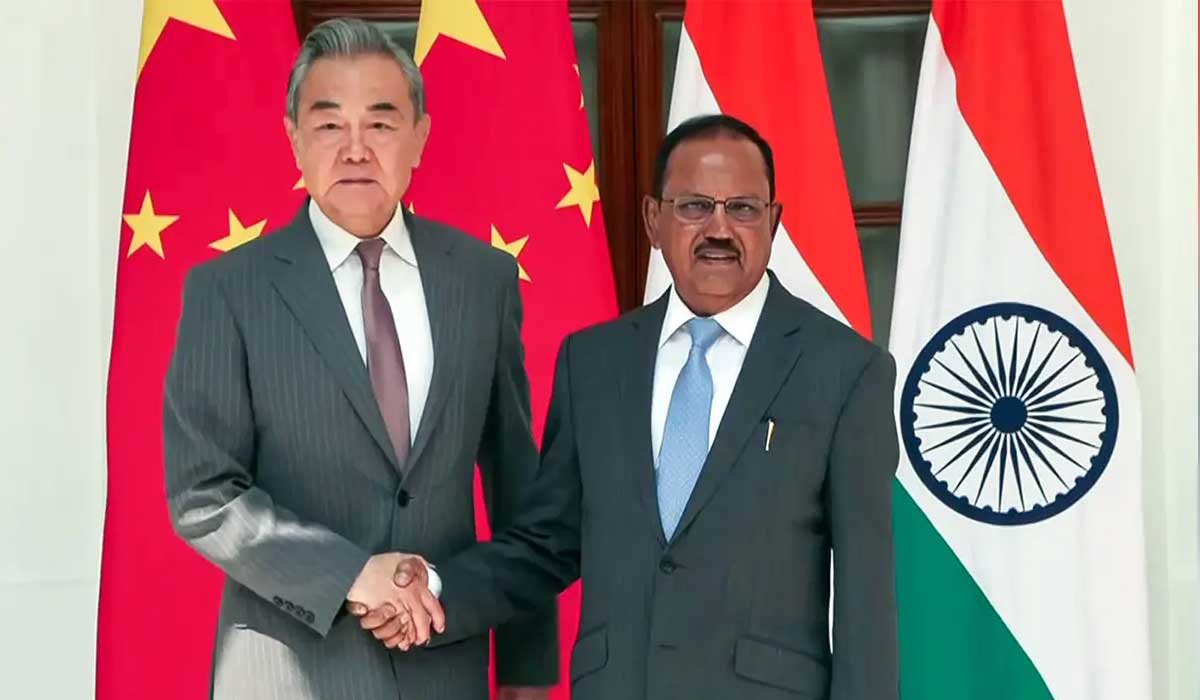
Doval in Beijing: Can India and China Turn Border Calm into a New Diplomatic Beginning?
The 25th Special Representatives’ talks come at a crucial moment as New Delhi and Beijing cautiously seek to stabilise ties
India and China have resumed one of their most important diplomatic channels as National Security Adviser Ajit Doval and Chinese Foreign Minister Wang Yi held the 25th round of the Special Representatives’ talks on the India–China boundary question in Beijing.
Doval arrived in the Chinese capital on August 24 for a two-day visit at Wang Yi’s invitation. Before the boundary talks, he also met Chinese Vice President Han Zheng, with discussions focusing on maintaining peace and tranquillity along the border and strengthening bilateral relations across economic, political and multilateral areas.
The Special Representatives mechanism, established in 2003, remains the principal high-level diplomatic channel for addressing the long-standing India–China boundary dispute. The latest round comes after years of tension following the 2020 Galwan Valley clash and subsequent military standoff.
For India, the message remains consistent: peace and tranquillity along the border are essential for the normalisation of the wider relationship. New Delhi has repeatedly maintained that broader cooperation cannot be separated from stability along the Line of Actual Control.
What makes the latest talks particularly significant is their timing. India is preparing to host the BRICS Summit in New Delhi on September 12–13, and Chinese President Xi Jinping is expected to attend, although Beijing has not yet formally confirmed his visit. If Xi does travel to India, it would be his first visit in seven years and could provide an important opportunity for Prime Minister Narendra Modi and Xi to assess the direction of bilateral relations.
The current diplomatic engagement should not, however, be interpreted as the end of strategic competition between the two Asian powers. Differences remain over the boundary, Arunachal Pradesh and broader regional security. Both countries continue to compete for influence across the Indo-Pacific.
At the same time, there are reasons for cautious optimism. Recent diplomatic and military contacts suggest that both New Delhi and Beijing recognise the cost of allowing border tensions to dominate the entire relationship.
The Doval–Wang dialogue therefore represents more than another round of negotiations. It is a test of whether border stability can become the foundation for controlled normalisation in other areas, including trade, investment, people-to-people exchanges and multilateral cooperation.
For India, the objective is not to choose between competition and cooperation with China. It is to manage both.
The coming weeks could therefore prove important. If Xi Jinping visits New Delhi for the BRICS Summit, the groundwork laid by Doval and Wang may provide the diplomatic space for another phase of India–China engagement.
The larger question is whether the two countries can transform “peace and tranquillity” on the border into a sustainable framework for managing competition across the relationship.
For India’s diplomacy, that may be the real test ahead.