



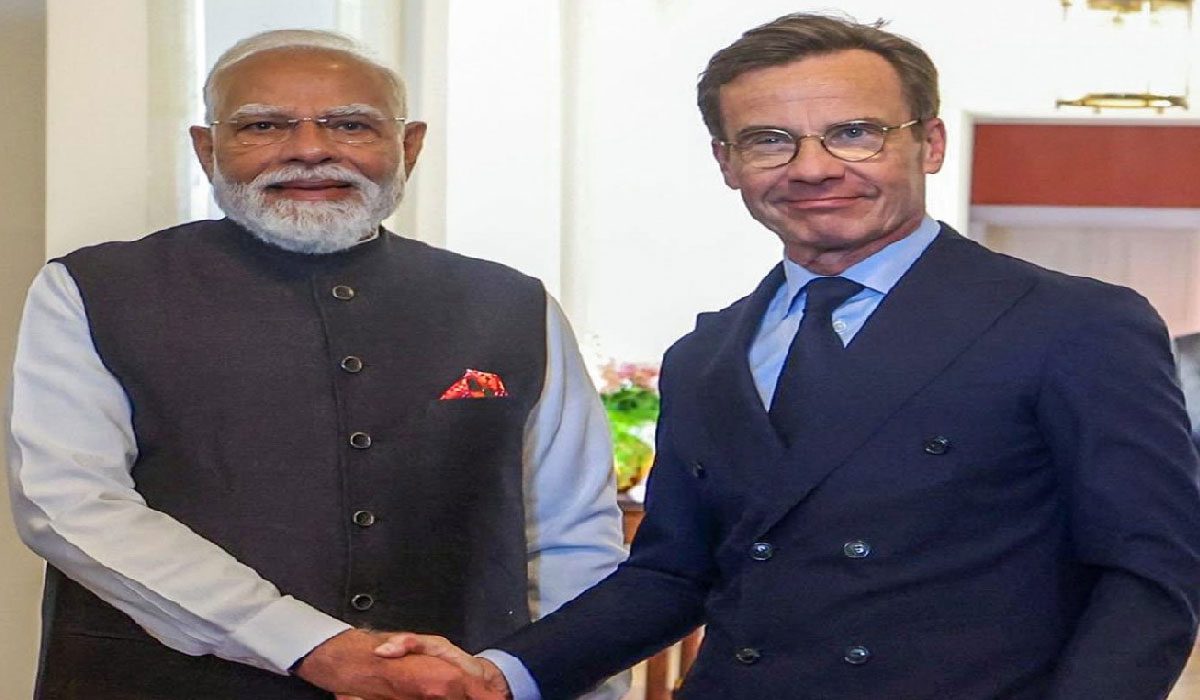
India–Sweden Partnership 2026: Advancing Green Growth, Innovation, and Strategic Convergence
Prime Minister Narendra Modi’s visit to Sweden in May 2026 marked an important step forward in India’s growing engagement with the Nordic region and the wider European Union. The visit took place within the framework of the India–Nordic Summit process, where India and Nordic countries continue to expand cooperation in sustainability, technology, trade, and innovation-led development.
The engagement underscored a shared understanding that global challenges such as climate change, energy transition, and supply chain resilience require deeper international collaboration. India and Sweden, despite differing scales and geographies, are increasingly aligned in their approach to green growth and future-oriented economic transformation.
Elevation of Bilateral Relations
During the visit, Prime Minister Modi and Swedish Prime Minister Ulf Kristersson agreed to further strengthen bilateral ties through an upgraded strategic framework. The discussions reflected a mutual commitment to expanding cooperation across political dialogue, economic partnership, innovation, and sustainable development.
Both sides emphasized the importance of stable and predictable global partnerships in a time of geopolitical uncertainty and economic fragmentation. The upgraded engagement reflects growing trust and convergence between India and Sweden as innovation-driven, democratic economies.
Focus on Green Transition and Clean Energy
A central theme of the visit was cooperation in green transition and clean technologies. Sweden, known for its leadership in environmental innovation and sustainable industrial practices, and India, one of the fastest-growing renewable energy markets, identified strong complementarities in this sector.
The two countries discussed expanding collaboration in renewable energy, green hydrogen, sustainable manufacturing, and climate-friendly infrastructure. The emphasis was on combining Swedish technological expertise with India’s scale of implementation and large domestic market.
This cooperation reflects a broader shift in global diplomacy, where climate action is increasingly linked with economic growth and industrial competitiveness.
Technology, Innovation, and Future Industries
Innovation played a key role in the discussions, with both countries highlighting opportunities in emerging technologies such as digital transformation, smart manufacturing, clean mobility, and advanced communications.
Cooperation between research institutions, startups, and industry stakeholders was identified as a priority area to accelerate innovation-led growth. Sweden’s advanced industrial ecosystem and India’s rapidly expanding digital and technology sector provide a strong foundation for deeper collaboration.
The discussions also reflected growing interest in next-generation technologies and digital infrastructure development, including areas linked to industrial automation and connectivity.
Trade, Investment, and Economic Cooperation
Economic engagement between India and Sweden continues to grow steadily, supported by strong industrial linkages and rising investment flows. Swedish companies are well established in India across sectors such as engineering, mobility, telecommunications, and sustainable solutions.
Both sides explored ways to further enhance trade and investment ties, particularly in green technologies, manufacturing, infrastructure, and innovation-driven industries. India’s expanding role as a global manufacturing hub and Sweden’s expertise in high-value industrial systems create natural synergies for long-term cooperation.
Broader Nordic Engagement
The visit also formed part of India’s wider engagement with the Nordic region, including Denmark, Finland, Iceland, Norway, and Sweden. This framework has increasingly become a platform for structured cooperation on climate action, innovation, maritime sustainability, and digital transformation.
The India–Nordic partnership is evolving beyond traditional diplomatic engagement into a more comprehensive relationship focused on shared global priorities and practical cooperation.
Climate Diplomacy and Global Responsibility
Climate change and sustainability remained central to the discussions. Both countries reaffirmed their commitment to international climate goals and emphasized the need for cooperative solutions that balance environmental protection with economic development.
India’s renewable energy expansion and Sweden’s green technology leadership were seen as complementary forces that can contribute to global climate solutions and sustainable industrial growth.
Conclusion
Prime Minister Modi’s visit to Sweden highlighted the increasing depth of India–Nordic relations and the growing strategic relevance of India–Sweden cooperation. The partnership is steadily evolving into a forward-looking framework centered on green growth, innovation, trade, and sustainable development.
In a world marked by uncertainty and transformation, India and Sweden are positioning their relationship as a model of practical cooperation—one that links technology, climate responsibility, and economic progress to build a more resilient and sustainable global future.