



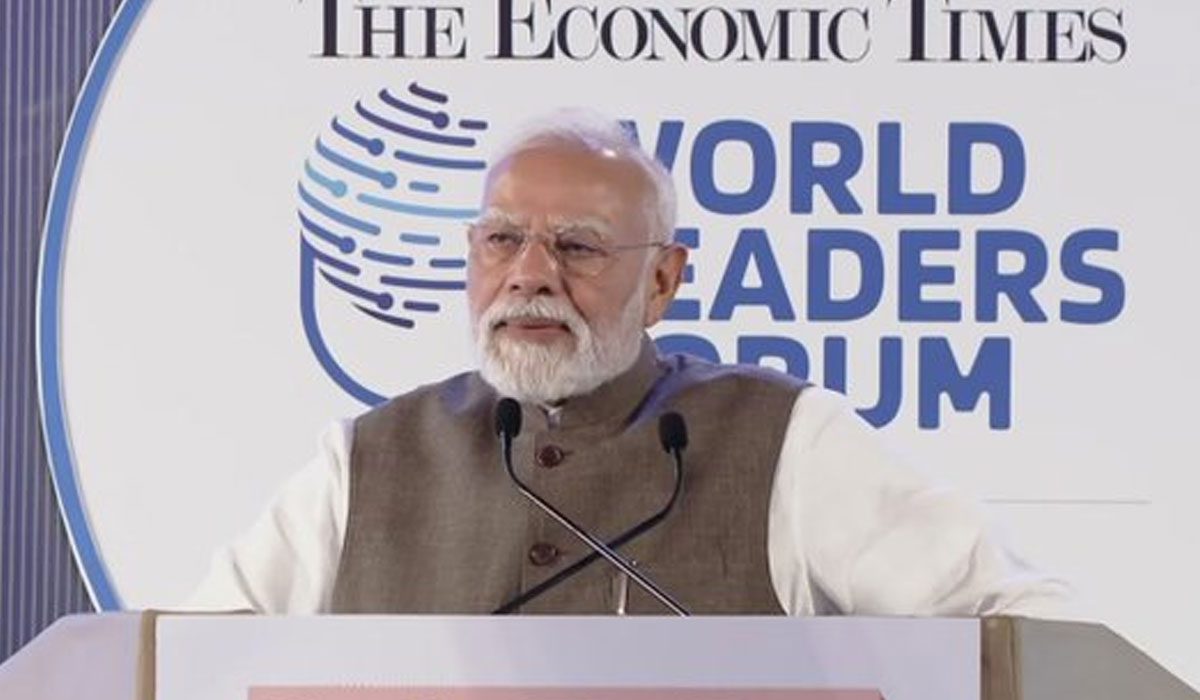
From People’s Prosperity to Global Power: PM Modi’s Pro-People, Pro-Growth Vision for a New India
At the ET World Leaders Forum, the Prime Minister presents India’s transformation as a model where economic growth, development and empowerment of ordinary citizens move together
A New Economic Philosophy for a Changing World
Prime Minister Narendra Modi’s address at the Economic Times World Leaders Forum 2026 placed India’s economic transformation at the centre of a rapidly changing global order, presenting a vision in which growth is not an end in itself but a means to expand opportunity, improve living standards and strengthen India’s role in the world.
Speaking before global business leaders, policymakers and investors, Modi underlined that India’s economic journey is increasingly being judged not merely by headline statistics, but by the changes taking place in the lives of ordinary citizens. His message was clear: the next phase of India’s development must combine economic expansion with social empowerment, technological progress and greater opportunity.
Pro-People: Growth Must Reach the Common Citizen
A central theme running through Modi’s address was the human dimension of economic development.
The Prime Minister pointed to the transformation of millions of Indians through better access to basic services, digital infrastructure, financial inclusion and government support. In his broader development narrative, poverty reduction is not simply about moving people above a statistical poverty line; it is about creating a new class of citizens with aspirations, purchasing power and confidence to participate in India’s growth story.
This approach represents a shift from viewing the poor primarily as beneficiaries of welfare to treating them as participants in economic development.
The emphasis on empowerment is particularly significant for India’s next stage of growth. Financial access, digital payments, infrastructure and entrepreneurship can give citizens the tools to become consumers, producers, workers and business owners in a rapidly expanding economy.
Pro-Growth: From Regulation to Opportunity
Another important message from Modi’s address was the changing relationship between government and enterprise.
The Prime Minister contrasted India’s earlier regulatory environment with a new policy approach designed to encourage production, investment and innovation. He highlighted the evolution from what he described as an era of “production-linked punishment” to policies that reward higher production and competitiveness through initiatives such as the Production-Linked Incentive framework.
The larger message is that India wants businesses to see the country not simply as a large consumer market, but as a place where they can manufacture, innovate, invest and build globally competitive enterprises.
That distinction matters. A growing domestic market can create demand, but a productive and competitive industrial ecosystem can create jobs, exports, technology and long-term economic strength.
Pro-Development: Infrastructure as a Force Multiplier
For Modi, development is also increasingly visible in India’s physical and digital infrastructure.
Railways, highways, border connectivity, digital public infrastructure and other large-scale investments have become important instruments in reducing the distance between citizens and economic opportunity.
The Prime Minister has repeatedly framed infrastructure not merely as construction activity, but as a way of improving convenience and the quality of everyday life. This philosophy links economic development directly with the citizen experience.
The transformation of infrastructure therefore becomes part of a larger development equation: better connectivity can reduce logistics costs, open new markets, support manufacturing and allow smaller businesses and communities to participate more fully in economic activity.
Manufacturing India, Empowering India
Manufacturing occupied an important place in Modi’s economic vision.
The Prime Minister has been pushing the idea of India becoming a major global manufacturing hub, supported by policy incentives, infrastructure, domestic demand and integration with international supply chains.
The growth of sectors such as electronics, defence production and advanced manufacturing is intended to create a deeper industrial base while reducing excessive dependence on imports.
The increase in India’s defence exports, highlighted by Modi at the forum, was presented as an example of how policy changes and domestic capability can alter India’s economic position.
The ambition goes beyond producing more goods. It is about building Indian companies and technologies capable of competing internationally.
The Digital Citizen at the Heart of Development
India’s digital transformation is another pillar of the Prime Minister’s development narrative.
Digital infrastructure has increasingly become an instrument for delivering financial services, public benefits and government services at scale. Modi’s argument is that technology becomes meaningful when it reduces barriers for ordinary citizens.
This philosophy is particularly relevant as India moves deeper into the era of artificial intelligence.
The challenge for the next decade will not simply be whether India develops world-class AI capabilities, but whether AI, digital services and new technologies reach small businesses, farmers, workers and citizens outside the largest metropolitan centres.
That wider question is already being debated at the ET World Leaders Forum, where business leaders have stressed the need to take AI beyond experimentation and into practical applications across the economy.
Growth With a Global Responsibility
Modi’s economic message also carries a wider diplomatic dimension.
India’s rise, in his formulation, is not intended to be isolated from the global economy. A stronger India can become a larger contributor to global growth, manufacturing, technology, investment and supply-chain resilience.
This is particularly important at a time when geopolitical tensions, technological disruption and changing trade patterns are forcing businesses and governments to reconsider assumptions about globalisation.
The ET World Leaders Forum itself is taking place against this backdrop, with global leaders discussing AI, geopolitics, demographic change, investment and the changing architecture of the world economy.
India’s proposition is therefore increasingly about partnership: attracting global capital and technology while building domestic capabilities and expanding India’s contribution to global markets.
Reform Is Becoming a Continuous Process
Perhaps the most significant element of Modi’s economic message is the idea that reform cannot be treated as a one-time event.
His broader reform philosophy has been expressed through the mantra of “Reform, Perform, Transform”, with the government arguing that India’s policy environment must continuously adapt to future opportunities and challenges.
The Prime Minister’s earlier ET World Leaders Forum addresses have similarly linked reforms with manufacturing, employment, ease of living and ease of doing business.
The underlying message is straightforward: India cannot become a developed economy by relying on yesterday’s policies.
From Fast Growth to Inclusive Prosperity
India’s central challenge now is not simply maintaining high growth, but converting that growth into broad-based prosperity.
That means creating productive employment, strengthening manufacturing, expanding opportunities for young people, supporting entrepreneurs, improving human capital and ensuring that smaller cities and rural communities participate in the transformation.
This is where the three ideas — pro-people, pro-growth and pro-development — converge.
Pro-people policies give citizens opportunity and security.
Pro-growth policies create investment, enterprise and employment.
Pro-development policies build the infrastructure, institutions and capabilities that allow both to reinforce each other.
India’s Next Chapter: Development With Ambition
Modi’s ET World Leaders Forum message ultimately reflects an India that wants to move from being a large emerging economy to becoming a decisive force in the global economy.
The ambition is not limited to becoming larger in economic rankings. It is about building a country where citizens have greater opportunity, businesses have greater confidence, technology creates wider access and infrastructure connects every part of the economy.
For global investors and policymakers, the message is equally significant: India wants its rise to be understood not merely as a story of GDP growth, but as a transformation of people, institutions, industry and national capability.
The road to Viksit Bharat will therefore be measured not only by how quickly India grows, but by how widely the benefits of that growth are shared.