




India at 80: From Post-Colonial Challenges to a Global Story of Transformation
Indian Ambassador to Egypt, Suresh K. Reddy, said that India has undergone far-reaching transformation across multiple sectors in the decades since independence, noting that the country’s journey is no longer defined solely by economic and technological growth, but also by the aspirations of more than 1.4 billion people and a broader ambition to offer a development model for the Global South.
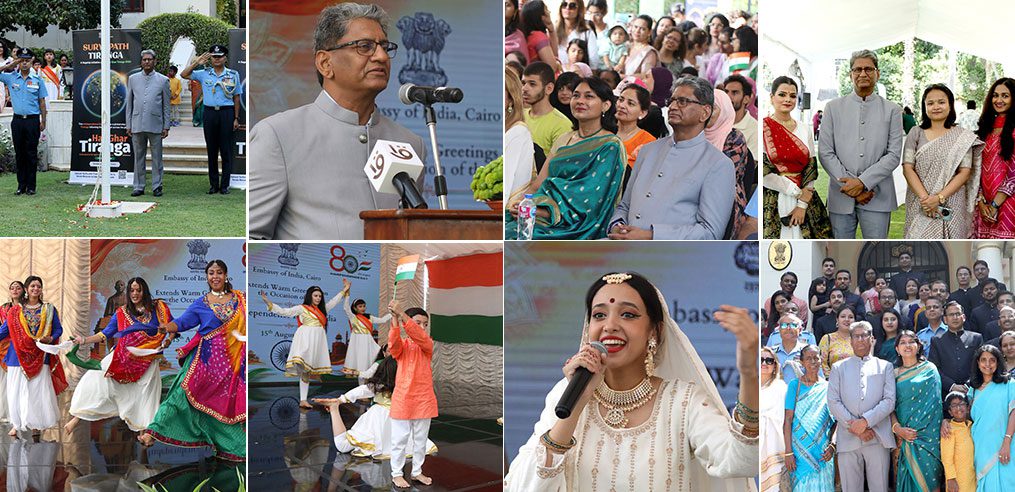
Reddy made the remarks during his address at a flag-hoisting ceremony marking the 80th anniversary of India’s independence, where he highlighted the country’s transformation across the economy, infrastructure, technology, space, defense and renewable energy.
He said India had moved from a newly independent state facing major development challenges to a country charting a new course across a range of fields, including space, science and technology, digital public infrastructure and defense.
A growing economy driven by innovation
Reddy noted that India’s economy has rapidly climbed the global rankings to become the world’s fourth-largest economy, arguing that the transformation goes beyond an economic ranking to reflect the expansion of the middle class, a young population and the growth of entrepreneurship and innovation.
"India currently has around 250,000 startups operating across various sectors and has become the world’s fourth-largest industrial economy," he said, adding that the country’s total trade exceeded $1.5 trillion last year.
These figures, according to the ambassador, reflect a changing economic landscape in which young people and entrepreneurs are increasingly turning ideas and innovation into businesses and opportunities for growth.
From infrastructure shortages to an expanding transport network
The ambassador also highlighted the transformation of India’s infrastructure, noting that the country faced severe infrastructure shortages in the aftermath of independence before witnessing significant expansion in its railways, roads, ports and airports.
"Indian Railways has become the world’s second-largest freight carrier, transporting around 1.6 billion metric tonnes annually, while India has also developed the domestically produced (Vande Bharat) train for passenger transport", he added.
The number of airports has risen to 147 within a decade, while the national highway network has expanded to around 150,000 kilometers. The capacity of major ports has also doubled.
According to Reddy, these developments have had a direct impact on the daily lives of millions of Indians, improving connectivity and mobility while modernizing transport networks and strengthening maritime infrastructure.
Technology: From adoption to homegrown solutions
Turning to technology, Reddy said India has embraced the principle of “technology for all” through the development of digital public infrastructure designed to broaden access to services and promote digital inclusion.
He cited "Bhashini", an AI-powered language translation platform aimed at enhancing digital inclusion, as an example of an approach that places citizens at the center of technological development.
He also highlighted India’s progress in quantum technology, noting that within less than two years of the launch of the program, the country had demonstrated the feasibility of operating a 1,000-kilometre quantum communication network.
The ambassador further pointed to developments in nuclear technology, including the domestically developed Prototype Fast Breeder Reactor in Kalpakkam and a facility for producing hydrogen using nuclear heat.
Space: From ambition to achievement
India’s space program also featured prominently in Reddy’s address. He cited the successful launch of the Vikram-1 rocket as India’s first successful private launch, alongside the Chandrayaan-3 mission, which achieved a landing near the Moon’s south polar region.
The ambassador said India’s progress in space exploration demonstrates its ability to turn scientific ambitions into practical achievements, with space emerging as one of the areas in which the country is seeking to expand its global presence.
Defense: From dependence on imports to exports
Reddy also highlighted the transformation of India’s defense industry, saying the country has moved from dependence on imported defense equipment towards strengthening domestic production and expanding defense exports.
He pointed to the BrahMos cruise missile and other programs, including the Long Range Land Attack Cruise Missile (LRLACM) and the Kusha long-range surface-to-air missile system, as well as the development of aircraft carriers, submarines, fighter aircraft and attack helicopters.
According to Reddy, the expansion of India’s defense capabilities is aimed not only at strengthening national security but also at reinforcing the country’s role as a responsible defense partner on the global stage.
Development and sustainability
On climate and energy, the ambassador said India is seeking to integrate sustainability into its development trajectory, highlighting the LiFE (Lifestyle for Environment) initiative and the rapid expansion of renewable-energy infrastructure.
India, he noted, ranks third globally in renewable-energy capacity, arguing that the country’s development strategy increasingly seeks to balance economic growth with environmental sustainability.
“Viksit Bharat”: The 2047 goal
Reddy concluded by highlighting India’s vision of “Viksit Bharat” — a developed India — by 2047, coinciding with the centenary of the country’s independence.
He described the vision as a goal driven by investment in young people, innovation and the development of citizens’ capabilities, while stressing that India’s aspirations are closely connected with those of the wider Global South in pursuing development and greater reliance on national capabilities.
India’s transformation across the economy, infrastructure, technology, space, defense and renewable energy, he said, forms part of a broader trajectory through which New Delhi seeks to consolidate its position as an influential economic and technological power while maintaining an active role in development and cooperation among countries of the Global South.
Concluding his remarks, Reddy said: “From food security to the frontiers of space, from the smallest digital transaction to the largest infrastructure project, from defense capabilities to the magic of culture, India is writing a story of transformation and resurgence. It is the story of a nation that has come a long way, yet remains determined to move towards even greater horizons. It is a story of diversity, resilience and resurgence. No wonder India is the land of wonders.”
About the Author