




The Diagnosis Three Rounds of Antibiotics Missed: Read the Conversation with Gautam Jha, M.D.
About the Conversation
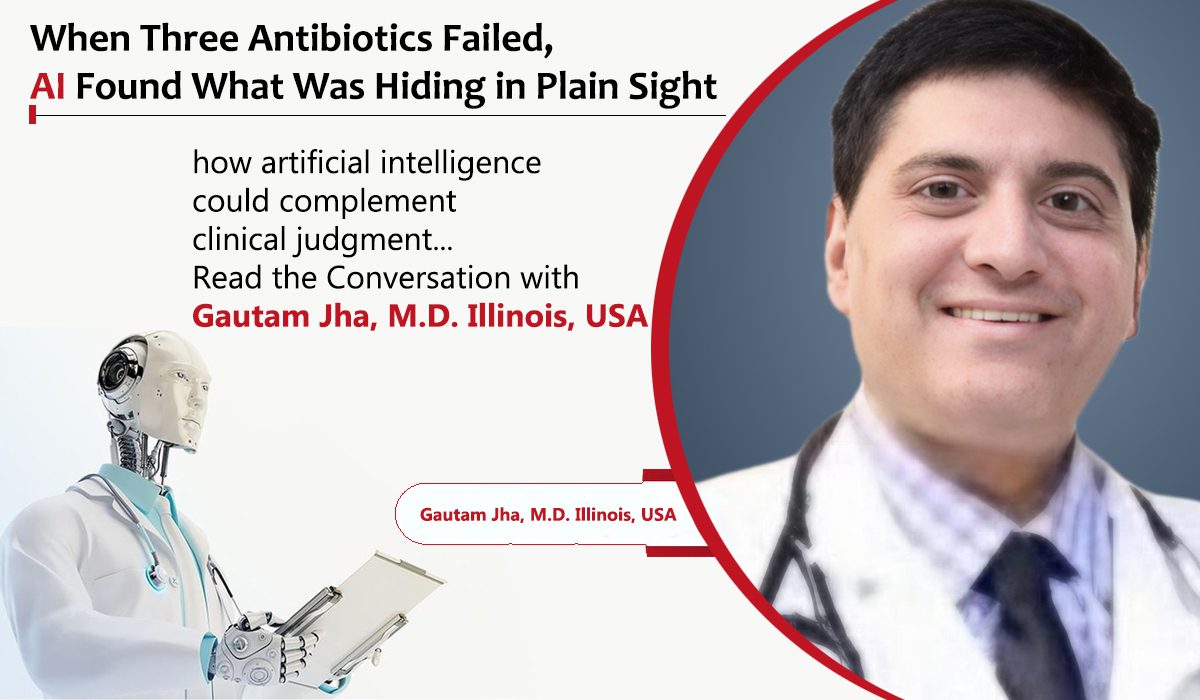
In this exclusive conversation with Diplomat Today, Gautam Jha, M.D., an internal medicine physician providing primary care in southern Illinois, USA, discusses the case, his experience using artificial intelligence as a clinical support tool, and the challenges doctors face in safely integrating AI into everyday medical practice. The discussion explores the intersection of medicine and emerging technology - from AI-assisted medical imaging and patient privacy to clinical responsibility, healthcare innovation and the need for practical safeguards. Read the conversation between Diplomat Today and Dr. Jha.
Three rounds of antibiotics had failed. The abdominal pain persisted, the patient’s condition was worsening, and something clearly did not add up. Then, on a Sunday night, primary-care physician Dr. Gautam Jha decided to take another look at the patient’s CT scan - not alone, but with an AI assistant as a second set of eyes. What followed was a striking example of how artificial intelligence could complement clinical judgment: the AI flagged a potentially serious colovesical fistula, a hidden connection between the bowel and bladder that could explain the patient’s repeated infections and failure to respond to antibiotics. But this was not a story of a machine replacing a doctor. It was a story of a doctor who refused to stop looking - and used AI to ask a better question: What are we missing?
When Three Antibiotics Failed, AI Found What Was Hiding in Plain Sight
The case
Q: Tell us about the patient.
Dr. Jha: He was a man in his 60s with weeks of abdominal pain. He'd already been through three rounds of antibiotics, and he wasn't getting better. When a patient isn't improving on the treatment that should work, that's a signal. Something was being missed, and I wanted to know what.
Q: So what did you do?
Dr. Jha: It was a Sunday night. I pulled up his latest CT scan and sat down with it. I'm a primary care doctor, not a radiologist, so I wanted a second pair of eyes.
Working with Claude
Q: Why Claude?
Dr. Jha: I didn't pick it at random. I had tried five different AI tools myself, and Claude had proven the most reliable of them. I use it in Cowork mode, in Anthropic's Claude desktop app, where it can work alongside me with the imaging viewer on my screen. When a patient's health is on the line, you use the tool you trust most.
Q: What did you compare across those five tools?
Dr. Jha: Four things: how accurately each one read CT scans, how accurately it read EKGs, how clearly it explained its reasoning, and how well it protected patient privacy. Claude came out ahead across the board. Clear reasoning matters most to me, because I need to check the AI's work, not just take its answer.
Q: What did it find?
Dr. Jha: It flagged signs of a colovesical fistula, a hidden connection between the bowel and the bladder. That fit everything. It explained why three rounds of antibiotics hadn't worked. Radiology hadn't picked it up. To be fair, it's a finding that's possible to miss, especially without the full picture.
Q: Did you take the AI's word for it?
Dr. Jha: No. Claude even told me to get the films from his earlier CT scans. He'd had three in the last three months, at several different hospitals, so I tracked them down. AI can be wrong, so the responsibility stayed with me. I tried several times to reach radiology but couldn't get hold of anyone, so I didn't wait. I transferred the patient to a higher level of care with urology.
Q: What about patient privacy?
Dr. Jha: That was built into how I work. The images stay in Sectra, the hospital's secure online imaging viewer. Before anything goes out over the web, Claude blurs the patient's identifiers in the viewer, such as the name and record number on screen, and it keeps them out of its reports. I double-check that nothing identifying is visible, including any text on the images themselves. And in telling this story, I've left out anything that could identify him. Privacy and patient safety don't have to be in conflict.
Getting him care
Q: How serious is a fistula like that?
Dr. Jha: Serious. It usually comes from severe diverticulitis. Left untreated, it can mean repeated infections, sepsis and worse. It typically needs surgery, not another round of antibiotics.
Q: What happened next?
Dr. Jha: He needed surgeons and urologists, so getting him to a larger hospital quickly was the priority. That's where he is now.
The barriers
Q: You've been outspoken about how hard it is for doctors to use AI. Why?
Dr. Jha: Many hospitals restrict doctors from using AI tools, often without offering a workable alternative. The reason given is usually patient privacy. That concern is real, and I take it seriously. But AI is advancing faster than hospitals' built-in systems can keep up. Those systems are often months to years behind the tools available outside. Rather than making doctors wait, and penalizing those who don't, hospitals should incorporate or allow outside AI tools with due precautions.
Q: Who pays the price for that delay?
Dr. Jha: Patients. They go without an extra layer of protection in the meantime. It falls hardest on small-town doctors like me. We don't have a specialist down the hall.
Q: Are you worried about speaking out?
Dr. Jha: Of course. But this isn't about blame. I haven't named any hospital or colleague. Everyone involved in my patient's care works hard under heavy loads. This story is about the patient.
What's next
Q: What are you asking for?
Dr. Jha: I'm not asking anyone to drop safeguards. I'm asking for safeguards that make safe use simple: AI tools with proper privacy protections, whether built into hospital systems or allowed from outside, with clear rules a busy physician can follow in minutes. And doctors who raise safety concerns should be heard, not penalized.
Q: Whose job is that?
Dr. Jha: Everyone's. This can't be left to hospitals alone. Government, AI companies, hospitals, doctors and the public all need to come forward and build a path that is both safe and simple. Readers can help too: ask your doctor whether they're able to use AI tools that could help them, and support policies that make it possible.
Q: How is your patient now?
Dr. Jha: He's in the hands of specialists, and I don't know yet how his story ends. But I know this: AI didn't replace me that night. It made me a better doctor for one patient who needed it.