



Former Egyptian Assistant Foreign Minister: India is a Genuine Partner for Africa, and Egypt is its Strategic Gateway to the Continent
Amid the accelerating geopolitical transformations reshaping the international landscape, Egyptian-Indian relations have emerged as a distinguished model of strategic partnership founded on mutual respect, deep-rooted cultural ties, and a shared commitment to sustainable development, regional stability, and South-South cooperation.
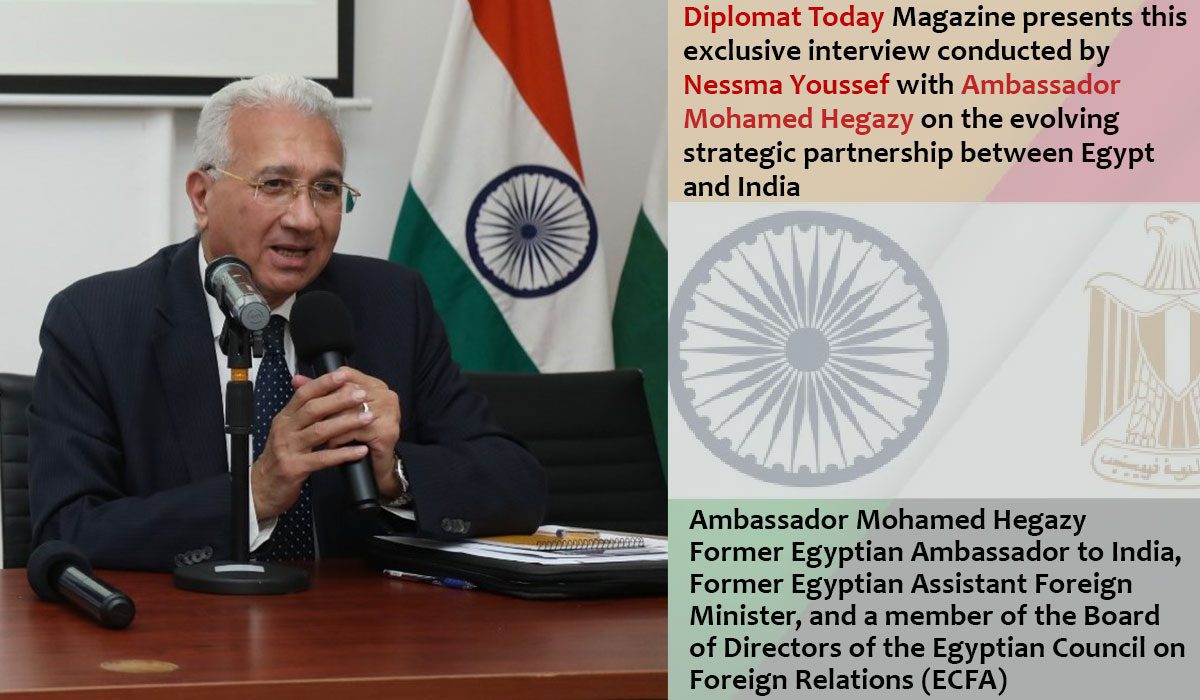
In this exclusive conversation, Mohamed Hegazy – former Egyptian Assistant Foreign Minister, former Egyptian Ambassador to India, and member of the Board of Directors of the Egyptian Council on Foreign Relations (ECFA) – shares his insights on the future of relations between Cairo and New Delhi, Egypt’s growing role as a strategic regional hub and gateway for India’s engagement with Africa, as well as his assessment of India’s evolving partnership model across the African continent.
Diplomat Today Magazine presents this exclusive interview conducted by Nessma Youssef with Ambassador Mohamed Hegazy on the evolving strategic partnership between Egypt and India.
■ How would you describe the nature of Egyptian-Indian relations today?
Egyptian-Indian relations represent a true model of genuine partnership based on mutual respect and cultural and human affinity. There is a convergence of political visions between the two countries, with a mutual understanding of the importance of the regional role of both Egypt and India. This is what drives the continuous development of relations between the two countries on political, economic, and cultural levels.
India views Egypt as a pivotal country in the Middle East and Africa, while Egypt recognizes India’s importance as a rising international power with an inspiring developmental and technological experience.
There is also a deep appreciation from India for Egypt and its political leadership. India is keen to ensure Egypt’s presence at various important international forums it hosts, whether at the G20 or the India-Africa Summits, considering Egypt a pivotal country representing its region and the African continent.
■ How do you see the role of the Indian Ambassador to Cairo, Suresh K. Reddy, in supporting these relations?
Ambassador Suresh K. Reddy is one of the most active ambassadors to have held this post in Cairo. He has genuine love, respect, and dedication to Egyptian-Indian relations and plays a significant role in strengthening ties between the two countries. He also possesses a profound understanding of the cultural and historical significance of both nations.
This type of humanitarian diplomacy is clearly reflected in the level of bilateral relations and gives them a strong impetus towards greater cooperation.
■ Economic relations between the two countries have witnessed remarkable development. How do you assess this development?
Economic relations between Cairo and New Delhi have achieved significant development in recent years. Dozens of Indian companies have successfully established their investments in Egypt despite some bureaucratic challenges.
Indian businesspeople are genuinely committed to the idea of establishing their industries in Egypt, and today we have about 50 Indian companies investing nearly $7 billion in the Egyptian market. This reflects mutual trust and a belief in the importance of the long-term partnership between the two countries.
■ Why is Egypt of particular importance to India in Africa?
For India, Egypt represents a key gateway to Africa. It possesses a unique strategic location, along with significant economic, trade, and developmental capabilities.
Furthermore, Egypt has a skilled and trained workforce capable of absorbing modern industries and advanced technologies, a fact well understood by Indian companies, especially those operating in the fields of technology and advanced industries.
Egypt, as a bridge and an African nation with numerous ties to its African brothers, is well-positioned to receive and localize Indian technology in its industrial zones, particularly in the Suez Canal Economic Zone. This zone could become a significant hub for localizing Indian technology and industry, launching them into African markets.
■ How does the Indian experience in Africa differ from traditional Western models?
The Indian experience is different because it is based on partnership, not domination. India does not impose political or economic conditions on African countries; rather, it seeks to transfer technology, build capacity, and achieve shared development.
India has provided substantial support to Africa, including thousands of scholarships, along with concessional financing through the Export-Import Bank of India (Exim Bank) at reduced interest rates. Furthermore, India has made Indian technology available to African countries in a manner that respects their specific circumstances and development needs. Therefore, I believe India is a truly sincere partner in its engagement with the African continent.
■ What makes the Indian model attractive to Africa today?
India has successfully overcome significant economic challenges and transformed into a major power in modern technology, information technology, space, energy, innovation, and genetic engineering, becoming a model for countries seeking to acquire the tools for progress.
At the same time, it offers a low-cost development model applicable to developing countries, making the Indian experience more relevant to the African context and more likely to succeed.
The Indian model is not based solely on exporting goods, but rather on localizing technology and creating genuine development partnerships.
■ How do you view the future of India-Africa relations?
I believe this relationship is poised for further success, especially given the current international challenges. Africa needs technology, development, and investment, and India possesses a successful experience that can offer much to the continent.
Furthermore, Indian-African relations are based on a long history of political and developmental support dating back to the era of leaders Gamal Abdel Nasser and Jawaharlal Nehru, when India supported African liberation movements and assisted countries in the transitional phase after independence. In other words, “Africa’s history with India is old and has many advantages, good memories, and virtues for the development of the continent,” and therefore there is a great deal of trust and mutual respect.
■ Given the current tensions in the Middle East, can India and Egypt play a greater role in supporting stability?
Absolutely. The current escalation in the region is creating a highly volatile situation and poses significant challenges to Arab national security and regional stability.
This underscores the importance of the strong relationship between Egypt and India, which we recognize as inevitably contributing to efforts toward regional de-escalation. Both countries share a balanced vision based on supporting stability, dialogue, and development.
Egypt’s role is crucial not only for regional stability but also for global stability, and I believe that supporting Egypt’s role is on the agenda and among the priorities of Indian policy.
■ Finally, how would you describe your personal relationship with India?
I always say that speaking about India and Africa comes from the heart.
Anyone who visits India feels like they are one of its own, just as Indians in Egypt feel at home in their second country. This relationship is not merely political or economic; it is a deeply rooted human and cultural bond.