





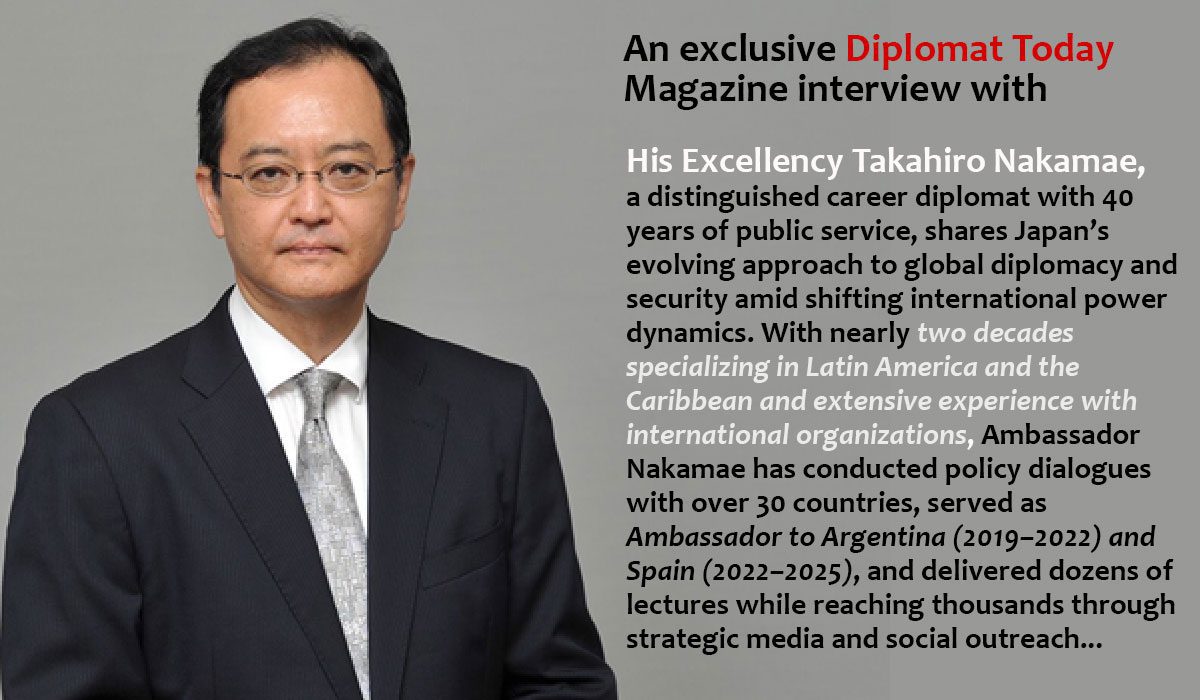
Rule-Based Order and Regional Stability: Insights from Ambassador Takahiro Nakamae
In this exclusive Diplomat Today Magazine interview, His Excellency Takahiro Nakamae, a distinguished career diplomat with 40 years of public service, shares Japan’s evolving approach to global diplomacy and security amid shifting international power dynamics. With nearly two decades specializing in Latin America and the Caribbean and extensive experience with international organizations, Ambassador Nakamae has conducted policy dialogues with over 30 countries, served as Ambassador to Argentina (2019–2022) and Spain (2022–2025), and delivered dozens of lectures while reaching thousands through strategic media and social outreach.
Drawing on this rich experience, he offers a unique perspective on Japan’s defence policies, including the recent easing of defence export restrictions, and the strategic rationale for strengthening regional partnerships with middle powers and Indo-Pacific allies. The conversation illuminates Japan’s commitment to a rule-based international order, deterrence through connectivity, and collaborative networks that safeguard regional stability, advance strategic autonomy, and reinforce peace in an increasingly complex global landscape.
1. Your Excellency, could you briefly share your vision for strengthening Japan’s diplomatic and strategic engagement with global partners?
Over the past three decades of the post-Cold War era, there has been a prevailing conviction that globalisation and interdependence among nations will lead to a better world for all and, for a group of countries that call themselves “the West”, that they will lead this movement. Today, however, this optimism is rapidly fading. Major powers are increasingly engaged in geostrategic rivalries, and our focus on global issues such as human rights, climate change, disaster prevention, health, and many others is waning. This will disproportionately affect the most vulnerable populations. The balance of power is shifting dramatically, with several countries experiencing emerging economies and greater assertiveness.
In my view, two points are fundamental. First, assuming that the rule-based international order is finished leads us nowhere better. Despite its many practical deficiencies, abandoning the concept would be disastrous: it is not a fixed product but a process of collective endeavour, aimed at preventing major disorder among sovereign states. Second, defining the world order by overusing vague classifications such as “the West” and “the (Global) South” is, at best, unproductive. Simplistic categorizations overlook significant diversity within these groups. Some parties even exploit this, portraying a confrontational relationship between them and embedding narratives that serve their own interests.
Japan is a nation outside Western civilisation and has benefited enormously from the rule-based development of the post-Second World War world. Therefore, my understanding is that Japan has a unique interest and responsibility in preserving and further enhancing a free and open international order based on the principle of the rule of law. For this purpose, and aware of the necessity for collective efforts, Japan’s recent diplomacy has increasingly focused on securing alignment with its ally and like-minded partners, regardless of whether they are from the “West” or the “South”.
2. Japan has recently eased restrictions on the export of lethal weapons. What are the key strategic reasons behind this policy shift?
I believe that deterrence through connectivity is a key strategic concept. The Japanese Government states that the review of restrictions would strengthen the deterrence and response capabilities of Japan’s ally and like-minded countries by sharing production and maintenance capabilities of defence equipment, recognising that no single country can ensure its own peace and security independently in today’s world. It is also true that extending the production and maintenance base through networking would enhance the defence industry’s capacity across the region as a whole.
As some specialists point out, the nature of modern warfare has fundamentally transformed, encompassing new dimensions such as space, cyber technology, and electromagnetism, as well as the use of drones and dual-use equipment in combat. This necessitates that the arms trade should not be limited to the sale of finished products but should also involve establishing a sustainable international chain for production, spare parts supply, maintenance, and repair.
Sharing defence equipment among partners enables a common technical network, which reinforces sustainability and manoeuvrability not only for Japan but also for its partners.
3. How does Japan view defence cooperation among middle powers in maintaining regional and global stability?
We are witnessing a global power shift, in which some countries are also seeking to redefine the world order to align with their own interests. There are even instances of attempts to unilaterally alter the status quo by force. Meanwhile, the United States’ commitment as a guardian of the global order appears less assured than ever.
Middle powers have been major beneficiaries of a predictable international order in which the rule of “might is right” does not prevail. Under the current circumstances, they share a common interest in jointly reinforcing their strategic autonomy, although this would by no means replace the existing system fundamentally. To this end, defence cooperation among middle powers that share such strategic interests is expected to enhance mutual connectivity and augment both technical and policy complementarity.
4. In what ways can Japan’s evolving defence export policy contribute to stronger partnerships in the Indo-Pacific region?
The Indo-Pacific region is home to more than half of the world’s population and economy. It hosts vital industrial supply chains for the global market. Any security disruption in one part of the region would affect global well-being by interrupting extensive supply chain networks; therefore, it is in our common interest to prevent such disturbances.
Given the absence of a collective security mechanism in the Indo-Pacific region, Japan and other regional powers have been pursuing policy cooperation among like-minded countries through bilateral and minilateral dialogues, among which the Quadrilateral Security Dialogue between Australia, India, Japan, and the United States (the Quad) is of particular importance. Defence policy exchanges and the supply of equipment will undoubtedly form a key part of such policy linkages.
Needless to say, Japan’s defence exports do not imply any intention to expand belligerence in the region. The new guidelines restrict the transfer of defence equipment solely to countries that have agreed with Japan to use such equipment only in a manner consistent with the purposes and principles of the UN Charter. As mentioned, the aim is to ensure the security of Japan and its partner countries by reinforcing deterrence through connectivity. I note that Japan’s commitment to peace is firmly rooted in strong public sentiment and is therefore unlikely to change.
5. What message would Japan like to convey to the international community regarding its changing security and defence approach?
As I am not in a position to speak on behalf of Japan or its government, allow me to offer the following personal view.
The global power shift is underway, the integrity of international law is facing challenges on various occasions, and the UN Security Council and other international bodies have been failing to fulfil its expected role. Given this situation, networks among like-minded countries are indispensable for reinforcing the integrity of the global order. It is argued that a number of countries in the so-called “Global South” harbour dissatisfaction with existing systems and rules. It is essential to expect new powers to fulfil their fair share of roles and responsibilities.
Both Japan and India are democratic countries with distinct cultural and historical backgrounds from those of “Western” countries, and therefore occupy a unique position in the global and regional order. I cannot emphasise enough the particular significance of collaboration between Japan and India, especially in our efforts towards a free and open Indo-Pacific.