




Strengthening Himalayan Trade Corridors: India – Bhutan Customs Dialogue Gains New Momentum
Deepening Economic Trust Through Institutional Cooperation
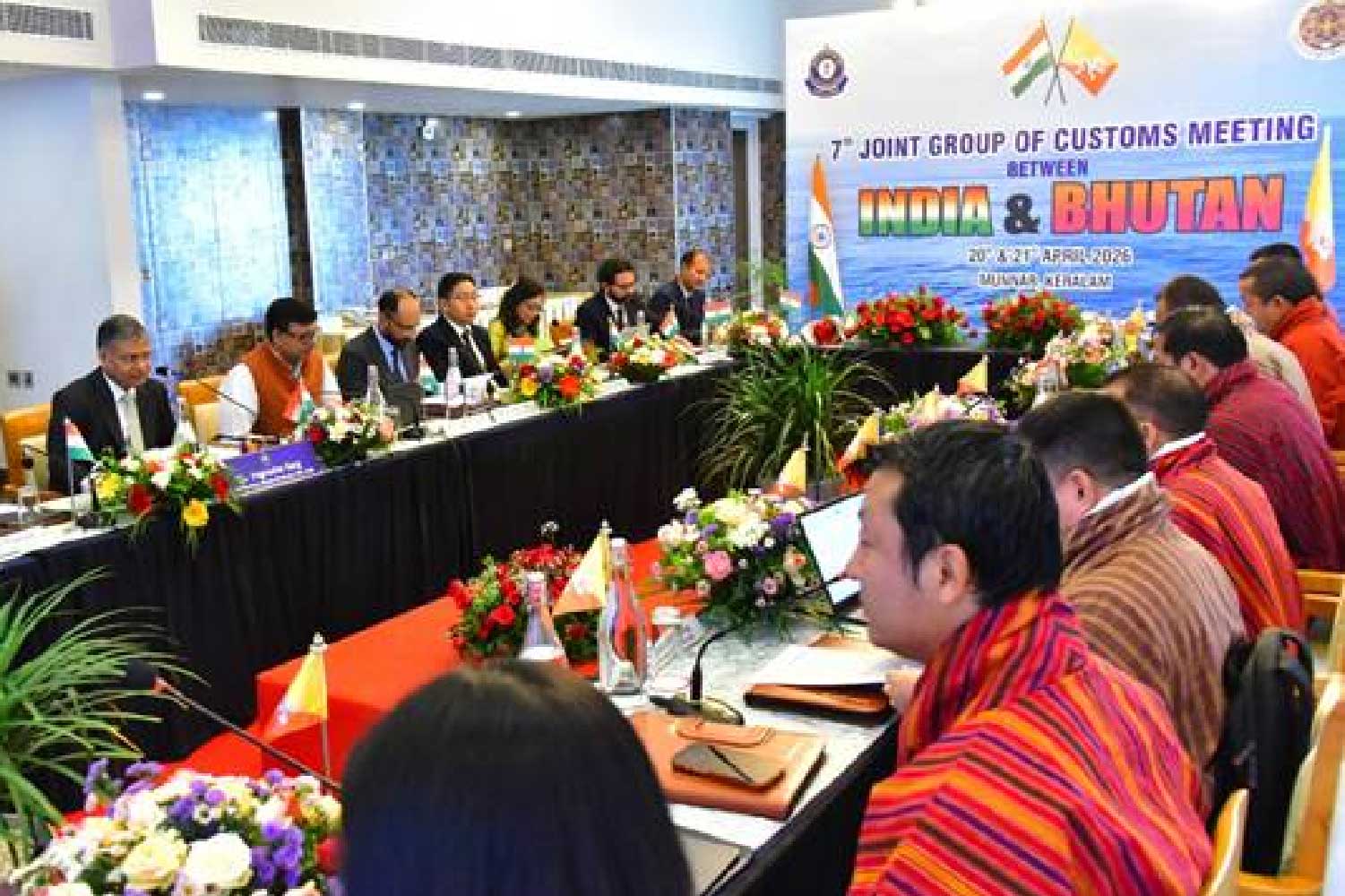
India and Bhutan have once again reaffirmed the strength of their enduring partnership during the 7th Joint Group of Customs (JGC) meeting held in Munnar on April 20–21, 2026. The high-level engagement reflects not only the depth of bilateral relations but also the strategic importance both nations attach to trade facilitation, customs cooperation, and seamless border management.
Co-chaired by Yogendra Garg, Special Secretary and Member (Customs), CBIC, Government of India, and Sonam Jamtsho, Director General of Bhutan’s Department of Revenue and Customs, the meeting underscored a shared commitment to modernizing trade infrastructure and enhancing regulatory coordination. Their leadership highlighted how institutional dialogue continues to play a vital role in sustaining economic synergy between the two neighbours.
At the heart of the discussions was the recognition that India remains Bhutan’s largest trading partner, with bilateral trade forming the backbone of Bhutan’s external economy. Given Bhutan’s landlocked geography, its reliance on Indian transit routes makes efficient customs processes and coordinated border management essential. The JGC, therefore, serves as a critical platform to address operational challenges and align policies for smoother cross-border trade.
A key focus of the meeting was the advancement of trade facilitation measures through digitisation and technological integration. Both sides explored the expansion of electronic systems such as pre-arrival data exchange and the Electronic Cargo Tracking System (ECTS), which are expected to significantly reduce transit time and enhance transparency. These initiatives are particularly important in an era where global supply chains demand speed, predictability, and security.
Equally significant was the emphasis on coordinated border management. With multiple land customs stations operating along the India–Bhutan border, harmonising procedures and improving infrastructure remain top priorities. The discussions also addressed the need for stronger enforcement mechanisms, including intelligence sharing to combat smuggling and illicit trade. Such cooperation ensures that trade growth is accompanied by robust security measures.
Beyond technical discussions, the meeting reflected a broader strategic vision. India and Bhutan share a unique relationship rooted in mutual trust, cultural affinity, and economic interdependence. The customs dialogue is not merely about regulation—it is about enabling prosperity and stability in the region. By simplifying trade processes and enhancing connectivity, both countries are working toward inclusive growth that benefits border communities and national economies alike.
The Bhutanese delegation’s engagement with India’s logistics ecosystem, including exposure to port operations in southern India, further illustrated the importance of knowledge exchange in strengthening institutional capacity. Such interactions help Bhutan align its systems with global best practices while leveraging India’s infrastructure capabilities.
As global trade faces increasing uncertainties, the outcomes of the 7th JGC meeting signal a forward-looking approach. India and Bhutan are not only reinforcing existing mechanisms but also adapting to new challenges through innovation and cooperation. The dialogue in Munnar stands as a testament to how sustained institutional engagement can translate diplomatic goodwill into tangible economic outcomes.
In an evolving geopolitical landscape, the India–Bhutan partnership continues to exemplify how neighbouring nations can build resilient, future-ready trade frameworks—anchored in trust, strengthened by collaboration, and driven by a shared vision of progress.